ChatGPT Prompts for Artists: Creative Ideas, Art Development, and Everyday Studio Work
Artists often have plenty of ideas but not always enough time to develop every one. A blank page, an unclear concept, a difficult composition, or a pile of unfinished notes can slow the creative process before the actual making begins.
ChatGPT can be useful as a creative thinking partner. It can help artists brainstorm concepts, explore themes, develop visual directions, organize projects, write supporting text, and look at an idea from a different angle. The key is to use it to expand your thinking rather than letting it replace your artistic voice.
The prompts below are designed for painters, illustrators, digital artists, concept artists, photographers, sculptors, mixed-media artists, and other visual creators. Replace the bracketed details with your own information and adjust the output until it fits your creative direction.
Explore Our ChatGPT Prompts, Microsoft Copilot Prompts, Google Gemini Prompts Library
Table of Contents
Using ChatGPT Without Losing Your Artistic Voice
A useful prompt gives ChatGPT enough context to understand what you are trying to create. Instead of asking:
“Give me an art idea.”
you can explain your medium, subject, mood, influences, limitations, and intended audience.
For example:
“I work primarily in acrylic painting and want to explore loneliness through urban landscapes. Give me several concepts that feel quiet and emotionally subtle rather than dramatic.”
That difference matters because the second prompt gives the AI something specific to work with.
You can also ask ChatGPT to generate multiple directions instead of one final answer. This makes it easier to compare possibilities and choose the ideas that actually feel like you.
Prompts for Generating New Art Ideas
These prompts are useful when you know you want to create something but have not yet decided what the work should be about.
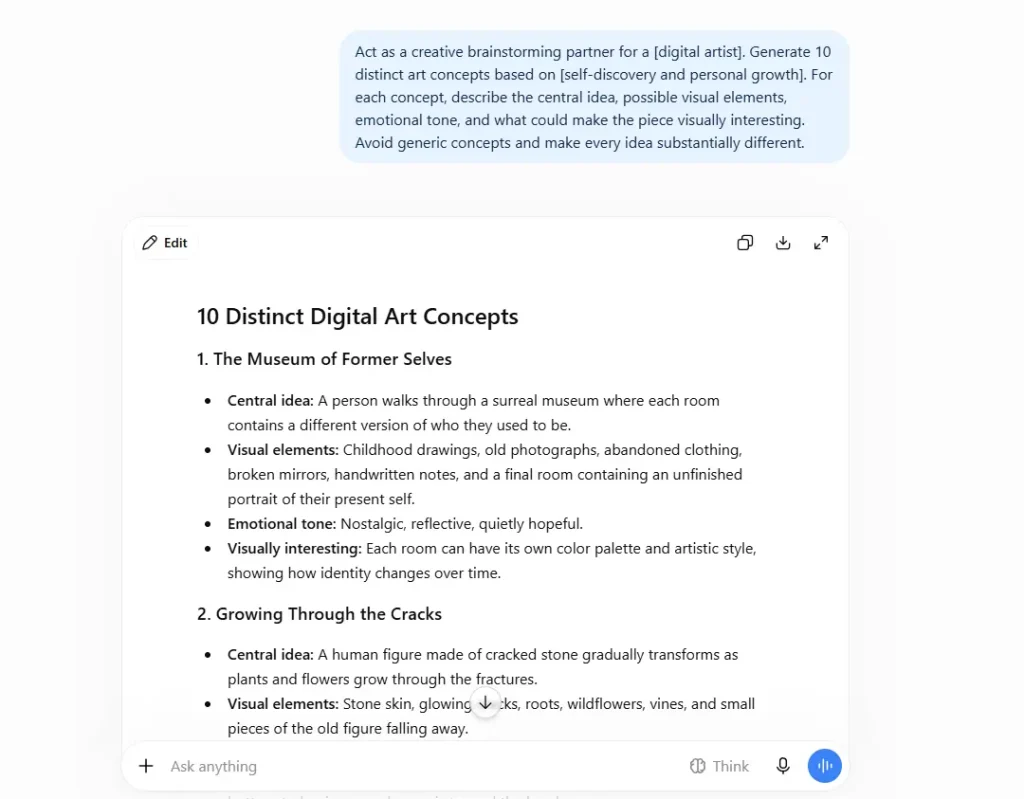
Prompt 1: Generate Original Art Concepts
Prompt:
Act as a creative brainstorming partner for a [type of artist]. Generate 10 distinct art concepts based on [theme, subject, emotion, or idea]. For each concept, describe the central idea, possible visual elements, emotional tone, and what could make the piece visually interesting. Avoid generic concepts and make every idea substantially different.
Prompt 2: Turn an Emotion Into an Artwork
Prompt:
Help me translate the emotion of [emotion] into a visual artwork. I work in [medium] and prefer [art style or visual approach]. Suggest several ways I could communicate this emotion through composition, color, lighting, texture, symbolism, scale, and subject matter without relying on obvious visual clichés.
Prompt 3: Explore a Theme From Different Angles
Prompt:
I want to create a body of artwork around the theme [theme]. Explore this theme from 10 different artistic angles. Include psychological, cultural, personal, environmental, symbolic, and abstract interpretations where appropriate. Focus on directions that could lead to visually distinct artworks rather than simply rewriting the same concept.
Prompt 4: Find an Unusual Subject
Prompt:
Give me 15 unusual subjects I could explore as an artist working in [medium]. My interests include [interests], and I want the work to feel [mood/style]. Avoid overused subjects and explain briefly why each subject could provide interesting visual possibilities.
Prompt 5: Combine Two Unrelated Ideas
Prompt:
Combine these two seemingly unrelated ideas into original artwork concepts: [idea 1] and [idea 2]. Generate 10 different interpretations. For each one, explain how the two ideas could connect visually, symbolically, or conceptually. Avoid simply placing both subjects next to each other.
Prompts for Developing an Existing Idea
Sometimes the problem is not coming up with an idea but figuring out where to take it next. These prompts can help you push an early concept beyond its first obvious interpretation.
Prompt 6: Expand a Rough Art Idea
Prompt:
Here is my rough artwork idea: [describe idea]. Help me develop it without completely changing its original identity. Give me 5 possible directions, ranging from subtle and minimal to more experimental. For each direction, explain the concept, visual approach, and potential challenges.
Prompt 7: Make a Concept More Original
Prompt:
Review this artwork concept: [describe concept]. Identify the most predictable or familiar aspects of the idea, then suggest ways to make it more distinctive while preserving its core meaning. Give me several alternatives involving composition, symbolism, perspective, materials, or narrative.
Prompt 8: Push an Idea Further
Prompt:
I have developed this artwork concept: [concept]. Ask yourself what the idea could become if it were pushed beyond its first obvious interpretation. Suggest 7 more ambitious directions while keeping the original theme recognizable. Prioritize conceptual depth and visual possibilities over complexity for its own sake.
Prompt 9: Create Variations of One Concept
Prompt:
Create 12 meaningful variations of this artwork concept: [concept]. Change one or more major elements in each version, such as viewpoint, setting, scale, subject, mood, symbolism, color approach, or medium. Make each variation feel like a genuine creative direction rather than a minor modification.
Prompt 10: Find the Core of an Artwork Idea
Prompt:
Help me identify the central idea behind this artwork concept: [describe concept]. Separate the concept into its subject, emotional core, visual idea, underlying message, and optional symbolic elements. Then suggest ways I could simplify the piece without losing what makes the idea meaningful.
For exploring different approaches to everyday challenges, you can also try these ChatGPT prompts for problem solving.
Prompts for Composition and Visual Direction
Once you have a concept, the next challenge is deciding how the finished work should actually look.
Prompt 11: Explore Composition Options
Prompt:
I am creating a [painting/illustration/sculpture/photograph/etc.] about [subject or concept]. Suggest 8 different composition approaches. Consider focal point, visual balance, negative space, scale, perspective, movement, and the viewer’s eye path. Explain the intended effect of each composition without assuming a single correct solution.
Prompt 12: Develop a Strong Focal Point
Prompt:
Help me explore ways to create a clear focal point in an artwork about [subject]. My medium is [medium], and the intended mood is [mood]. Suggest techniques involving composition, contrast, scale, detail, lighting, color, texture, or placement. Keep the suggestions appropriate to my medium.
Prompt 13: Use Negative Space Intentionally
Prompt:
I want to use negative space as an important part of this artwork: [describe artwork]. Suggest several composition approaches that make empty space feel intentional rather than unfinished. Explain how the placement and size of the negative space could influence mood and attention.
Prompt 14: Create Visual Movement
Prompt:
Suggest ways to create visual movement in an artwork featuring [subject]. I am working in [medium] and want the viewer’s eye to move [describe desired path or effect]. Explore composition, directional lines, repetition, contrast, gesture, shapes, and placement as appropriate.
Prompt 15: Explore Different Perspectives
Prompt:
I am developing an artwork featuring [subject]. Give me 10 possible viewpoints or perspectives that could make the subject more visually interesting. Include conventional and unconventional options, and explain how each viewpoint could change the emotional or narrative effect.
Prompts for Color and Mood
Color can change the emotional reading of an artwork even when the subject stays exactly the same.
Prompt 16: Build a Color Direction
Prompt:
Help me develop a color direction for an artwork about [subject/concept]. I want the emotional atmosphere to feel [mood]. Suggest 5 different color approaches, including dominant colors, supporting colors, contrast level, temperature, and where the strongest accents could appear. Keep the suggestions suitable for [medium].
Prompt 17: Create Mood Variations
Prompt:
Show me how the same artwork concept could communicate five different moods: [concept]. For each mood, suggest changes to color, lighting, composition, texture, contrast, and visual details. Keep the central subject recognizable across all five versions.
Prompt 18: Develop a Limited Palette
Prompt:
Create several limited-palette approaches for an artwork about [subject]. I want the palette to support a [mood or atmosphere] feeling. For each approach, explain the role of the dominant, supporting, and accent colors and how the limitations could strengthen visual cohesion.
Prompt 19: Rescue an Unbalanced Color Scheme
Prompt:
I am working with this current color scheme: [describe or paste colors]. The artwork is intended to feel [mood], but the colors currently feel [problem]. Suggest several ways to adjust the palette while preserving the original concept. Explain which colors could be reduced, emphasized, shifted, or used as accents.
Prompt 20: Explore Light and Shadow
Prompt:
Help me explore lighting possibilities for an artwork featuring [subject]. I want the atmosphere to feel [mood]. Suggest 6 different lighting directions, including the apparent light source, shadow behavior, contrast level, highlights, and overall emotional effect. Keep the ideas compatible with [medium/style].
Prompts for Style Exploration and Artistic Direction
Artists often know the kind of feeling they want but struggle to describe the visual decisions that could create it. ChatGPT can help you explore possibilities while leaving the final artistic decisions in your hands.
Prompt 21: Explore Different Visual Styles
Prompt:
I am developing an artwork about [subject/concept] using [medium]. Suggest 10 distinct visual directions I could explore. Vary elements such as mark-making, composition, level of detail, texture, shape language, contrast, and abstraction. Keep the underlying concept consistent while making each direction visually different.
Prompt 22: Blend Two Artistic Approaches
Prompt:
Help me explore a visual approach that combines [artistic approach/style 1] with [artistic approach/style 2]. My artwork is about [concept]. Suggest several ways to combine the characteristics of both approaches without simply copying either one. Focus on composition, texture, color, forms, and overall atmosphere.
Prompt 23: Develop a Personal Visual Language
Prompt:
Help me identify possible elements of a consistent visual language for my artwork. My current work focuses on [subjects/themes], and I am drawn to [colors, textures, shapes, moods, materials, or techniques]. Suggest recurring visual elements I could experiment with while keeping enough flexibility for each artwork to remain individual.
Prompt 24: Break Away From Habitual Choices
Prompt:
Review these artistic choices I tend to make: [describe recurring choices]. Suggest 10 creative experiments that deliberately challenge those habits without requiring me to abandon my overall artistic identity. Explain what each experiment could help me discover.
Prompt 25: Explore Abstraction Levels
Prompt:
Take this artwork concept, [concept], and develop it at five different levels of abstraction: recognizable, simplified, semi-abstract, highly abstract, and almost entirely non-representational. Describe the key visual decisions for each version.
Prompts for Artist Sketching and Concept Development
A sketch does not have to be the final artwork. It can be a tool for testing ideas before investing significant time and materials.
Prompt 26: Generate Thumbnail Ideas
Prompt:
Give me 12 thumbnail composition ideas for an artwork about [subject/concept]. Keep each idea concise but visually specific. Vary the placement of the main subject, viewpoint, scale, negative space, and visual balance so I can use the descriptions as starting points for quick sketches.
Prompt 27: Plan a Concept Sketch
Prompt:
Help me plan a preliminary sketch for [artwork concept]. Break the sketch into the major shapes, focal area, supporting elements, perspective or spatial relationships, and areas that should remain intentionally simple. Do not over-detail the plan.
Prompt 28: Turn a Written Idea Into a Visual Brief
Prompt:
Convert this written art idea into a concise visual brief: [paste idea]. Include subject, composition, mood, color direction, lighting, texture, important visual elements, and elements that should be avoided. Keep the brief open enough for artistic interpretation.
Prompt 29: Create Concept Variations Before Sketching
Prompt:
Before I sketch this artwork, give me 8 different concept directions based on [idea]. For each direction, describe the main visual structure, focal point, emotional effect, and one distinctive feature. Help me compare the options before choosing one to develop.
Prompt 30: Find the Strongest Sketch Direction
Prompt:
Compare these preliminary artwork ideas: [list ideas]. Evaluate them based on visual clarity, originality, emotional potential, composition possibilities, and feasibility for [medium/time constraints]. Identify the strengths and possible weaknesses of each without declaring one objectively “best.”
Prompts for Character and Figure Artists
Character artists can use structured prompting to explore personality, visual identity, poses, costumes, and narrative details before refining a design.
Prompt 31: Develop a Character Concept
Prompt:
Help me develop a character concept for an artwork. The character is [basic description], exists in [setting/world], and should communicate [personality, emotion, or role]. Suggest ideas for silhouette, clothing, accessories, posture, expression, color direction, and distinctive visual details. Keep the design coherent rather than adding details randomly.
Prompt 32: Create Character Design Variations
Prompt:
Generate 8 different design directions for this character concept: [description]. Keep the character’s core identity consistent but vary silhouette, clothing, proportions, accessories, hairstyle, materials, and visual motifs. Make each version suitable for further artistic development.
Prompt 33: Explore Character Poses
Prompt:
Suggest 12 poses for a character who is [character description] in the context of [scene or situation]. Include a mix of calm, dynamic, expressive, and natural poses. For each pose, briefly explain the emotion or story information it could communicate.
Prompt 34: Strengthen Character Silhouette
Prompt:
Review this character description: [description]. Suggest ways to make the character’s silhouette more recognizable and visually interesting. Consider proportions, clothing shapes, accessories, posture, hairstyle, and negative space. Avoid adding unnecessary complexity.
Prompt 35: Build a Character’s Visual Story
Prompt:
Help me communicate this character’s personality and background visually without relying on written explanation: [character description]. Suggest details involving clothing, objects, posture, expression, environment, color, wear, and composition. Separate subtle suggestions from more obvious storytelling choices.
Prompts for Illustration and Concept Art
Illustrators and concept artists often need to move between an initial idea and a clearly structured visual scene.
Prompt 36: Develop a Scene Concept
Prompt:
Develop a scene concept for an illustration about [story/event/concept]. Include the setting, main subject, supporting elements, focal point, atmosphere, lighting, and visual storytelling opportunities. Give me 5 different scene directions so I can choose which one to sketch.
Prompt 37: Create Environment Ideas
Prompt:
Generate 10 environment concepts for a [genre/theme] artwork. The environment should communicate [mood/story/function] and include distinctive architectural, natural, atmospheric, or material details. Avoid generic fantasy, sci-fi, or urban environments unless they are specifically relevant to the concept.
Prompt 38: Develop a Visual Narrative
Prompt:
Help me turn this idea into a visual narrative: [idea]. Identify what the viewer should notice first, what information should become apparent next, and what details could reward closer observation. Suggest composition and environmental storytelling techniques that could support the sequence.
Prompt 39: Design a Keyframe
Prompt:
Help me develop a keyframe illustration for [scene/story moment]. Suggest several options for camera position, subject placement, foreground and background elements, lighting, atmosphere, and focal hierarchy. The goal is to communicate the story moment clearly in a single image.
Prompt 40: Create Supporting Visual Details
Prompt:
Review this illustration concept: [concept]. Suggest small environmental or object details that could make the scene feel more specific and believable. Organize the suggestions into foreground, middle ground, background, character details, and atmospheric details. Avoid adding details that distract from the main subject.
Prompts for Photography and Visual Storytelling
Photography is not only about choosing a subject. Decisions about framing, timing, light, setting, and sequence can change how the viewer interprets the image.
Prompt 41: Develop a Photography Concept
Prompt:
Help me develop a photography project around [theme/subject]. Suggest 8 distinct visual approaches involving location, framing, lighting, subject interaction, timing, color, and storytelling. Keep the concepts practical for [available equipment or setting].
Prompt 42: Create a Photo Series Concept
Prompt:
Develop a cohesive [number]-image photography series about [theme]. Give each image a distinct purpose while maintaining visual and conceptual continuity. Suggest possible subjects, compositions, recurring visual elements, and a logical sequence.
Prompt 43: Explore Different Camera Angles
Prompt:
Suggest 10 camera angles or viewpoints for photographing [subject]. Explain how each viewpoint could change the perceived mood, scale, relationship, or story of the subject. Include conventional and less obvious options.
Prompt 44: Plan a Portrait Concept
Prompt:
Help me develop a portrait concept for [subject/person type] with the intended mood of [mood]. Suggest ideas for setting, composition, posture, expression, wardrobe, lighting, background, and visual symbolism. Keep the concept respectful and appropriate to the subject.
Prompt 45: Build a Documentary Photo Story
Prompt:
Help me plan a documentary-style photo story about [subject/community/event]. Suggest a range of image types that could establish context, introduce people or places, show details, capture activity, and provide transitions. Focus on visual storytelling rather than staged scenes.
Prompts for Painting and Traditional Media
Traditional artists can use AI to think through materials, process options, composition, and experimentation before committing to a finished piece.
Prompt 46: Plan a Painting Process
Prompt:
Help me create a flexible painting process for this artwork: [describe artwork]. I am working with [medium] and want the final piece to feel [mood/style]. Break the process into broad stages such as preparation, composition, major shapes, value or color development, refinement, and final adjustments. Keep the plan adaptable rather than prescribing one exact method.
Prompt 47: Explore Surface and Texture
Prompt:
Suggest ways I could use surface and texture in an artwork about [subject/concept] using [medium/materials]. Explore subtle, moderate, and highly visible approaches. Explain how each could affect the viewer’s perception of the subject and mood.
Prompt 48: Develop a Material Experiment
Prompt:
Design 8 small artistic experiments using [materials/medium] to explore [texture, color, transparency, mark-making, layering, or another goal]. Keep each experiment manageable and describe what I should observe rather than promising a particular result.
Prompt 49: Rescue an Unfinished Painting
Prompt:
I have an unfinished [painting/drawing/etc.] that currently looks [describe problem]. The original concept was [concept]. Suggest several possible directions for continuing the piece, including simplifying it, changing the focal hierarchy, adjusting values or colors, adding/removing elements, or intentionally leaving areas unresolved. Do not assume the original painting is flawed simply because it is unfinished.
Prompt 50: Decide What to Simplify
Prompt:
Review this description of my artwork: [description]. Identify areas that could potentially be simplified to create stronger visual hierarchy. Consider unnecessary details, competing focal points, repetitive textures, excessive color variation, and distracting shapes. Explain what could be simplified and what should remain prominent.
Prompts for Creative Blocks and Idea Recovery
A creative block does not always mean you have run out of ideas. Sometimes the problem is uncertainty about where to begin, dissatisfaction with an early result, or spending too long trying to make one direction work. These prompts can help you generate alternatives and make the next creative decision easier.
Prompt 51: Break Through a Creative Block
Prompt:
I am experiencing a creative block while working on [type of artwork/project]. I feel stuck because [describe the problem]. Give me 10 small creative exercises that can help me start moving again without requiring me to finish a complete artwork. Focus on experimentation, observation, and generating possibilities rather than perfection.
Prompt 52: Find a New Direction
Prompt:
I have been developing this artwork but no longer feel connected to the current direction: [describe project]. Suggest 7 alternative directions that preserve something from the original idea while changing the composition, subject, mood, medium, process, or concept. Explain what could be retained from the original work in each direction.
Prompt 53: Turn a Failed Attempt Into an Experiment
Prompt:
This artwork attempt did not develop as I expected: [describe what happened]. Instead of simply fixing it, suggest 8 ways I could treat the unexpected result as part of a new artistic experiment. Consider composition, materials, texture, abstraction, cropping, layering, and conceptual reinterpretation.
Prompt 54: Create a Five-Minute Art Exercise
Prompt:
Create 10 five-minute creative exercises for an artist working in [medium] who wants to explore [theme, technique, or skill]. Each exercise should have one clear constraint and should be designed to encourage experimentation rather than producing a polished finished piece.
Prompt 55: Use Constraints to Generate Ideas
Prompt:
Give me 12 creative art challenges based on strict constraints. My medium is [medium], and I want to explore [theme/skill]. Vary the constraints involving time, color, materials, composition, subject, scale, or process. Make the constraints challenging but realistically achievable.
Prompts for Art Series and Collections
A collection becomes stronger when individual works feel connected without becoming repetitive. These prompts can help artists explore that balance.
Prompt 56: Build an Art Series
Prompt:
Help me develop a cohesive art series around [central theme]. Suggest [number] individual artwork concepts that explore different aspects of the theme. For each piece, describe its unique focus, visual direction, emotional role, and how it could relate to the rest of the series.
Prompt 57: Create Variation Within a Series
Prompt:
I am creating a series about [theme], but I want the works to feel connected without looking repetitive. Suggest ways to vary composition, scale, subject, color, viewpoint, materials, and visual rhythm while maintaining a recognizable connection across the collection.
Prompt 58: Develop a Series Narrative
Prompt:
Help me organize these artwork ideas into a meaningful sequence: [list concepts]. Suggest several possible orders based on emotional progression, narrative development, visual contrast, or conceptual relationships. Explain why each sequence could work.
Prompt 59: Create a Series Title System
Prompt:
Generate several naming systems for an art series about [theme/concept]. Explore poetic, minimal, descriptive, conceptual, and abstract approaches. For each system, provide a possible overall series title and examples of individual artwork titles that feel related without being repetitive.
Prompt 60: Identify the Common Thread
Prompt:
Review these artwork ideas: [list works or descriptions]. Identify the recurring themes, visual elements, emotional ideas, materials, or compositional choices that connect them. Then suggest ways to make the shared identity more intentional without forcing every artwork to look the same.
Prompts for Artist Statements and Concept Explanations
Artists frequently need to explain their work for portfolios, exhibitions, websites, applications, or conversations. The strongest statements communicate the artist’s actual ideas rather than inventing a complicated interpretation.
Prompt 61: Draft an Artist Statement
Prompt:
Draft an artist statement based only on the information I provide below: [describe practice, themes, materials, process, and intentions]. Write in a clear, thoughtful voice that sounds personal without becoming overly academic. Do not invent motivations, experiences, influences, or meanings that I have not provided.
Prompt 62: Explain the Concept Behind a Work
Prompt:
Help me explain the concept behind this artwork: [describe artwork and intended meaning]. Write a concise explanation covering what I explored, why the subject or approach matters to the work, and how the visual decisions support the idea. Do not add interpretations that I did not intend.
Prompt 63: Write a Short Artwork Description
Prompt:
Write a short description for this artwork: [artwork details]. Include the subject, medium, key visual characteristics, and the central idea if provided. Keep it suitable for a gallery website or portfolio and avoid exaggerated promotional language.
Prompt 64: Adapt an Artist Statement for Different Audiences
Prompt:
Adapt my artist statement for these three audiences: 
Prompt 65: Simplify an Overly Academic Statement
Prompt:
Rewrite this artist statement so it is clearer and easier to understand while preserving the actual meaning: [paste statement]. Remove unnecessary jargon, abstract filler, and overly complicated sentences. Do not make the work sound simpler than the ideas actually are.
Prompts for Artwork Titles and Naming
A title can provide context, create curiosity, or simply identify a work. There is no single correct naming style, so exploring different approaches can be useful.
Prompt 66: Generate Artwork Titles
Prompt:
Generate 20 possible titles for this artwork: [describe artwork]. Divide them into poetic, minimal, descriptive, conceptual, and unexpected categories. Avoid clichés and titles that simply repeat the subject. Keep the titles appropriate to the mood and meaning of the work.
Prompt 67: Find a Stronger Title
Prompt:
Here is my current artwork title: [title]. The artwork explores [concept/theme]. Suggest alternative titles that preserve the intended meaning while offering different levels of subtlety. Include options that are direct, ambiguous, poetic, and understated.
Prompt 68: Create Titles for an Art Series
Prompt:
Create a naming system for a series of [number] artworks about [theme]. I want the titles to feel connected but not repetitive. Suggest several approaches and provide example titles for each approach.
Prompt 69: Test a Title Against the Artwork
Prompt:
Evaluate this artwork title in relation to the artwork description: [title] and [description]. Consider clarity, emotional tone, originality, ambiguity, and whether the title adds something to the viewer’s understanding. Give constructive feedback without assuming there is one objectively correct title.
Prompt 70: Generate Minimal Titles
Prompt:
Generate 25 short artwork titles inspired by [concept, subject, or emotion]. Prefer one-to-three-word titles. Avoid common inspirational phrases and obvious clichés. Organize the options by tone: quiet, mysterious, emotional, conceptual, and neutral.
To better understand your clients and improve your services, you can also explore these ChatGPT prompts for customer feedback.
Prompts for Portfolio Development
A portfolio needs more than individual strong artworks. The selection and presentation should communicate what the artist is exploring and how the works relate to one another.
Prompt 71: Plan an Art Portfolio
Prompt:
Help me structure an art portfolio using these available works: [list artworks]. Consider thematic connection, visual variety, medium, chronology where relevant, and overall flow. Suggest a possible order and explain the role each group of works could play.
Prompt 72: Select Portfolio Pieces
Prompt:
Review the following list of artworks and their descriptions: [list]. Suggest a framework for evaluating which pieces should be included in a portfolio. Consider consistency, originality, technical development, conceptual clarity, visual variety, and relevance to [portfolio purpose]. Do not assume quality from the descriptions alone.
Prompt 73: Organize Portfolio Sections
Prompt:
Create several possible portfolio structures for an artist working in [medium/discipline] with these main areas of work: [list]. Explain how each structure could communicate a different aspect of the artist’s practice.
Prompt 74: Write Portfolio Artwork Captions
Prompt:
Create concise portfolio captions for these artworks using only the information provided: [artwork details]. Include title, medium, dimensions if supplied, year if supplied, and a short conceptual description where appropriate. Do not invent missing details.
Prompt 75: Review Portfolio Flow
Prompt:
Review this proposed portfolio sequence: [list artworks in order]. Identify possible issues with visual rhythm, repetition, abrupt transitions, inconsistent scale, or thematic flow. Suggest alternative ordering options while explaining the reasoning behind each change.
If writing engaging captions takes too much time, these ChatGPT prompts for Instagram captions can help you create clearer and more engaging content.
Prompts for Artist Websites and About Pages
Your website often introduces your practice before someone has seen the full body of work. Clear writing can help visitors understand who you are and what you make.
Prompt 76: Write an Artist About Page
Prompt:
Draft an About page for my artist website using only these verified details: [background, location if you choose to include it, medium, artistic focus, education or experience, and other approved information]. Keep the tone personal and professional. Do not add achievements, exhibitions, credentials, or experiences that I have not provided.
Prompt 77: Create a Short Artist Bio
Prompt:
Write a short artist bio of approximately [word count] words using these verified details: [information]. Make it suitable for [website/exhibition/program/social profile]. Prioritize clarity and specificity over promotional language.
Prompt 78: Create an Artist Website Structure
Prompt:
Suggest a clear website structure for an artist whose practice focuses on [medium/themes]. Include recommended pages, the purpose of each page, the information visitors should find there, and a logical navigation flow. Keep the structure appropriate for a portfolio rather than a generic business website.
Prompt 79: Write a Project Page
Prompt:
Draft a project page for this body of artwork: [project details]. Include a concise introduction, project context, artistic approach, materials or process where provided, and a short explanation of the work’s central idea. Use only the information supplied.
Prompt 80: Improve an Artist Bio
Prompt:
Improve the clarity, rhythm, and structure of this artist bio while preserving all factual information: [paste bio]. Remove repetition and vague promotional language. Do not add credentials, exhibitions, influences, or achievements that are not already included.
If you manage your own nutrition practice, these ChatGPT prompts for business tasks can also help with planning, organization, and everyday administrative work.
Prompts for Exhibition and Gallery Preparation
Preparing for an exhibition involves both creative decisions and practical organization. AI can help artists turn scattered information into clearer working documents.
Prompt 81: Plan an Exhibition Concept
Prompt:
Help me develop an exhibition concept based on this body of work: [describe works]. Identify possible thematic connections, spatial relationships, visitor experience, and curatorial directions. Provide several concepts without claiming that one interpretation is definitive.
Prompt 82: Create an Exhibition Checklist
Prompt:
Create a practical exhibition preparation checklist for [solo/group exhibition]. Organize tasks into artwork preparation, documentation, framing or presentation, labels, installation, communication, transportation, administration, and final checks. Include only tasks relevant to [specific exhibition details].
Prompt 83: Write Artwork Labels
Prompt:
Create concise artwork labels using the following verified information: [title, artist name, medium, dimensions, year, description]. Keep the wording clear and suitable for an exhibition setting. Do not invent missing information.
Prompt 84: Draft an Exhibition Proposal
Prompt:
Draft an exhibition proposal based on these details: [concept, artwork list, intended audience, venue requirements, practical information]. Clearly communicate the central idea, proposed works, presentation approach, and practical needs. Do not add unsupported claims about audience response or significance.
Prompt 85: Create an Installation Planning Document
Prompt:
Turn these exhibition details into a structured installation planning document: [artwork list, dimensions, wall information, layout requirements, equipment, notes]. Organize the information into artwork placement, measurements, materials, sequence, and outstanding decisions. Flag information that is missing rather than guessing.
For writing follow-ups, professional messages, and other client communications, you may also find these ChatGPT prompts for email writing useful.
Prompts for Art Business and Pricing Preparation
Artists who sell or license work may need help organizing information, preparing descriptions, and thinking through practical business questions.
Prompt 86: Organize an Artwork Inventory
Prompt:
Turn the following artwork information into a structured inventory with columns for [title, medium, dimensions, year, status, location, price, availability, notes]. Preserve the information exactly as supplied and flag missing fields rather than filling them in.
Prompt 87: Create a Pricing Framework
Prompt:
Help me build a framework for thinking about pricing my artwork. My situation is [medium, dimensions, time involved, materials, experience level, sales history if relevant, market context, and goals]. Identify the factors I should consider and suggest questions I should answer before setting prices. Do not claim that there is one objectively correct price.
Prompt 88: Write an Artwork Listing
Prompt:
Write an online artwork listing using these verified details: [title, medium, dimensions, year, materials, concept, condition, availability, shipping information if applicable]. Make the description informative and appealing without inventing details or making unsupported claims.
Prompt 89: Create a Commission Brief
Prompt:
Create a structured commission brief for an artist and client. Include the project concept, size, medium, references, deadline, revisions or approval stages, deliverables, payment milestones, shipping or collection details, and any questions that still need clarification. Use placeholders for information that has not been decided.
Prompt 90: Organize Art Sales Records
Prompt:
Organize the following art sales information into a clear record: [paste sales data]. Create useful categories such as artwork, date, buyer or channel if appropriate, price, fees, expenses, payment status, and notes. Do not calculate or infer missing financial information.
Dietitians can also use these ChatGPT prompts for goal setting to create clearer and more structured goals for professional or personal planning.
Prompts for Social Media and Content Creation
Social platforms can help artists document their process, introduce finished work, and share ideas without turning every post into a sales pitch.
Prompt 91: Create an Artist Content Plan
Prompt:
Create a [number]-day social media content plan for an artist working in [medium] and exploring [themes/topics]. Include a mix of finished artwork, work-in-progress, process, studio observations, educational content, personal creative reflections, and audience interaction. Avoid repeating the same post concept.
Prompt 92: Write a Behind-the-Scenes Caption
Prompt:
Write a natural social media caption about the process behind this artwork: [describe process]. The tone should be [quiet/personal/informative/casual]. Focus on a genuine detail from the process rather than generic motivational language.
Prompt 93: Turn an Artwork Into Multiple Posts
Prompt:
Create 6 different social media post concepts from this single artwork: [describe artwork]. Give each post a different angle, such as the concept, process, detail, material, inspiration provided by me, finished piece, or a question for viewers. Avoid repeating the same caption idea.
Prompt 94: Create a Studio Process Series
Prompt:
Design a short social media series documenting the development of [artwork/project] from early idea to finished work. Suggest what to photograph or record at each stage and provide a distinct caption angle for each post. Keep the sequence natural rather than overly promotional.
Prompt 95: Repurpose an Artist Statement for Social Media
Prompt:
Turn this artist statement into [number] social media posts while preserving the actual ideas and voice: [paste statement]. Give each post a different focus and avoid reducing the statement to generic inspirational language.
Dietitians creating educational content online can also use these ChatGPT prompts for Instagram posts and captions to generate fresh ideas for their social media strategy.
Prompts for Creative Research and Inspiration
Research can help artists discover references, historical context, materials, ideas, and new ways of looking at familiar subjects. AI-generated information should be checked when factual accuracy matters.
Prompt 96: Generate Research Directions
Prompt:
I am developing artwork around [theme/subject]. Suggest 15 research directions that could deepen my understanding of the topic. Include possible areas such as history, culture, symbolism, materials, environment, technology, philosophy, visual references, or related disciplines where relevant. Separate factual research topics from purely creative prompts.
Prompt 97: Build an Artist Research Question Set
Prompt:
Create a set of focused research questions for an artist exploring [topic]. Organize the questions into visual, historical, cultural, technical, conceptual, and contemporary areas where appropriate. Make the questions specific enough to guide further research.
Prompt 98: Explore Symbolic Possibilities
Prompt:
Explore possible symbolic interpretations of these visual elements: [list elements]. For each, distinguish between widely recognized associations and interpretations that could be personal or context-dependent. Avoid presenting symbolic meanings as universal facts.
Prompt 99: Connect Art With Another Field
Prompt:
Help me explore connections between my art project about [concept] and [science/history/literature/architecture/music/technology/another field]. Suggest 10 creative connections that could inspire visual experimentation. Clearly distinguish established factual connections from speculative or imaginative ideas.
Prompt 100: Create an Inspiration Map
Prompt:
Create an inspiration map for an art project about [theme]. Organize possible influences into subject matter, visual qualities, materials, environments, ideas, sensory experiences, cultural references, and personal observations that I provide. Highlight unexpected connections without inventing personal experiences or factual relationships.
If you also use AI to explore studies, organize information, or support evidence-based work, these ChatGPT prompts for academic research can provide additional ideas.
Prompts for Critique and Self-Review
AI can provide another perspective on an artwork description, but its feedback should be treated as a source of questions and possibilities rather than an objective verdict on artistic quality.
Prompt 101: Critique an Artwork Description
Prompt:
Review this artwork description as a constructive creative critic: [description]. Discuss possible strengths, areas that may need clarification, visual hierarchy, conceptual clarity, and questions the work raises. Base the feedback only on the information provided and clearly distinguish observations from suggestions.
Prompt 102: Ask Better Questions About My Artwork
Prompt:
Give me 15 thoughtful questions I can ask myself about this artwork: [describe artwork]. Cover concept, composition, material choices, emotional effect, viewer experience, originality, and what I may want to revise. Focus on questions that could lead to useful reflection rather than simple yes/no questions.
Prompt 103: Review a Work in Progress
Prompt:
I am working on this piece: [describe current state and intended outcome]. Give me a structured review covering what appears to be working, what may need further exploration, competing focal points, unresolved decisions, and possible next steps. Do not assume that every unresolved area needs to be “fixed.”
Prompt 104: Compare Two Artistic Directions
Prompt:
Compare these two possible directions for my artwork: [direction A] and [direction B]. Evaluate how each could affect concept, composition, emotional tone, visual identity, effort required, and potential for further development. Present trade-offs rather than declaring one objectively superior.
Prompt 105: Create a Final Self-Critique
Prompt:
Create a self-critique framework for this completed artwork: [describe artwork]. Include questions about the original intention, what changed during the process, composition, material choices, visual hierarchy, emotional effect, conceptual clarity, and what I would explore differently next time. Keep the framework reflective rather than judgmental.
Prompts for Art Marketing and Audience Engagement
Creating the artwork is only one part of an artist’s practice. Sharing the work effectively can help people understand the idea, process, and personality behind it. The following prompts can help you develop marketing content without making every post feel like an advertisement.
Prompt 106: Create a Launch Plan for New Artwork
Prompt:
Create a launch plan for my new artwork [artwork title or description]. The artwork will be shared through [Instagram/website/email/gallery/social platforms]. Suggest a sequence of content before, during, and after the launch, including process content, artwork details, story angles, audience questions, and a final presentation post. Keep the communication natural and aligned with an artist’s voice.
Prompt 107: Write a New Artwork Announcement
Prompt:
Write an announcement for this newly completed artwork: [describe artwork]. Include the title, medium, central idea, and any relevant details I provide. Make the tone [personal/quiet/confident/conversational] and avoid exaggerated claims or generic promotional phrases.
Prompt 108: Create Content Around an Art Process
Prompt:
Turn this description of my creative process into 8 different content ideas: [describe process]. Give each idea a distinct angle, such as experimentation, materials, decisions, challenges, details, unfinished stages, or final results. Do not invent experiences or process details that I have not provided.
Prompt 109: Develop Audience Conversation Starters
Prompt:
Generate 15 thoughtful conversation starters for people interested in my artwork about [theme/subject]. Encourage genuine discussion about visual details, interpretation, emotion, or creative process without asking overly personal questions or relying on engagement bait.
Prompt 110: Write a Soft-Sell Artwork Promotion
Prompt:
Write a subtle promotional post for this artwork: [describe artwork and verified sales information]. Mention availability or purchase information only where provided. Focus primarily on the artwork itself and its concept rather than pressure-based sales language.
For newsletters, client engagement, and promotional campaigns, you may also find these ChatGPT prompts for email marketing helpful.
Prompts for Art Commissions
Commission projects can become complicated when expectations are unclear. Structured prompts can help artists organize requirements before beginning creative work.
Prompt 111: Create a Commission Intake Questionnaire
Prompt:
Create a detailed but easy-to-complete questionnaire for an art commission involving [type of artwork]. Include questions about subject, size, medium, visual preferences, references, intended setting, deadline, budget, revisions, delivery, and usage rights where relevant. Separate essential questions from optional ones.
Prompt 112: Clarify a Commission Request
Prompt:
Review this client commission request: [paste request]. Identify information that is already clear, information that is ambiguous, and important questions I should ask before accepting the project. Do not assume details the client has not provided.
Prompt 113: Create a Commission Proposal
Prompt:
Draft a professional commission proposal using these details: [project description, artwork specifications, timeline, price, payment terms, revisions, delivery, and other agreed information]. Clearly separate confirmed details from placeholders and do not add terms that have not been provided.
Prompt 114: Create a Commission Timeline
Prompt:
Create a realistic project timeline for an art commission based on [artwork type, size, medium, deadline, approval stages, and other details]. Break the project into major stages and identify where client feedback or approval may be required. If information is insufficient to estimate timing, state what needs clarification.
Prompt 115: Handle a Revision Request Professionally
Prompt:
Help me draft a professional response to this commission revision request: [paste client message]. My agreed revision terms are [terms]. Write a calm response that acknowledges the request, clarifies what is included, and explains any additional work that may need separate agreement.
Prompts for Art Teaching and Workshops
Artists who teach classes, tutorials, or workshops can use AI to structure lessons and generate exercises while adapting the final material to their own teaching approach.
Prompt 116: Create an Art Lesson Plan
Prompt:
Create a lesson plan for teaching [art technique/topic] to [beginner/intermediate/advanced] students. The session will last [duration]. Include learning objectives, materials, demonstration steps, practice exercises, common difficulties, reflection questions, and a short closing activity.
Prompt 117: Design a Beginner Art Exercise
Prompt:
Design a beginner-friendly art exercise that teaches [skill/concept] using [medium]. Include the objective, materials, step-by-step instructions, a time estimate, and optional variations for students who want an additional challenge.
Prompt 118: Explain an Art Technique Simply
Prompt:
Explain the art technique [technique] to someone who has never used it before. Use simple language and describe the purpose of the technique, basic process, common mistakes, and a small practice exercise. Avoid assuming prior technical knowledge.
Prompt 119: Create a Workshop Curriculum
Prompt:
Design a [number]-session workshop curriculum about [art topic]. Give each session a distinct learning goal, key concepts, practical exercise, materials needed, and suggested progression. Make the sequence build logically from foundational skills to more independent application.
Prompt 120: Create Student Feedback Questions
Prompt:
Create a set of constructive questions an art teacher can use when discussing a student’s work. Cover intention, composition, material choices, experimentation, visual hierarchy, and areas for further exploration. Keep the questions encouraging without giving every student the same formulaic feedback.
Prompts for Art History and Contextual Research
Artists may want historical or cultural context for a project, but AI-generated research should be verified before being used in academic, professional, or published work.
Prompt 121: Build an Art Research Brief
Prompt:
Create a research brief for an artist exploring [artist, movement, period, technique, culture, or theme]. Organize the research questions into historical context, visual characteristics, materials, ideas, important figures, and relevant debates. Clearly identify areas that require verification from reliable sources.
Prompt 122: Compare Art Movements
Prompt:
Compare [art movement A] and [art movement B] for an artist who wants to understand their visual and conceptual differences. Cover historical context, common themes, techniques, composition, materials, and approaches to representation. Distinguish established historical information from interpretation.
Prompt 123: Study an Artist’s Methods
Prompt:
Help me create a research framework for studying the artistic methods of [artist]. Identify areas I could investigate, such as materials, process, composition, subject matter, working methods, influences, and documented statements. Do not claim that the artist used a technique unless reliable information confirms it.
Prompt 124: Create an Art History Reading Guide
Prompt:
Create a reading and research guide for learning about [art movement/topic]. Organize the guide into foundational concepts, historical context, key artists or works, major debates, visual analysis, and questions for further research. Do not invent books, sources, or quotations.
Prompt 125: Analyze an Artwork Contextually
Prompt:
Help me create a framework for contextual analysis of [artwork]. Consider the work’s subject, visual elements, historical context, cultural context, materials, intended function if documented, and possible interpretations. Clearly distinguish verified context from interpretation or speculation.
Prompts for Digital Art Workflows
Digital artists often move through several stages, from concept development to asset organization and final delivery. AI can help structure these workflows without dictating the creative result.
Prompt 126: Plan a Digital Art Project
Prompt:
Create a project workflow for a digital artwork about [concept]. I am using [software/tools] and have [time/resources/technical constraints]. Break the project into concept development, references, sketching, composition, rendering, refinement, export, and review where relevant.
Prompt 127: Organize Digital Art Layers
Prompt:
Suggest a practical layer organization system for a digital artwork containing [list elements]. Group layers logically and suggest naming conventions that make future editing easier. Keep the structure appropriate for [software] and avoid unnecessary complexity.
Prompt 128: Create a Digital Asset Checklist
Prompt:
Create a checklist of digital assets I may need for this artwork project: [describe project]. Organize the list into references, sketches, textures, typography, visual elements, source files, exports, and documentation where relevant. Clearly distinguish assets I need to create from assets I may need to locate or verify.
Prompt 129: Plan Multiple Export Versions
Prompt:
Create an export checklist for this artwork: [describe project]. I need versions for [website/social media/print/gallery/client delivery/etc.]. List the required considerations for dimensions, file format, resolution, naming, color handling, transparency, and quality checks without assuming specifications that have not been provided.
Prompt 130: Create a Digital Art Backup System
Prompt:
Design a practical backup and file-organization system for my digital art practice. I work with [software/file types] and create [number/type] projects regularly. Suggest folder structures, file naming conventions, versioning, backup locations, and an archive process. Keep the system simple enough to maintain consistently.
Prompts for Building a Sustainable Creative Routine
A creative practice benefits from systems that support making art without turning creativity into an endless productivity exercise.
Prompt 131: Design a Studio Routine
Prompt:
Help me design a flexible studio routine around these circumstances: [available days, hours, medium, responsibilities, workspace limitations]. Include time for creating, planning, experimentation, documentation, administration, and rest where appropriate. Make the routine realistic rather than maximizing every available hour.
Prompt 132: Create a Weekly Art Practice Plan
Prompt:
Create a weekly practice plan for improving [art skill] while continuing my personal artwork. I have approximately [hours] available each week. Balance focused exercises, independent projects, experimentation, review, and recovery.
Prompt 133: Build a Creative Project Tracker
Prompt:
Create a simple project-tracking system for my art practice. My projects usually move through these stages: [stages]. Include fields for project name, concept, materials, current stage, next action, deadline if relevant, reference files, and notes. Keep the system easy to update.
Prompt 134: Prioritize Unfinished Art Projects
Prompt:
Help me organize these unfinished art projects: [list projects and current status]. Suggest a prioritization framework based on factors such as creative interest, effort remaining, deadlines, materials, strategic importance, and willingness to continue. Do not tell me to finish everything.
Prompt 135: Create a Monthly Creative Review
Prompt:
Create a monthly review framework for my art practice. Include questions about what I created, what I learned, experiments I tried, projects that changed direction, recurring themes, obstacles, documentation, and what I want to explore next month. Keep the review reflective rather than purely productivity-focused.
Prompts for Collaboration With Other Creatives
Artists may collaborate with designers, writers, photographers, musicians, filmmakers, galleries, or other artists. Clear project language can reduce misunderstandings.
Prompt 136: Develop a Collaboration Concept
Prompt:
Help me develop a collaborative art project between [artist/creative disciplines] around [theme]. Suggest 8 possible concepts and explain each person’s potential contribution, the shared creative objective, and the practical considerations that would need to be discussed.
Prompt 137: Create a Creative Collaboration Brief
Prompt:
Create a collaboration brief for an art project involving [people/disciplines]. Include the concept, creative roles, deliverables, timeline, communication process, decision-making, ownership or usage questions to clarify, and unresolved issues. Do not assume agreements that have not been made.
Prompt 138: Prepare a Collaboration Meeting
Prompt:
Create a meeting agenda for a creative collaboration about [project]. Include creative goals, responsibilities, timeline, references, deliverables, communication, budget if relevant, and decisions that need to be made. Add questions that can help prevent misunderstandings later.
Prompt 139: Summarize Creative Feedback
Prompt:
Organize the following feedback from collaborators into clear categories: [paste feedback]. Separate agreed changes, suggestions, disagreements, questions, and decisions that still need discussion. Preserve the original meaning and do not decide which creative opinion is correct.
Prompt 140: Create a Project Handover
Prompt:
Create a handover document for this creative project: [project details]. Include current progress, completed work, outstanding tasks, file locations, technical notes, creative decisions, deadlines, responsibilities, and unresolved questions. Flag missing information rather than guessing.
Prompts for Licensing, Usage, and Artwork Documentation
Artists may need to communicate clearly about how artwork can be used. Because contracts and legal rules vary, AI-generated documents should be reviewed appropriately before being relied upon.
Prompt 141: Organize Artwork Usage Information
Prompt:
Organize the following artwork usage information into a clear summary: [paste agreement or details]. Separate the artwork owner, permitted uses, duration, territory, exclusivity, media, restrictions, payment information, and unresolved questions where those details are provided. Do not interpret legal rights beyond the supplied information.
Prompt 142: Create a Licensing Question List
Prompt:
Create a list of questions I should consider before licensing my artwork for [project/use]. Cover intended use, duration, territory, exclusivity, modifications, attribution, reproduction, distribution, payment, termination, and other relevant points. Present these as questions for discussion or professional review, not as legal advice.
Prompt 143: Create Artwork Documentation
Prompt:
Create a documentation template for my artwork archive. Include fields for title, date, medium, dimensions, materials, concept, process notes, images, exhibition history, sales or ownership status, licensing information, location, and other relevant records. Make fields optional where they may not apply.
Prompt 144: Organize Exhibition History
Prompt:
Turn the following exhibition information into a clean chronological record: [paste information]. Use fields for exhibition title, venue, location, date, role, participating works, and notes where supplied. Do not invent missing details.
Prompt 145: Create a Certificate Information Template
Prompt:
Create a template for documenting information that may be included with an artwork certificate, such as artwork title, artist, year, medium, dimensions, edition information if applicable, authenticity details, and date of issue. Clearly mark fields that should be completed or verified rather than inventing them.
Prompts for Creative Reflection and Long-Term Development
The most useful AI conversations for artists are not always about generating another idea. They can also help organize observations about an evolving practice.
Prompt 146: Identify Recurring Themes in My Work
Prompt:
Review these descriptions of my recent artworks: [paste descriptions]. Identify recurring subjects, emotions, visual motifs, questions, materials, and conceptual concerns. Separate patterns that are clearly present from possible interpretations that require my confirmation.
Prompt 147: Map My Artistic Development
Prompt:
Analyze this timeline of my artwork and creative projects: [paste timeline]. Identify visible changes in subject matter, medium, process, composition, themes, and creative priorities. Do not invent reasons for those changes; instead, give me questions I can use to reflect on them.
Prompt 148: Find Areas for Further Exploration
Prompt:
Based on these themes and artistic interests [list interests], suggest 15 areas I could explore next. Include both natural extensions of my existing practice and directions that challenge it. Explain the creative question each direction could help me investigate.
Prompt 149: Create a Personal Creative Research Map
Prompt:
Build a creative research map around my current artistic interests: [describe interests]. Organize possible areas of exploration into themes, visual references, materials, techniques, subjects, questions, and related disciplines. Prioritize connections that could lead to actual experiments or artwork.
Prompt 150: Plan the Next Stage of My Practice
Prompt:
Help me reflect on the next stage of my art practice using this information: [current work, interests, unfinished projects, goals, constraints, and questions]. Identify possible priorities, experiments, projects, and areas of learning. Present several paths rather than assuming there is one correct direction.
ChatGPT Prompts for Artists
Using AI Without Losing Your Artistic Voice
ChatGPT can help with planning, research, writing, organization, teaching, marketing, and many other parts of an artist’s practice. But the most useful role for AI is often not deciding what the art should be. It is helping you think through options, organize information, and reduce repetitive work while you remain responsible for the creative direction.
Before using an AI-generated idea, description, research summary, or public-facing statement, review it against your actual work. Remove anything that sounds unlike you, correct inaccurate details, and avoid allowing generic AI language to replace your own perspective.
The final group of prompts focuses on creative decision-making, portfolio development, career planning, exhibitions, and responsible use of AI.
Prompts for Portfolio Development
A portfolio should make it easier for someone to understand the work, rather than simply presenting as many pieces as possible. AI can help artists evaluate structure and communication while leaving the final artistic choices to the artist.
Prompt 151: Organize a Portfolio
Prompt:
Help me organize a portfolio using these artworks: [list artworks or descriptions]. Consider thematic connections, medium, chronology, visual flow, and the intended audience
Prompt 152: Write Artwork Descriptions
Prompt:
Write a concise description for this artwork using only the information I provide: [artwork details]. Explain the subject, medium, concept, and relevant creative decisions in clear language. Avoid inventing symbolism, emotions, intentions, or artistic influences that I have not stated.
Prompt 153: Refine an Artist Statement
Prompt:
Review my artist statement: [paste statement]. Improve its clarity, structure, specificity, and flow while preserving my actual ideas and voice. Identify vague or overly abstract language separately before suggesting revisions. Do not add artistic influences, credentials, experiences, or interpretations that I have not provided.
Prompt 154: Create a Portfolio Introduction
Prompt:
Draft a short introduction for my portfolio based on these verified details: [describe practice, mediums, themes, projects, and relevant background]. Make it clear and personal without using exaggerated claims or generic phrases. Keep the focus on what the portfolio actually contains.
Prompt 155: Review Portfolio Gaps
Prompt:
Review this portfolio outline: [paste portfolio structure]. Identify areas where information, documentation, context, or visual examples may be missing. Distinguish between genuine communication gaps and optional improvements. Do not suggest adding work simply to make the portfolio longer.
Prompts for Exhibition Preparation
Preparing for an exhibition involves more than producing artwork. Artists may need to organize work lists, wall information, installation notes, timelines, and communication.
Prompt 156: Create an Exhibition Checklist
Prompt:
Create an exhibition preparation checklist for [solo/group/gallery/pop-up/online exhibition]. Include artwork preparation, documentation, labels, inventory, transportation, installation, promotional materials, communication, deadlines, and post-exhibition tasks where relevant. Separate confirmed requirements from items I still need to verify with the venue.
Prompt 157: Prepare an Artwork List
Prompt:
Turn these artwork details into a professional exhibition artwork list: [paste details]. Include title, year, medium, dimensions, edition information where applicable, price or availability if provided, and notes. Do not invent missing information.
Prompt 158: Create Installation Notes
Prompt:
Create structured installation notes for this exhibition: [describe artworks, space, dimensions, display requirements, and available information]. Organize the notes into artwork placement, hanging or display considerations, equipment, sequencing, labels, lighting considerations, and unresolved questions. Do not assume venue specifications that have not been confirmed.
Prompt 159: Plan an Exhibition Timeline
Prompt:
Create a backwards-planned timeline for my exhibition opening on [date]. The project includes [artwork production, framing, shipping, installation, promotion, documentation, etc.]. Organize tasks by deadline and dependency. Flag tasks that require information or confirmation from other people.
Prompt 160: Write an Exhibition Proposal
Prompt:
Draft an exhibition proposal based only on these details: [concept, artworks, theme, intended audience, space, goals, and verified information]. Include a clear project description, artistic concept, proposed works, presentation approach, and practical requirements. Do not invent curatorial credentials, previous exhibitions, audience statistics, or institutional support.
Prompts for Gallery and Professional Communication
Artists frequently need to communicate with galleries, curators, collectors, clients, venues, and collaborators. Clear writing can make these exchanges easier without making every message sound overly formal.
Prompt 161: Draft a Gallery Introduction Email
Prompt:
Draft a concise introduction email to
Prompt 162: Follow Up With a Gallery
Prompt:
Write a polite follow-up to this previous gallery or curator message: [paste previous email]. The purpose is [follow-up purpose]. Keep it brief, respectful, and non-pushy. Do not imply that the recipient has reviewed something unless that has been confirmed.
Prompt 163: Respond to a Collector Inquiry
Prompt:
Draft a professional response to this collector inquiry: [paste message]. Use these confirmed details about the artwork, availability, price, delivery, and payment terms: [details]. Clearly separate confirmed information from anything that still needs discussion.
Prompt 164: Write a Professional Thank-You Message
Prompt:
Write a sincere thank-you message to [collector/gallery/curator/collaborator/organizer] for [specific contribution or interaction]. Keep it personal and professional without sounding overly promotional or generic.
Prompt 165: Decline a Project Respectfully
Prompt:
Help me write a respectful response declining this art opportunity or project: [paste request]. My reason is [reason, if I want to include it]. Keep the relationship positive and avoid unnecessary explanation. Do not invent excuses.
Prompts for Art Career Planning
Career development looks different for every artist. Instead of producing a rigid formula, AI can help organize options and identify decisions worth considering.
Prompt 166: Map Possible Career Directions
Prompt:
Based on my current artistic practice [describe practice], experience [details], interests [details], and constraints [details], identify several possible career directions. For each, describe the type of work involved, potential opportunities to investigate, skills that may be useful, and questions I should consider before choosing a direction. Do not assume that commercial success is my primary goal.
Prompt 167: Create a One-Year Art Practice Plan
Prompt:
Create a flexible one-year development plan for my art practice based on [current situation, goals, available time, projects, skills, and constraints]. Divide it into practical phases involving artwork development, learning, documentation, portfolio work, opportunities, and reflection where relevant. Avoid unrealistic productivity targets.
Prompt 168: Identify Professional Priorities
Prompt:
Help me prioritize these professional art goals: [list goals]. Evaluate them based on urgency, importance, effort, dependencies, potential creative value, and alignment with my stated goals. Give me a short list of priorities and explain what can reasonably wait.
Prompt 169: Create an Opportunity Evaluation Framework
Prompt:
Create a decision framework for evaluating art opportunities such as exhibitions, residencies, commissions, collaborations, or open calls. Include factors such as creative fit, time commitment, cost, visibility, ownership or usage terms, learning value, logistics, and alignment with my goals. Make the framework useful for comparing opportunities without assuming that prestige is the most important factor.
Prompt 170: Plan a Professional Development Review
Prompt:
Create a quarterly professional development review for my art practice. Include questions about creative progress, portfolio development, opportunities pursued, relationships developed, skills learned, administrative systems, finances where appropriate, and priorities for the next quarter.
Prompts for Art Opportunities and Open Calls
Applications often require artists to adapt existing information to different requirements. AI can help with organization and editing, but the artist should verify every claim before submission.
Prompt 171: Analyze an Art Open Call
Prompt:
Analyze this art open call: [paste opportunity details]. Extract the eligibility requirements, theme, submission materials, deadlines, fees, technical specifications, selection criteria if provided, and important restrictions. Separate explicit requirements from details that are unclear or require confirmation.
Prompt 172: Check My Application Against Requirements
Prompt:
Compare my application materials with this opportunity’s requirements: [paste requirements] and [paste my materials]. Create a checklist showing what is complete, what appears incomplete, and what needs clarification. Do not rewrite anything unless requested.
Prompt 173: Adapt a Project Description
Prompt:
Adapt this existing project description for the following opportunity: [paste opportunity]. Original description: [paste description]. Preserve the factual information and core concept while making the relevance to the opportunity clearer. Do not add achievements, interpretations, or project details that are not provided.
Prompt 174: Create an Application Checklist
Prompt:
Create a submission checklist for this art opportunity: [paste details]. Include required documents, images, file specifications, written materials, fees, naming requirements, deadline, submission method, and final verification steps. Flag anything that is not explicitly stated.
Prompt 175: Proofread an Artist Application
Prompt:
Proofread this artist application for clarity, grammar, consistency, repetition, and readability: [paste application]. Preserve my meaning and voice. Identify any factual statements that should be verified separately rather than silently changing them.
Prompts for Creative Problem-Solving
Artists often encounter a practical or conceptual problem that does not have one obvious answer. These prompts are designed to generate possibilities rather than dictate a final artistic decision.
Prompt 176: Generate Solutions to a Creative Block
Prompt:
I am stuck on this creative problem: [describe problem]. Generate 10 different ways I could approach it, including at least three options that deliberately challenge my current assumptions. For each option, explain the creative question it explores. Do not assume I want to preserve my current direction.
Prompt 177: Develop Variations on an Idea
Prompt:
Here is my current artwork concept: [describe concept]. Develop 12 distinct variations by changing one meaningful element at a time, such as scale, material, perspective, composition, process, subject, context, or presentation. Keep each variation genuinely different rather than simply rewording the same idea.
Prompt 178: Challenge My Artistic Assumptions
Prompt:
Examine this artistic idea or approach: [describe idea]. Identify the assumptions it appears to rely on, then suggest ways I could test, challenge, reverse, or complicate those assumptions through actual creative experiments. Do not judge the idea as objectively good or bad.
Prompt 179: Turn a Limitation Into an Experiment
Prompt:
I have this creative limitation: [limited materials/time/space/budget/technique/etc.]. Suggest 10 artwork experiments that deliberately use the limitation as part of the creative process. Explain the constraint each experiment uses and what it could help me investigate.
Prompt 180: Compare Creative Directions
Prompt:
I am considering these creative directions: [option A], [option B], and [option C]. Compare them based on conceptual possibilities, technical demands, resources, originality of the question being explored, relationship to my existing work, and potential challenges. Do not choose for me; end with questions that could help me make the decision.
Prompts for Responsible AI Use in Art
AI can support parts of an artistic workflow, but artists should remain aware of authorship, originality, attribution, permissions, and the terms governing any tools or materials they use. These issues can vary by jurisdiction, platform, contract, and specific circumstances.
Prompt 181: Create an AI-Assisted Art Workflow
Prompt:
Design an AI-assisted workflow for my art practice using AI primarily for [brainstorming/research/organization/writing/reference development/etc.]. Identify where AI can assist, where my own creative decisions should remain central, and where outputs should be checked or revised. Include practical review steps before anything is published or presented as my work.
Prompt 182: Review an AI-Assisted Project for Transparency
Prompt:
Review this description of how AI was used in my art project: [paste description]. Identify places where the wording could be clearer about the role AI played. Preserve the facts and avoid implying either more or less human involvement than actually occurred.
Prompt 183: Create an AI Use Disclosure
Prompt:
Draft a concise disclosure explaining how AI was used in this artwork or project: [describe actual AI use]. Provide three versions: formal, conversational, and very brief. Do not claim that AI was used in ways I have not described.
Prompt 184: Review an AI-Generated Art Concept
Prompt:
Review this AI-assisted art concept: [paste concept]. Identify generic elements, predictable visual ideas, missing personal context, and opportunities for me to introduce my own experience, materials, decisions, or conceptual questions. Do not claim that the concept is original or unique without evidence.
Prompt 185: Create a Human Review Checklist for AI Output
Prompt:
Create a checklist for reviewing AI-generated text, concepts, research summaries, or creative suggestions before I use them in my art practice. Include checks for factual accuracy, originality concerns, unwanted generic language, unsupported claims, permissions or usage questions, personal voice, and whether the final result actually reflects my artistic intention.
If you regularly create educational resources around common nutrition questions, these ChatGPT prompts for question answering may also be useful.
Prompts for Artist Websites and Online Portfolios
An artist’s website often needs to communicate several things quickly: what the artist makes, how the work can be explored, and how visitors can find relevant information.
Prompt 186: Plan an Artist Website
Prompt:
Create a practical website structure for my art practice based on these details: [type of artist, work, audience, goals, available content]. Suggest the essential pages, navigation structure, content needed for each page, and a simple visitor journey. Avoid adding pages that do not serve a clear purpose.
Prompt 187: Write an Artist Homepage
Prompt:
Draft homepage copy for my artist website using these verified details: [practice, medium, themes, location if relevant, current work, and goals]. Create a concise introduction, short practice description, and clear next-step options for visitors. Keep the language specific and avoid generic artist-marketing phrases.
Prompt 188: Create an Artwork Page Template
Prompt:
Create a reusable artwork-page structure for my website. Include fields for artwork title, year, medium, dimensions, description, concept, process notes where appropriate, image information, availability if applicable, and related works. Keep optional fields clearly marked.
Prompt 189: Improve an Artist Website Bio
Prompt:
Review this artist bio: [paste bio]. Improve clarity, readability, specificity, and flow while preserving every factual claim. Flag anything that sounds vague, exaggerated, outdated, or difficult to verify rather than inventing replacements.
Prompt 190: Create Website Content Priorities
Prompt:
Review the following artist website content: [paste content or page list]. Identify what a first-time visitor most needs to understand and suggest a priority order for improving the site. Focus on clarity, artwork presentation, navigation, contact information, and relevant professional details.
When creating website copy, educational resources, or promotional material, these ChatGPT prompts for copywriting can help generate more useful content ideas.
Prompts for Building an Art Archive
A well-organized archive can make future exhibitions, applications, sales records, documentation, and portfolio updates easier to manage.
Prompt 191: Create an Artwork Database Structure
Prompt:
Design a database structure for my artwork archive. Include useful fields for identification, creation details, dimensions, medium, images, location, ownership, exhibition history, sales or licensing information, documentation, and notes. Separate essential fields from optional ones.
Prompt 192: Create Artwork Naming Conventions
Prompt:
Create a consistent file-naming convention for my art documentation. I need to manage [artwork images/source files/videos/scans/contracts/etc.]. Suggest a naming format that includes useful identifiers such as artwork name, year, version, file type, and date where appropriate.
Prompt 193: Organize Digital Artwork Records
Prompt:
Organize these artwork records into a consistent archive structure: [paste records]. Standardize formatting without changing factual information, identify duplicates or conflicting entries, and flag missing fields for later review.
Prompt 194: Create an Artwork Documentation Checklist
Prompt:
Create a documentation checklist for each completed artwork. Include final images, artwork details, process documentation where useful, exhibition information, ownership or availability records, related files, and backup requirements. Keep the checklist adaptable to different media.
Prompt 195: Build an Annual Archive Review
Prompt:
Create an annual review process for my art archive. Include checks for missing artwork information, outdated files, inconsistent naming, backup status, exhibition records, portfolio images, website information, and documents that need updating. Make the process manageable for an individual artist.
Prompts for Planning Future Creative Projects
Long-term projects often become easier to manage when the artist can separate the central creative question from the practical tasks surrounding it.
Prompt 196: Turn a Theme Into an Art Project
Prompt:
Help me develop an art project around this theme: [theme]. Generate several possible creative approaches involving different media, scales, processes, and presentation methods. For each, identify the central question and practical considerations. Do not assume what the theme means to me.
Prompt 197: Create a Multi-Work Series Concept
Prompt:
Develop a framework for a series of [number] artworks based on [theme/concept]. Each work should have its own purpose while contributing to a larger investigation. Suggest possible relationships between the works without forcing them into identical compositions or repeated concepts.
Prompt 198: Plan a Long-Term Art Project
Prompt:
Create a project plan for this long-term artwork or series: [describe project]. Break it into research, experimentation, production, review, documentation, presentation, and reflection stages where relevant. Include dependencies, decision points, and areas where the project can intentionally change direction.
Prompt 199: Create an Artistic Experiment Log
Prompt:
Create a reusable experiment log for my art practice. Include fields for the question being explored, materials, process, variables changed, observations, unexpected results, images or references, what I learned, and possible next experiments. Keep the format simple enough to use after each experiment.
Prompt 200: Reflect on My Creative Direction
Prompt:
Help me reflect on the direction of my art practice using these materials: [recent artwork descriptions, notes, projects, goals, questions, and observations]. Identify recurring interests, tensions, unanswered questions, and possible directions for exploration. Clearly separate observations from interpretations and do not tell me what my art “should” become.
A Simple Way to Get Better Results From These Artist Prompts
The quality of a ChatGPT response often depends on the context you provide. Instead of pasting a short instruction such as “help me plan an art project,” give the model enough information to understand what you are actually trying to accomplish.
For example, include:
- Your medium: painting, illustration, sculpture, photography, digital art, ceramics, mixed media, etc.
- The specific project: what you are currently making or planning.
- Your objective: what you want the response to help you accomplish.
- Your constraints: time, materials, budget, space, technical limitations, or deadlines.
- Your audience: collectors, students, gallery visitors, clients, social media followers, or another group.
- Your preferences: tone, visual direction, process, or communication style.
- Existing material: sketches, notes, artwork descriptions, application requirements, or drafts.
A useful prompt does not need to be extremely long. It needs to contain the context that actually changes the answer.
Treat AI Suggestions as Working Material
For artists, the best AI output is often a starting point rather than a finished decision.
If ChatGPT gives you several concepts, compare them with your own intentions. If it produces an artist statement, make sure it sounds like something you would actually say. If it summarizes research, verify important claims against the original sources.
This is particularly important when AI is being used for art history, cultural subjects, licensing, professional applications, or public-facing claims. AI can organize information quickly, but it should not become a substitute for checking important details.
Keep Your Own Creative Judgment at the Center
There is a useful distinction between using AI to support your practice and letting AI determine your practice.
You can use it to:
- Organize project ideas
- Generate questions
- Structure research
- Improve drafts
- Plan workflows
- Prepare teaching materials
- Organize artwork records
- Explore alternative approaches
- Draft routine communication
- Review repetitive administrative work
But the decisions about what you want to investigate, what your artwork means, what experiments matter, and which direction fits your practice remain yours.
FREE AI TOOLS
Visit Our Free AI tools
Prompts AI Hub Team Has Tailored Their AI Knowledge and Created Tools for You Free of Cost, Enjoy
Frequently Asked Questions
Can ChatGPT help artists come up with ideas?
Yes. It can generate variations, creative constraints, questions, project frameworks, and alternative approaches. The strongest results usually come when you provide a specific theme, medium, limitation, or creative problem rather than asking for random ideas.
Can I use ChatGPT to write my artist statement?
You can use it to organize or refine an artist statement, but the underlying ideas should come from your actual practice. Give ChatGPT your real themes, methods, motivations, and verified background, then review the draft carefully so it still represents your voice.
Can ChatGPT help with art commissions?
Yes. It can help artists organize commission requirements, create intake questionnaires, draft proposals from confirmed information, structure timelines, and prepare professional communication. Agreements involving payment, intellectual property, licensing, or other legal matters should be reviewed according to the circumstances and applicable rules.
How can artists use ChatGPT without making their work feel generic?
Give the model specific context and use its output as material to evaluate rather than as a final creative answer. Add your own references, constraints, questions, observations, and vocabulary. Most importantly, remove suggestions that do not genuinely fit your artistic practice.
Can ChatGPT help with an artist portfolio?
Yes. It can help organize a portfolio, identify communication gaps, refine artwork descriptions, review an artist statement, create website structures, and prepare application materials. It should not invent exhibitions, credentials, awards, collectors, or other professional achievements.
Should artists fact-check ChatGPT’s research?
Yes. Research summaries, historical information, cultural claims, technical information, and other factual material should be checked against reliable sources before being published or used as authoritative information.
Can artists use ChatGPT for social media content?
Yes. It can help develop content ideas, captions, launch sequences, educational posts, behind-the-scenes concepts, and audience discussion prompts. Artists should still make sure the final content accurately represents their artwork and does not make unsupported claims.
Is ChatGPT useful for art students?
It can be useful for brainstorming exercises, structuring research questions, understanding terminology, planning projects, organizing notes, and reviewing writing. Students should follow their institution’s rules regarding AI use and should not misrepresent AI-generated work as their own where that would violate academic or course requirements.
How many prompts should an artist use at once?
There is no fixed number. Start with the prompt that addresses the immediate task, then add context or follow-up instructions based on the response. Using several unrelated prompts at once can make the conversation less focused.
Can ChatGPT replace an artist’s creative process?
No. It can support parts of the process, but it does not replace the artist’s personal judgment, intention, experimentation, material decisions, or responsibility for the final work.
Download All Prompts
To Download 50K Plus Prompts Click Below and Get Them In One Click.
Final Thoughts
The most useful way to approach ChatGPT as an artist is to treat it as a flexible studio assistant for the parts of creative work that benefit from organization, questioning, drafting, and exploration.
Use it to help turn scattered notes into a project plan, challenge an idea from another angle, organize an exhibition checklist, prepare a workshop, refine a piece of writing, or identify questions you had not considered. Then bring the response back into your own practice and decide what actually belongs there.
The goal is not to make every creative decision faster. It is to give you more room to focus on the decisions that only you can make.
For more ready-to-use AI workflows and prompt resources, explore Prompts AI Hub and adapt the prompts in this article to your own medium, practice, and creative goals.

For More Information, About Author Visit Our Team