ChatGPT Prompts for Dancers: 150+ AI Prompts to Train & CreateChatGPT Prompts for Dancers
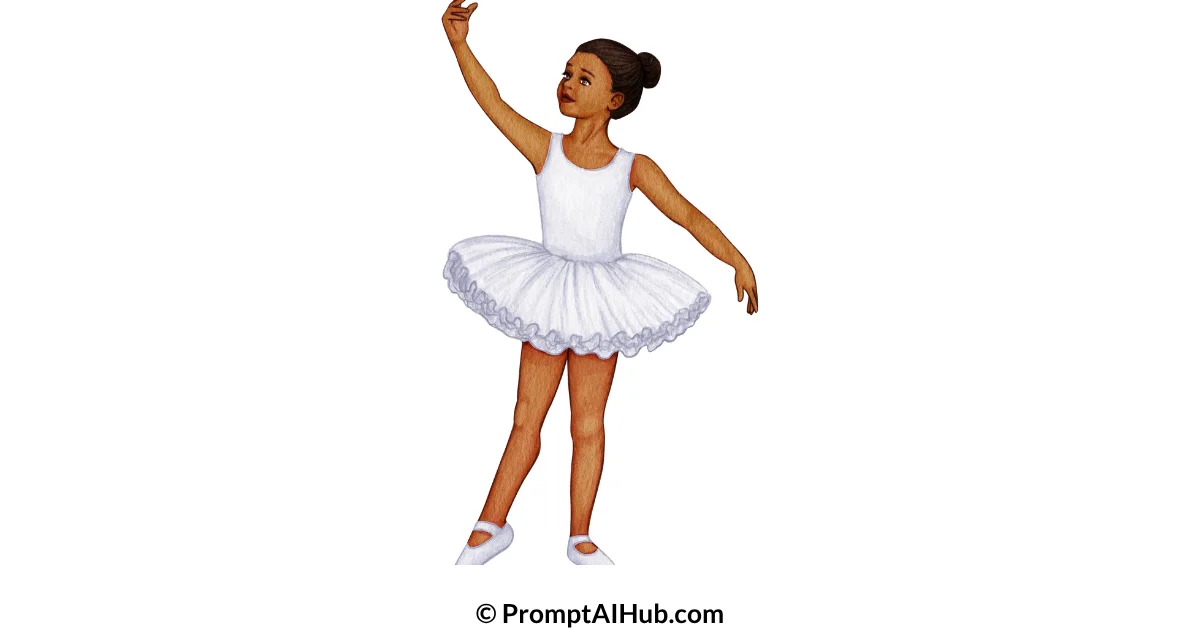
Dance involves much more than memorizing choreography. Dancers may need to plan practice sessions, improve specific skills, prepare for performances, understand musicality, organize choreography notes, and develop their creative ideas.
ChatGPT can help with many of these tasks when you provide clear context. Add details such as your dance style, experience level, goals, available practice time, and the specific challenge you are working on.
The prompts below are designed for dancers, dance students, and other people involved in dance who want practical ways to use ChatGPT in their training and creative workflow.
Table of Contents
How to Get Better Results From These Prompts
Before using a prompt, replace the text inside [brackets] with information relevant to your situation.
For example, when asking ChatGPT to create a practice plan, include details such as:
- Dance style: [ballet, hip-hop, contemporary, jazz, salsa, etc.]
- Experience level: [beginner, intermediate, advanced]
- Goal: [improve flexibility, prepare for an audition, learn choreography, etc.]
- Available time: [30 minutes, 1 hour, 5 days per week]
- Current challenge: [turns, musicality, stamina, confidence, etc.]
Giving ChatGPT more useful context can help you receive a response that is easier to adapt to your actual needs.
Dance Practice and Skill Development Prompts
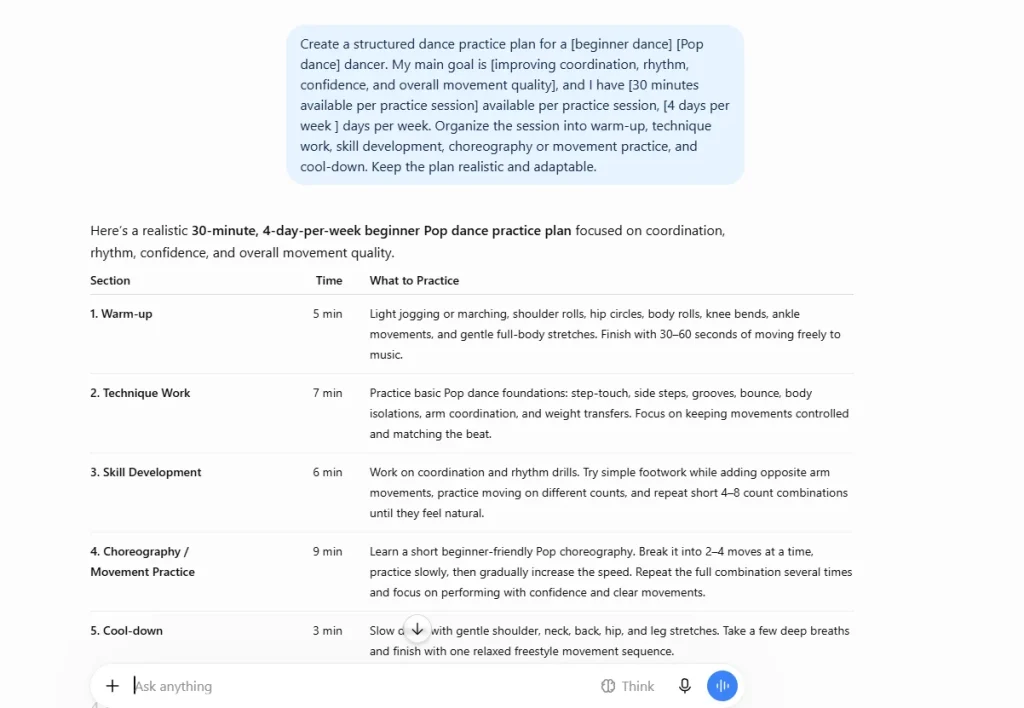
Prompt 1: Create a Dance Practice Plan
Prompt:
Create a structured dance practice plan for a [beginner/intermediate/advanced] [dance style] dancer. My main goal is [goal], and I have [amount of time] available per practice session, [number] days per week. Organize the session into warm-up, technique work, skill development, choreography or movement practice, and cool-down. Keep the plan realistic and adaptable.
Prompt 2: Break Down a Difficult Dance Skill
Prompt:
Help me break down the dance skill [skill or movement] into smaller practice components. Explain the key areas to focus on, common difficulties that may occur, and a gradual practice approach. Adapt the explanation for a [experience level] dancer practicing [dance style].
Prompt 3: Build a Weekly Training Routine
Prompt:
Create a weekly dance training routine for a [dance style] dancer with the goal of improving [technique, flexibility, stamina, musicality, strength, or another goal]. I can train [number] days per week for approximately [time] each day. Balance practice intensity and include recovery considerations.
Prompt 4: Plan a Focused Practice Session
Prompt:
Design a focused [duration] dance practice session centered on improving [specific skill or challenge]. Include a clear sequence of activities, suggested time for each section, and a progression from easier preparation to more challenging practice.
Prompt 5: Create a Technique Improvement Plan
Prompt:
Help me create a practice plan to improve my [specific technique or movement] in [dance style]. My current challenge is [describe challenge]. Suggest practice priorities, questions I can ask my instructor, and ways to track whether I am improving without assuming a specific cause for the problem.
Prompt 6: Develop a Flexibility Practice Routine
Prompt:
Create a flexible practice routine for a dancer who wants to work toward improving mobility and flexibility in [specific areas]. My dance style is [style], my experience level is [level], and I have [time] available. Keep the routine general, gradual, and adaptable, and include reminders to adjust the practice based on individual needs and professional guidance where appropriate.
Prompt 7: Improve Dance Stamina
Prompt:
Help me plan a dance-focused conditioning routine to support my goal of improving stamina for [class, rehearsal, performance, competition, or audition]. I am a [experience level] [dance style] dancer. Suggest a balanced weekly structure that considers dance practice, conditioning, and recovery.
Prompt 8: Create a Practice Progress Tracker
Prompt:
Create a simple progress-tracking template for my dance practice. My current goal is [goal], and I want to track [skills, practice time, challenges, improvements, confidence, or other factors]. Include sections for daily or weekly reflection and make the format easy to copy into a document or spreadsheet.
Prompt 9: Identify Questions to Ask a Dance Instructor
Prompt:
Based on this dance challenge, help me create a list of thoughtful questions to ask my instructor: [describe the challenge]. Focus on questions that could help me better understand technique, movement quality, practice priorities, or areas that need clarification.
Prompt 10: Review My Practice Routine
Prompt:
Review the following dance practice routine: [paste routine]. Identify areas that may be repetitive, unclear, unrealistic, or poorly balanced. Suggest ways to organize the routine more clearly while preserving the activities that are relevant to my goal: [goal].
Prompts for Learning and Understanding Choreography
Learning choreography can involve remembering movement sequences, understanding musical structure, identifying transitions, and finding an efficient way to practice difficult sections.
Prompt 11: Create a Choreography Learning Plan
Prompt:
Create a step-by-step plan for learning a piece of choreography in [timeframe]. The dance style is [style], the choreography length is approximately [length], and my experience level is [level]. Break the learning process into manageable stages, including how to review difficult sections and prepare for a full run-through.
Prompt 12: Break Choreography Into Sections
Prompt:
Help me organize this choreography into smaller sections for practice: [describe or paste notes about the choreography]. Create a logical breakdown with section names, movement cues, transitions, and practice priorities. Do not invent choreography details that are not provided.
Prompt 13: Create Movement Memory Cues
Prompt:
Based on the following choreography notes, create short memory cues that can help me remember the sequence of movements: [paste notes]. Keep the cues concise and easy to recall. Preserve the original movement information and clearly identify any sections that are unclear.
Prompt 14: Analyze a Difficult Transition
Prompt:
Help me analyze this transition in a dance routine: [describe transition]. Break it into preparation, movement sequence, timing, and the next position. Identify questions or details I should clarify with my choreographer or instructor rather than inventing missing movement information.
Prompt 15: Create a Rehearsal Checklist
Prompt:
Create a rehearsal checklist for preparing [dance piece or performance]. Include choreography review, timing, spacing, transitions, music preparation, costume or equipment checks if relevant, and personal preparation. Keep the checklist adaptable to the needs of the rehearsal.
Prompt 16: Prepare for a Full Run-Through
Prompt:
Help me prepare for a full run-through of [dance piece]. Create a practical preparation routine covering what to review beforehand, how to identify priority sections, what to observe during the run-through, and how to reflect afterward.
Prompt 17: Organize Choreography Notes
Prompt:
Organize the following choreography notes into a clear structure. Use sections for [counts, movement sequence, formations, transitions, musical cues, corrections, or other relevant categories]. Preserve the original information and flag anything unclear instead of filling in missing details: [paste notes].
Prompt 18: Create a Choreography Review Schedule
Prompt:
Create a review schedule for maintaining a dance routine that I have already learned. I need to remember it until [date or event], and I can practice [number] times per week. Suggest a realistic schedule that includes full reviews and focused practice of difficult sections.
Prompts for Musicality and Performance Development
Prompt 19: Explore the Musical Structure of a Dance
Prompt:
Help me analyze the musical structure of this piece for dance practice: [describe the music or provide notes]. Identify useful elements to listen for, such as changes in energy, rhythm, phrasing, accents, pauses, or transitions. Explain how a dancer could use these observations when practicing musicality without inventing details that are not provided.
Prompt 20: Create a Performance Preparation Reflection
Prompt:
Create a reflection guide for a dancer preparing to perform [dance piece]. Include questions about intention, movement quality, musicality, focus, stage awareness, transitions, and areas that need further practice. Make the questions practical and specific enough to guide rehearsal.
Prompts for Dance Creativity and Choreography Development
Sometimes the hardest part of creating a dance is deciding where to begin. These prompts can help dancers explore themes, movement ideas, choreography concepts, and different creative directions without replacing their own artistic decisions.
Prompt 21: Generate a Dance Concept
Prompt:
Help me develop a creative concept for a dance piece. The dance style is [style], the theme or idea is [theme], and the intended audience or setting is [audience or performance setting]. Suggest possible emotions, movement qualities, visual ideas, and directions I could explore.
Prompt 22: Brainstorm Choreography Ideas
Prompt:
Generate choreography ideas for a [dance style] piece based on the theme [theme]. Suggest different movement qualities, levels, pathways, energy changes, formations, and transitions. Keep the ideas flexible so I can adapt them to my own choreography.
Prompt 23: Develop a Dance Story
Prompt:
Help me develop a simple narrative or story for a dance performance about [theme or idea]. Suggest a beginning, development, turning point, and ending. Focus on emotional and movement possibilities rather than writing a detailed script.
Prompt 24: Create a Movement Exploration Exercise
Prompt:
Create a movement exploration exercise for a [dance style] dancer based on the idea of [emotion, object, word, image, or theme]. Include several movement questions or prompts that encourage experimentation with speed, space, energy, direction, and levels.
Prompt 25: Explore Different Movement Qualities
Prompt:
Give me creative movement exploration ideas based on the following qualities: [list qualities]. For each quality, suggest ways a dancer could experiment with body shape, speed, energy, direction, space, and transitions.
Prompt 26: Create an Improvisation Exercise
Prompt:
Design an improvisation exercise for a [beginner/intermediate/advanced] dancer practicing [dance style]. The exercise should focus on [specific goal, such as musicality, creativity, spatial awareness, or movement flow]. Include clear instructions, a time structure, and reflection questions.
Prompt 27: Generate Dance Themes
Prompt:
Generate [number] original theme ideas for a [dance style] performance. The desired mood is [mood], and the performance context is [competition, stage show, video, class project, etc.]. For each theme, provide a short concept and possible movement direction.
Prompt 28: Turn an Emotion Into Movement Ideas
Prompt:
Help me explore the emotion [emotion] through dance. Suggest movement qualities, body shapes, levels, pacing, spatial choices, and transitions that could communicate different interpretations of this emotion. Avoid assuming there is only one correct way to express it.
Prompt 29: Create a Choreography Starting Point
Prompt:
I want to create choreography but do not know where to begin. My dance style is [style], my music or concept is [describe it], and the approximate length is [duration]. Give me several possible starting approaches, such as beginning with a movement motif, musical accent, formation, gesture, or emotional idea.
Prompt 30: Develop a Movement Motif
Prompt:
Help me create and develop a movement motif for a dance piece about [theme]. Suggest an initial movement idea and several ways I could vary it through changes in direction, speed, level, size, rhythm, or energy.
Prompts for Dance Performance and Stage Preparation
Preparing for a performance can involve much more than remembering the choreography. Dancers may need to organize rehearsals, prepare mentally, think about spacing, review costumes, and reflect on areas that need attention.
Prompt 31: Create a Performance Preparation Plan
Prompt:
Create a preparation plan for my upcoming dance performance on [date or timeframe]. I am performing [dance style or piece], and my main preparation needs are [describe needs]. Organize the plan into choreography review, rehearsal priorities, practical preparation, and final checks.
Prompt 32: Build a Pre-Performance Routine
Prompt:
Help me create a personal pre-performance routine for a dancer. The performance begins at approximately [time], and I have [amount of time] available beforehand. Include practical preparation, focus exercises, choreography review, and a flexible warm-up structure without making assumptions about my individual physical needs.
Prompt 33: Create a Backstage Checklist
Prompt:
Create a backstage checklist for a dance performance. Include items related to costumes, shoes, music, props, timing, personal belongings, and any other practical details that may be useful. Make the checklist adaptable for [type of performance].
Prompt 34: Plan a Final Rehearsal
Prompt:
Create a plan for the final rehearsal before performing [dance piece]. Include what should be reviewed, how to prioritize difficult sections, what practical details should be checked, and how to avoid spending unnecessary time on areas that are already secure.
Prompt 35: Prepare for Stage Awareness
Prompt:
Help me create practice exercises to improve my awareness of space and positioning during a dance performance. My dance style is [style], and my main challenge is [describe challenge]. Suggest exercises I can discuss with or adapt alongside guidance from my instructor.
Prompt 36: Reflect After a Performance
Prompt:
Create a post-performance reflection template for a dancer. Include sections for what went well, unexpected challenges, choreography or timing issues, stage awareness, emotional experience, audience or instructor feedback, and priorities for future practice.
Prompt 37: Prepare for a Dance Competition
Prompt:
Help me organize my preparation for a dance competition. The competition involves [dance style or category], and my event date is [date]. Create a practical checklist covering rehearsals, choreography review, music, costumes, travel or event preparation, and questions I should confirm with the organizers.
Prompt 38: Create a Performance Day Schedule
Prompt:
Create a flexible performance day schedule for a dancer performing at [event]. My call time is [time], my performance time is [time], and I need to manage [travel, costume preparation, rehearsal, hair and makeup, meals, or other responsibilities]. Organize the schedule with realistic time buffers.
After an important performance, a structured performance review and feedback process can help you identify what worked well and what deserves more attention in future rehearsals.
Prompts for Dance Auditions and Career Preparation
Auditions can require dancers to prepare choreography, learn combinations quickly, present themselves professionally, and organize practical information about opportunities.
Prompt 39: Create an Audition Preparation Plan
Prompt:
Create an audition preparation plan for a [dance style] audition taking place on [date]. My experience level is [level], and I want to focus on [technique, learning speed, performance quality, confidence, flexibility, or another area]. Organize my preparation into manageable practice priorities.
Prompt 40: Prepare Questions About an Audition
Prompt:
Based on the following audition information, create a list of useful questions I may need to clarify before attending: [paste audition details]. Focus on practical information such as requirements, schedule, dress expectations, music, choreography, registration, and any unclear instructions. Do not invent missing details.
Prompts for Dance Auditions and Career Preparation
Auditions and career opportunities often require more than strong dance technique. Dancers may need to organize application information, prepare professional materials, research opportunities, communicate clearly, and reflect on their goals.
Prompt 41: Create an Audition Self-Introduction
Prompt:
Help me create a short professional self-introduction for a dance audition. I am a [dance style] dancer with [experience level or years of experience]. My relevant strengths include [skills, training, performance experience, or specialties]. Keep the introduction natural, confident, and appropriate for an audition setting without exaggerating my experience.
Prompt 42: Prepare an Audition Checklist
Prompt:
Create a practical checklist for preparing for a [dance style] audition on [date]. Include choreography preparation, clothing, footwear, music, required documents, travel planning, timing, and questions I should confirm with the organizers. Separate the checklist into preparation before the audition and items to bring on audition day.
Prompt 43: Organize My Dance Resume Information
Prompt:
Help me organize the information for a professional dance resume. My background includes [training, performances, competitions, teaching, choreography, workshops, or other experience]. Create clear categories and suggest what information may be useful to include. Do not invent achievements or qualifications that I have not provided.
Prompt 44: Improve Dance Resume Wording
Prompt:
Review the following dance resume content: [paste resume text]. Suggest clearer and more professional wording while preserving the facts and experience I provided. Keep the language concise and suitable for a dancer applying for [audition, company, school, teaching position, performance opportunity, etc.].
Prompt 45: Create a Dance Portfolio Outline
Prompt:
Create an outline for a professional dance portfolio based on my experience in [dance style]. My main goals are [auditions, performances, teaching opportunities, choreography opportunities, or other goals]. Suggest useful sections, examples of content to include, and a logical order for presenting my work.
Prompt 46: Write a Dance Biography
Prompt:
Help me draft a short professional biography for a dancer. My dance background is [describe background], my main styles are [styles], and my notable experience includes [experience]. My current goal is [goal]. Keep the biography authentic, concise, and professional, and do not add information that I have not provided.
Prompt 47: Prepare an Artist Statement
Prompt:
Help me develop an artist statement for my dance work. My main creative interests are [themes, ideas, emotions, or subjects], and my dance style or approach is [style or approach]. Ask me useful questions or organize my ideas into a clear statement that communicates my artistic perspective without making it sound overly generic.
Prompt 48: Research a Dance Opportunity
Prompt:
Help me create a research framework for evaluating this dance opportunity: [describe opportunity]. Identify the types of information I should investigate, such as organization background, requirements, schedule, location, compensation if applicable, expectations, application process, and important questions. Clearly separate confirmed information from details that still need verification.
Prompt 49: Compare Dance Opportunities
Prompt:
Help me create a comparison framework for these dance opportunities: [opportunity 1], [opportunity 2], [opportunity 3]. Compare factors such as artistic fit, requirements, schedule, location, costs, experience requirements, growth opportunities, and practical considerations. Use only the information I provide and identify missing details that I should research.
Prompt 50: Set Dance Career Goals
Prompt:
Help me create short-term, medium-term, and long-term career goals as a dancer. My current dance style is [style], my experience level is [level], and my main aspirations are [career goals]. Make the goals specific and realistic, and suggest measurable actions I can take toward each one.
Dance instructors can also combine these lesson-planning ideas with broader tutoring and teaching strategies to create more organized learning experiences for students.
Prompts for Dance Teaching and Coaching
Dancers who teach classes or help other dancers can also use ChatGPT to organize lessons, create exercises, explain concepts, and structure class activities. These prompts can help with planning while leaving the actual teaching decisions to the instructor.
Prompt 51: Create a Dance Class Plan
Prompt:
Create a structured class plan for teaching [dance style] to [beginner/intermediate/advanced] students. The class is [duration] long, and the main learning goal is [goal]. Organize the class into an appropriate sequence of activities, including introduction, technique work, movement practice, choreography or application, and review.
Prompt 52: Design a Beginner Dance Lesson
Prompt:
Design a beginner-friendly [dance style] lesson for students with little or no previous experience. The lesson should be approximately [duration] long and focus on [skill or concept]. Break the lesson into simple stages and include teaching points, practice activities, and opportunities for students to review what they learned.
Prompt 53: Explain a Dance Concept Simply
Prompt:
Explain the dance concept [concept] in a simple way that a [beginner/intermediate] dancer can understand. Use clear language, practical examples, and movement-related explanations. Avoid assuming that the student already understands advanced dance terminology.
Prompt 54: Create Dance Exercises for Students
Prompt:
Create several classroom exercises to help [beginner/intermediate/advanced] dancers develop [skill]. My dance style is [style], and the class duration is [duration]. For each exercise, provide the objective, basic instructions, approximate time, and a way to make the activity easier or more challenging.
Prompt 55: Create a Dance Warm-Up Structure
Prompt:
Help me structure a general warm-up for a [dance style] class. The class is for [experience level] dancers and I have approximately [time] available. Organize the warm-up progressively and keep it adaptable to the students’ needs. Avoid prescribing movements that may not be appropriate for every individual.
Prompt 56: Plan a Choreography Lesson
Prompt:
Create a lesson plan for teaching choreography to [experience level] dancers. The choreography is approximately [length], and the class has [number] students. Suggest ways to introduce the movement, divide the choreography into manageable sections, review difficult sections, and finish with an opportunity for students to perform the material.
Prompt 57: Create Student Reflection Questions
Prompt:
Create reflection questions for students after a [dance style] class or rehearsal. Focus on what they learned, which movements were challenging, how they approached practice, what improved, and what they want to work on next. Make the questions appropriate for [age or experience level].
Prompt 58: Create a Dance Class Feedback Template
Prompt:
Create a constructive feedback template for evaluating a student’s progress in [dance style]. Include areas such as technique, musicality, movement quality, coordination, focus, participation, and areas for future development. Keep the feedback specific, supportive, and based on observable performance rather than assumptions.
Prompt 59: Adapt an Exercise for Different Skill Levels
Prompt:
Take this dance exercise and suggest ways to adapt it for beginner, intermediate, and advanced dancers: [describe exercise]. Preserve the main learning objective while adjusting complexity, pacing, coordination demands, or creative requirements as appropriate.
Prompt 60: Plan a Dance Workshop
Prompt:
Help me plan a [duration]-long dance workshop focused on [topic or skill]. The participants are [experience level], and the workshop setting is [studio, school, community event, online, etc.]. Create a clear structure with learning objectives, activities, practice periods, transitions, and a final review.
Prompts for Dance Organization and Time Management
Dancers often balance classes, rehearsals, performances, training, school, work, and personal commitments. The following prompts can help organize these responsibilities more clearly.
Prompt 61: Create a Dance Weekly Schedule
Prompt:
Create a weekly schedule that helps me organize dance classes, rehearsals, independent practice, conditioning, recovery time, and other responsibilities. My available days and times are [schedule], my dance commitments are [commitments], and my other responsibilities include [responsibilities]. Prioritize realistic scheduling rather than filling every available time slot.
Prompt 62: Organize Multiple Rehearsals
Prompt:
Help me organize the following rehearsals and dance commitments into a clear schedule: [paste commitments]. Identify possible conflicts, preparation periods, travel buffers, and independent practice opportunities. Do not move fixed commitments unless I specifically allow it.
Prompt 63: Create a Dance Practice Priority List
Prompt:
Based on these current dance goals and commitments, create a priority list for my practice: [list goals and commitments]. Separate high-priority tasks from tasks that can wait. Explain briefly why each priority matters and help me avoid trying to improve everything at once.
Prompt 64: Build a Dance Time-Management System
Prompt:
Create a simple time-management system for a dancer balancing [classes/rehearsals/school/work/other responsibilities]. My available weekly time is approximately [time]. Include a method for prioritizing practice, tracking commitments, and adjusting the schedule when unexpected rehearsals or performances are added.
Prompt 65: Create a Rehearsal Notes Template
Prompt:
Create a reusable rehearsal notes template for a dancer. Include sections for choreography changes, corrections, counts, musical cues, formations, questions, practice priorities, and notes from the instructor or choreographer. Keep the template simple enough to use quickly during rehearsal.
Prompt 66: Organize My Dance Goals
Prompt:
Help me organize these dance goals into categories such as technique, creativity, performance, fitness or conditioning, musicality, choreography, and career development: [paste goals]. Identify overlapping goals and suggest a practical order for working on them.
Prompt 67: Create a Monthly Dance Review
Prompt:
Create a monthly dance progress review template. Include sections for skills practiced, choreography learned, performances or rehearsals completed, challenges, improvements, instructor feedback, creative discoveries, and priorities for the next month.
Prompt 68: Plan Practice Around a Busy Schedule
Prompt:
Help me create a flexible dance practice strategy for a busy week. I have [number] hours available, but my schedule changes frequently. My main dance goal is [goal]. Suggest short, medium, and longer practice options so I can continue making progress when my available time changes.
Prompt 69: Track Dance Rehearsal Corrections
Prompt:
Create a simple system for recording and reviewing corrections I receive during dance rehearsals. Include categories for technique, timing, musicality, spacing, performance quality, choreography, and other relevant corrections. Make it easy to review before my next rehearsal.
Prompt 70: Create a Dance Monthly Action Plan
Prompt:
Create a monthly action plan based on my current dance goals: [goals]. Include weekly priorities, practice tasks, choreography review, creative work, performance preparation if relevant, and a simple progress review at the end of the month. Keep the plan realistic for my available time of [time].
Breaking larger ambitions into smaller milestones can make setting clear and measurable goals easier to manage over time.
Prompts for Dance Fitness, Recovery, and Well-Being
Dancers often need to balance training demands with rest, recovery, energy management, and general well-being. ChatGPT can help organize questions and routines, but individual physical needs are different, so professional guidance may be appropriate when needed.
Prompt 71: Create a Dance Conditioning Plan
Prompt:
Help me organize a general conditioning plan that supports my dance training in [dance style]. My experience level is [level], I currently train [number] days per week, and my main goal is [goal]. Suggest a balanced structure for conditioning, dance practice, and recovery without assuming specific physical needs.
Prompt 72: Plan a Recovery Week
Prompt:
Help me organize a lower-intensity recovery week around my dance schedule. I normally train [number] days per week and have recently been managing [busy rehearsal period/heavy training schedule/competition preparation]. Suggest ways to reduce training demands while maintaining useful movement and practice habits.
Prompt 73: Create a General Mobility Routine
Prompt:
Create a general mobility-focused routine for a [dance style] dancer who wants to support movement quality. I have approximately [time] available and want to focus on [areas or movement goals]. Keep the routine gradual and adaptable, and include reminders to stop or modify activities that cause pain or discomfort.
Prompt 74: Organize a Dance Recovery Routine
Prompt:
Help me create a general post-training recovery routine for a dancer. My typical practice session lasts [duration], and I usually work on [dance style or activities]. Include simple recovery habits, reflection questions, and ways to monitor how I feel before deciding what to do in my next session.
Prompt 75: Track Training Load
Prompt:
Create a simple training-load tracking template for my dance practice. I want to record practice duration, perceived effort, rehearsal intensity, performance commitments, rest days, and how I felt afterward. Make the system easy to maintain weekly and useful for identifying patterns in my schedule.
Prompt 76: Identify Questions About Physical Training
Prompt:
Based on my dance training situation, create questions I could discuss with a qualified dance teacher, physical therapist, strength professional, or other appropriate professional. My situation is [describe situation]. Focus on questions about training balance, movement demands, recovery, and safe progression rather than diagnosing a physical problem.
Prompt 77: Plan Rest Around Performance Week
Prompt:
Help me organize my dance schedule during the week leading up to a performance. My performance is on [date], my rehearsals are [schedule], and my main priorities are [priorities]. Suggest ways to organize practice, review, preparation, and rest while avoiding unnecessary last-minute workload.
Prompt 78: Create an Energy Management Plan
Prompt:
Help me organize my daily schedule around dance classes, rehearsals, performances, and other responsibilities. My current commitments are [commitments], and my available time is [time]. Suggest ways to structure demanding activities, breaks, preparation, and recovery without making assumptions about my individual nutritional or medical needs.
Prompt 79: Create a Dance Training Reflection
Prompt:
Create a weekly reflection template for reviewing my dance training. Include questions about practice quality, energy, focus, musicality, technique, creativity, recovery, challenges, and accomplishments. Keep the reflection practical and focused on identifying useful patterns rather than judging my performance.
Prompt 80: Review My Training Balance
Prompt:
Review my current weekly dance schedule: [paste schedule]. Identify whether the workload appears repetitive, overly concentrated, unclear, or difficult to maintain based on the information provided. Suggest organizational changes while recognizing that individual training needs should be discussed with an appropriate instructor or professional.
Prompts for Dance Music and Musicality
Musicality can influence timing, dynamics, phrasing, accents, transitions, and how movement connects with music. These prompts can help dancers organize what they hear and translate observations into practice ideas.
Prompt 81: Create a Musicality Practice Plan
Prompt:
Create a practice plan to help me develop musicality as a [dance style] dancer. My current challenge is [challenge], and I have [amount of time] available. Include exercises involving rhythm, phrasing, accents, pauses, dynamics, and changes in energy.
Prompt 82: Practice Dancing to Different Rhythms
Prompt:
Create exercises that help me practice responding to different rhythmic patterns while dancing. My dance style is [style], and my experience level is [level]. Include exercises that progress from simple rhythmic awareness to more complex musical interpretation.
Prompt 83: Explore Musical Accents
Prompt:
Help me create dance exercises focused on identifying and responding to musical accents. My dance style is [style]. Suggest several ways to practice accents using changes in direction, energy, level, speed, pauses, or movement quality.
Prompt 84: Practice Phrasing
Prompt:
Create a musicality exercise that helps me understand and respond to musical phrasing. Explain what I should listen for and provide practical ways to experiment with movement timing, dynamics, transitions, and emphasis.
Prompt 85: Create a Music Analysis Worksheet
Prompt:
Create a worksheet I can use to analyze music for choreography. Include sections for tempo, rhythm, phrasing, accents, pauses, changes in energy, song structure, emotional qualities, and possible movement ideas. Keep the worksheet easy to copy into a document.
Prompt 86: Match Movement Quality to Music
Prompt:
Give me movement exploration exercises for matching different movement qualities to music. Use qualities such as [sharp, smooth, heavy, light, sustained, explosive, controlled]. Include questions that encourage me to experiment rather than giving only one interpretation.
Prompt 87: Explore Dynamics in Dance
Prompt:
Create a dance exercise focused on exploring dynamics. My dance style is [style], and I want to experiment with [soft versus strong, slow versus fast, controlled versus explosive, or other contrasts]. Provide a progression that allows me to explore several interpretations.
Prompt 88: Create a Musicality Self-Assessment
Prompt:
Create a self-assessment for evaluating my musicality during dance practice. Include questions about staying with the rhythm, recognizing accents, responding to phrasing, using dynamics, maintaining timing, and making intentional movement choices.
Prompt 89: Turn Music Observations Into Choreography Ideas
Prompt:
Based on these observations about a piece of music, help me brainstorm choreography possibilities: [paste observations]. Suggest movement qualities, transitions, formations, pauses, accents, or motifs that could respond to the musical structure without creating a fixed choreography for me.
Prompt 90: Create a Musicality Challenge
Prompt:
Design a [7-day/14-day/30-day] musicality challenge for a [dance style] dancer. Each day should include one short exercise focused on a different aspect of musicality, such as rhythm, accents, phrasing, dynamics, pauses, texture, or interpretation.
Prompts for Dance Creativity and Artistic Development
Creative development can help dancers move beyond repeating familiar patterns. The following prompts encourage experimentation while allowing the dancer to make the final artistic decisions.
Prompt 91: Break Out of a Movement Habit
Prompt:
Help me design creative exercises that challenge my usual movement habits. My dance style is [style], and I tend to rely on [describe habit]. Suggest experiments involving unfamiliar pathways, levels, timing, dynamics, directions, or movement qualities.
Prompt 92: Create a Choreographic Constraint
Prompt:
Give me a creative choreography constraint for a [dance style] piece. The constraint should challenge me to make interesting movement choices without completely limiting my creativity. Provide several variations I could try.
Prompt 93: Explore Space in Choreography
Prompt:
Create movement exploration exercises focused on spatial choices. Include experiments with levels, directions, pathways, proximity, stillness, formations, and use of performance space. Adapt the ideas for [dance style].
Prompt 94: Develop a Repeating Motif
Prompt:
Help me develop a simple movement motif for a dance piece. Start with this idea or movement: [movement or concept]. Suggest ways to repeat, reverse, expand, shrink, fragment, change the rhythm, or alter the energy while preserving a connection to the original motif.
Prompt 95: Create a Choreographic Improvisation Prompt
Prompt:
Give me an improvisation prompt based on [theme, emotion, image, word, sound, or concept]. Include a clear starting instruction, several exploration questions, and a final reflection. Encourage experimentation with space, timing, energy, and movement quality.
Prompt 96: Explore Contrasting Movement
Prompt:
Create a choreography exercise based on movement contrasts such as large/small, fast/slow, high/low, tense/relaxed, direct/indirect, or still/moving. Give me several ways to explore these contrasts within a [dance style] piece.
Prompt 97: Develop a Dance Scene
Prompt:
Help me develop a movement-based scene for a dance piece about [theme]. Suggest the emotional purpose of the scene, possible movement qualities, spatial ideas, transitions, and ways the scene could connect to what comes before and after it.
Prompt 98: Generate Choreography Questions
Prompt:
Give me a list of questions I can ask myself while creating choreography. Cover movement choice, musicality, intention, space, repetition, contrast, transitions, formations, emotional meaning, and audience experience.
Prompt 99: Review My Choreography Concept
Prompt:
Review my choreography concept: [describe concept]. Identify what appears clear, what could be developed further, and what questions I should explore during the creative process. Do not rewrite the concept completely or assume what I intended.
Prompt 100: Create a Personal Creative Practice
Prompt:
Create a weekly creative practice routine for me as a [dance style] dancer and choreographer. I have [amount of time] available each week and want to improve [improvisation, choreography, musicality, movement vocabulary, artistic expression, or other goal]. Include short creative exercises, experimentation time, documentation, and reflection.
Prompts for Dance Content and Social Media
Dancers, choreographers, studios, teachers, and dance creators may also use ChatGPT to organize ideas for online content while keeping their personal voice and artistic identity at the center.
Prompt 101: Create Dance Content Ideas
Prompt:
Generate [number] content ideas for a dancer who creates content about [dance style, training, choreography, performances, education, or lifestyle]. Divide the ideas into educational, entertaining, behind-the-scenes, creative, and community-focused categories.
Prompt 102: Create a Dance Social Media Calendar
Prompt:
Create a [7-day/14-day/30-day] social media content calendar for a dancer or dance creator. My main platform is [platform], my dance style is [style], and my main goal is [education, audience growth, portfolio building, community, or another goal]. Include content topics, formats, and simple calls to action.
Prompt 103: Write a Dance Video Caption
Prompt:
Write a short social media caption for my dance video. The video shows [describe video], my dance style is [style], and the main message is [message]. Make the caption natural, engaging, and appropriate for [platform]. Avoid exaggerated claims and keep my personal voice in mind.
Prompt 104: Generate Dance Reel Ideas
Prompt:
Generate [number] short-form video ideas for a [dance style] creator. Include concepts based on choreography, practice sessions, common mistakes, progress, behind-the-scenes moments, musicality, challenges, and creative movement. For each idea, provide a short hook and basic video structure.
Prompt 105: Create a Dance Educational Post
Prompt:
Help me create an educational social media post about [dance topic]. My target audience is [beginners/intermediate dancers/teachers/parents/other audience]. Explain the topic clearly, provide practical takeaways, and finish with a simple question or call to action that encourages meaningful discussion.
Along with a clear call to action, using relevant hashtags can help organize and categorize your dance content for social media audiences.
Prompt 106: Create a Dance Behind-the-Scenes Post
Prompt:
Write a behind-the-scenes social media post about [rehearsal/performance/choreography process/class preparation]. Include a natural opening, a short description of the experience, and a closing thought or question. Keep it authentic rather than overly promotional.
Prompt 107: Build a Dance Creator Brand Voice
Prompt:
Help me define a consistent content voice for my dance brand. My dance style is [style], my audience is [audience], and I want my content to feel [educational, energetic, artistic, friendly, professional, humorous, inspiring, or other qualities]. Suggest tone guidelines, vocabulary preferences, content themes, and examples of how the voice could sound.
Prompt 108: Create Dance Video Hooks
Prompt:
Generate [number] short hooks for dance videos about [topic]. Make the hooks suitable for the first few seconds of a short-form video and avoid misleading clickbait. Include different approaches such as curiosity, education, personal experience, challenge, and transformation.
Prompt 109: Repurpose Dance Content
Prompt:
Take this dance content and suggest ways to repurpose it into a short video, carousel post, story, text post, and longer educational piece: [paste content]. Keep the core message consistent while adapting the format and length for each platform.
Prompt 110: Create a Dance Content Strategy
Prompt:
Create a practical content strategy for a dancer or choreographer who wants to build an online presence. My dance style is [style], my target audience is [audience], my main platforms are [platforms], and my goal is [goal]. Suggest content pillars, posting themes, community-building ideas, and ways to showcase my dance work authentically.
Beyond social media, dancers who want to showcase their portfolio, performances, and services can also explore building a professional website
Once you have recorded your dance content, AI can also help you organize video content and editing ideas for reels, tutorials, performance clips, and behind-the-scenes videos.
Prompts for Dance Business and Professional Growth
Dancers who teach, choreograph, perform, create content, or work independently may also need to manage professional communication, services, projects, and business tasks. ChatGPT can help organize these areas while the dancer remains responsible for final decisions and professional commitments.
If you share your training, performances, or choreography online, AI can also help you create engaging social media posts and captions that match your content.
Prompt 111: Create a Dance Business Plan
Prompt:
Help me create a simple business plan for my dance-related work. I offer [dance classes, private lessons, choreography, performances, workshops, online content, or other services]. My target audience is [audience], and my main goals are [goals]. Include services, audience, marketing ideas, basic operations, and measurable goals without inventing financial information.
Prompt 112: Define My Dance Services
Prompt:
Help me organize and describe my dance services. I currently offer [services]. My target audience is [audience], and my main strengths are [strengths]. Suggest clear service categories and descriptions that accurately represent what I provide without making unsupported claims.
Prompt 113: Create a Dance Workshop Description
Prompt:
Write a professional description for my dance workshop. The workshop focuses on [style/topic], is designed for [audience or experience level], and lasts [duration]. Include what participants can expect to learn, the overall experience, and any important information I provide. Keep the description clear and engaging without exaggeration.
Prompt 114: Create a Private Dance Lesson Description
Prompt:
Help me write a clear description for my private dance lessons. I teach [dance style], work with [beginner/intermediate/advanced] dancers, and focus on [skills or goals]. Explain what students can expect from the lessons while keeping the wording professional and realistic.
Prompt 115: Organize Dance Client Information
Prompt:
Create a simple client information template for my dance services. Include relevant sections for goals, experience level, preferred dance style, scheduling preferences, previous training, project requirements, and questions. Avoid collecting unnecessary personal information.
If you want to turn your dance skills into classes, workshops, choreography services, or other creative opportunities, exploring generating business ideas can help you identify possible directions.
Prompt 116: Create a Professional Dance Inquiry Response
Prompt:
Draft a professional response to this dance-related inquiry: [paste inquiry]. Make the response friendly, clear, and concise. Address the questions that were provided and identify any details I still need to confirm before making a commitment.
Prompt 117: Create a Dance Collaboration Proposal
Prompt:
Help me create a proposal for a potential dance collaboration. The project involves [describe project], my role would be [role], and the potential collaborator is [type of collaborator]. Include the project concept, responsibilities, timeline, expected deliverables, and questions that should be discussed before confirming the collaboration.
Prompt 118: Organize a Dance Project
Prompt:
Help me organize this dance project: [describe project]. Create categories for objectives, tasks, people involved, deadlines, rehearsals, creative decisions, required materials, and final deliverables. Clearly separate confirmed information from items that still need decisions.
Prompt 119: Create a Dance Event Planning Checklist
Prompt:
Create a practical checklist for organizing a dance event. The event is [type of event], expected to involve [number or type of participants], and take place around [date or timeframe]. Include planning, venue, rehearsal, music, costumes, communication, promotion, technical requirements, and event-day tasks.
Prompt 120: Create a Professional Development Plan
Prompt:
Create a professional development plan for me as a dancer. My current experience is [level], my main dance styles are [styles], and my long-term goals are [goals]. Organize development areas such as technique, performance, creativity, networking, teaching, portfolio development, and learning opportunities.
As you work toward your long-term dance career, you can also use AI to organize your professional development and productivity goals.
Prompts for Dance Confidence and Performance Mindset
Performance confidence can involve preparation, focus, familiarity with the performance environment, and learning how to respond to mistakes. These prompts can help dancers reflect on their experience and create practical preparation strategies without treating ChatGPT as a substitute for qualified mental-health support.
Prompt 121: Create a Pre-Performance Reflection
Prompt:
Create a short reflection exercise I can use before a dance performance. Include questions about what I have prepared, what I can control, where I want to direct my attention, and what I want to communicate through my performance.
Prompt 122: Build a Performance Focus Routine
Prompt:
Help me create a short focus routine for before performing. I have approximately [number] minutes available, and my main challenge is [distraction, nerves, rushing, loss of focus, or another challenge]. Include practical preparation, attention cues, and performance intentions without assuming a specific psychological condition.
Prompt 123: Reflect on Performance Nerves
Prompt:
Help me reflect on my experience of feeling nervous before a dance performance. Ask me useful questions about when the nerves appear, what thoughts or situations seem connected to them, what preparation has helped before, and what I might discuss with my instructor or an appropriate professional if the issue continues to interfere with my activities.
Prompt 124: Create a Mistake Recovery Strategy
Prompt:
Help me create a practical strategy for recovering from a mistake during a dance performance. My main concern is [forgetting choreography, missing a cue, losing timing, spacing error, or another situation]. Focus on simple attention cues and ways to reconnect with the choreography without becoming distracted by the mistake.
Prompt 125: Build a Performance Confidence Journal
Prompt:
Create a short weekly journal template for building confidence as a dancer. Include sections for accomplishments, difficult moments, instructor feedback, skills I am developing, performances or rehearsals completed, lessons learned, and one practical focus for the following week.
Prompt 126: Prepare for an Important Performance
Prompt:
Help me prepare mentally and practically for an important dance performance. The event is [event], my role is [role], and the areas I am most concerned about are [concerns]. Create a preparation framework that separates things I can control from things I cannot control.
Prompt 127: Create Positive Performance Cues
Prompt:
Generate short performance cues I can use before and during a dance routine. My dance style is [style], and I want to focus on [musicality, presence, timing, expression, confidence, connection, or another goal]. Keep the cues concise, realistic, and easy to remember.
Prompt 128: Reflect After Making a Mistake
Prompt:
Help me review a dance mistake without turning the reflection into negative self-criticism. The situation was [describe what happened]. Create questions that help me identify what I learned, what information I need, what I can practice, and what I would approach differently next time.
Prompt 129: Prepare for an Unfamiliar Stage
Prompt:
Create a preparation checklist for performing in an unfamiliar venue. Include questions about stage dimensions, entrances and exits, flooring, lighting, sound, backstage areas, spacing, rehearsal access, and timing. Clearly identify details that I should confirm with the event organizers.
Prompt 130: Create a Performance Mindset Routine
Prompt:
Help me create a simple routine for preparing my attention and performance mindset before dance rehearsals or performances. My main goals are [goals]. Include reflection questions, performance cues, preparation reminders, and a short post-performance review.
Prompts for Dance Reflection and Long-Term Progress
Long-term progress becomes easier to understand when dancers regularly document what they practice, what they learn, and which areas deserve attention next.
Prompt 131: Create a Dance Progress Journal
Prompt:
Create a reusable dance progress journal with sections for practice sessions, skills worked on, choreography learned, challenges, corrections, accomplishments, questions, and next steps. Make it simple enough to complete in a few minutes after training.
Prompt 132: Review My Dance Progress
Prompt:
Review these dance progress notes from [time period]: [paste notes]. Identify recurring improvements, repeated challenges, skills that received consistent attention, and areas that may need more focused practice. Base the review only on the information provided.
Prompt 133: Identify Patterns in My Training
Prompt:
Analyze the following dance training log: [paste training log]. Identify patterns in practice frequency, recurring challenges, choreography review, performance preparation, and recovery. Highlight observations separately from suggestions so I can decide what changes make sense.
Prompt 134: Create a Goal Review System
Prompt:
Create a monthly goal-review system for my dance training. My current goals are [goals]. Include questions for measuring progress, identifying obstacles, reviewing feedback, and deciding whether each goal should be continued, adjusted, completed, or replaced.
Prompt 135: Create a Dance Achievement Tracker
Prompt:
Create a tracker for recording my dance achievements and experiences. Include categories for performances, competitions, classes, workshops, choreography, teaching, collaborations, certifications or training, and creative projects. Make the format easy to update over time.
Prompt 136: Build a Dance Learning Portfolio
Prompt:
Help me design a personal learning portfolio for my dance development. Include sections for training history, skills, choreography, performances, feedback, creative experiments, goals, reflections, and important milestones.
Prompt 137: Create a Dance Reflection After Class
Prompt:
Create a five-minute reflection template I can complete after each dance class. Include what I learned, what felt challenging, corrections I received, what improved, what remains unclear, and what I want to practice before the next class.
Prompt 138: Create a Dance Milestone Plan
Prompt:
Help me identify realistic milestones for reaching my dance goal of [goal]. My current experience level is [level], and I have approximately [time] available for training each week. Break the larger goal into smaller milestones and suggest ways to review progress without assuming a fixed timeline for every dancer.
Prompt 139: Create a Dance Learning Review
Prompt:
Help me review what I have learned about [dance style or skill] over the past [time period]. Based on these notes, [paste notes], organize my learning into skills, discoveries, challenges, corrections, questions, and next areas to explore.
Prompt 140: Create a Personal Dance Development Roadmap
Prompt:
Create a long-term development roadmap for me as a dancer. My current level is [level], my main styles are [styles], my primary goals are [goals], and my available training time is [time]. Organize the roadmap into technique, musicality, performance, creativity, conditioning, professional development, and personal reflection. Keep it adaptable as my priorities change.
Prompts for Dance Research and Learning
Dancers may encounter unfamiliar terminology, historical references, techniques, styles, and choreographic concepts. These prompts can help organize research questions and make complex information easier to understand.
Prompt 141: Explain a Dance Term
Prompt:
Explain the dance term [term] in simple language. Include its general meaning, the context in which it is commonly used, and an example of how a dancer might encounter it in training. If the term has multiple meanings, clearly explain the differences.
Prompt 142: Compare Dance Styles
Prompt:
Compare [dance style 1], [dance style 2], and [dance style 3]. Discuss their general characteristics, movement qualities, musical relationships, training approaches, and common performance contexts. Avoid presenting broad generalizations as rules that apply to every dancer or tradition.
Prompt 143: Create a Dance Research Outline
Prompt:
Create a research outline for studying [dance topic]. Include key questions, important subtopics, terminology to understand, historical or cultural context to investigate, and potential areas where reliable sources should be consulted.
Prompt 144: Turn Dance Notes Into Study Questions
Prompt:
Convert these dance notes into study questions: [paste notes]. Organize the questions by definitions, concepts, technique, history, musicality, choreography, and practical application where appropriate. Do not add information that is not present in the notes.
Prompt 145: Create Dance Flashcards
Prompt:
Turn the following dance study material into concise flashcards: [paste material]. Format each card with a question on one side and a short answer on the other. Preserve the original information and flag anything that appears incomplete or ambiguous.
Prompt 146: Simplify a Dance Article
Prompt:
Explain the following dance-related text in simpler language while preserving its main meaning: [paste text]. Define specialized terminology and organize the explanation into clear sections. Do not remove important context.
Prompt 147: Create a Dance Study Plan
Prompt:
Create a study plan for learning about [dance topic]. I have [amount of time] available each week and want to understand [specific areas]. Divide the subject into manageable topics and include review questions and practical ways to connect the information to dance practice.
Prompt 148: Generate Questions for Dance Research
Prompt:
Generate thoughtful research questions about [dance topic]. Include questions about history, technique, culture, artistic development, performance, education, and contemporary practice where relevant. Avoid assuming that one perspective represents the entire dance community.
Prompt 149: Summarize Dance Research Notes
Prompt:
Summarize these dance research notes into clear sections: [paste notes]. Separate key facts, important concepts, examples, unresolved questions, and areas that require further verification. Do not add unsupported information.
Prompt 150: Create a Dance Knowledge Review
Prompt:
Create a review quiz based only on these dance notes: [paste notes]. Include a mixture of definition, comparison, application, and short-answer questions. Do not introduce facts that are not contained in the provided material.
Final Prompt: Build a Complete Dance Training Assistant
Prompt 151: Create My Personal Dance Planning System
Prompt:
Act as my dance planning assistant. My dance style is [style], experience level is [level], current goals are [goals], available practice time is [time], and my upcoming commitments are [classes, rehearsals, performances, auditions, or other commitments]. Help me organize practice priorities, choreography review, creative work, performance preparation, progress tracking, and reflection.
Before creating a plan, identify any important information that is missing. Do not assume details about my physical condition, training capacity, choreography, or professional commitments. Keep recommendations adaptable and clearly distinguish general planning suggestions from decisions that should be discussed with my instructor, choreographer, or another qualified professional.
FREE AI TOOLS
Visit Our Free AI tools
Prompts AI Hub Team Has Tailored Their AI Knowledge and Created Tools for You Free of Cost, Enjoy
Frequently Asked Questions About ChatGPT Prompts for Dancers
Can dancers use ChatGPT to create practice plans?
Yes. Dancers can use ChatGPT to organize general practice plans based on their dance style, experience level, goals, available time, and current priorities. It can help structure warm-ups, technique practice, choreography review, creative exercises, and reflection. However, a generated plan should be adapted to the dancer’s individual circumstances and, when appropriate, reviewed with a qualified instructor or professional.
Can ChatGPT help me learn choreography?
ChatGPT can help organize choreography notes, divide a routine into practice sections, create memory cues, build review schedules, and identify questions about difficult transitions. It should not invent missing choreography details. When information is unclear, provide the original notes or ask your choreographer or instructor for clarification.
Can ChatGPT improve my dance technique?
ChatGPT can help you organize practice ideas, explain general concepts, create questions for an instructor, and build progress-tracking systems. It cannot directly observe your movement unless you provide appropriate information or media through a tool that supports it, and even then, it should not replace qualified instruction or professional assessment.
What information should I include in a dance prompt?
Useful information can include your dance style, experience level, goal, available practice time, choreography length, performance date, current challenge, and the type of output you want. The more relevant context you provide, the easier it is for ChatGPT to create a response that fits your situation.
Can ChatGPT help with dance auditions?
Yes. It can help you organize audition preparation plans, checklists, questions for organizers, resume information, portfolio ideas, self-introductions, and practice priorities. For specific audition requirements, always verify the official information provided by the organizer rather than relying solely on AI-generated assumptions.
Can ChatGPT create choreography for dancers?
ChatGPT can generate creative starting points, movement exploration exercises, motifs, themes, improvisation prompts, and choreography concepts. Dancers and choreographers can then adapt these ideas according to their own artistic decisions, musical interpretation, technique, and creative vision.
Can ChatGPT help dancers with musicality?
Yes. It can suggest exercises for practicing rhythm, accents, phrasing, dynamics, pauses, timing, and movement quality. You can also provide observations about a piece of music and ask ChatGPT to turn those observations into practice or choreography exploration ideas.
Can dance teachers use these prompts?
Absolutely. Dance teachers can use them to organize class plans, create exercises, explain concepts, prepare reflection questions, adapt activities for different experience levels, and structure workshops. Teachers should still use their professional judgment when deciding what is appropriate for their students.
Can ChatGPT help me prepare for a dance performance?
Yes. It can help create rehearsal schedules, performance-day timelines, backstage checklists, choreography review plans, reflection templates, and preparation routines. These tools can help with organization while leaving performance-specific decisions to the dancer, instructor, choreographer, or event team.
Can ChatGPT help dancers manage their time?
Yes. You can provide your class schedule, rehearsals, performances, practice availability, work or school responsibilities, and other commitments. ChatGPT can then help organize priorities and identify scheduling conflicts or opportunities for focused practice.
Should I follow a ChatGPT-generated dance or conditioning routine exactly?
No. AI-generated routines should be treated as general planning suggestions rather than individualized professional instruction. Dancers have different training histories, physical needs, experience levels, and schedules. Modify activities as appropriate and seek qualified professional guidance when necessary, particularly when dealing with pain, injury, or significant physical concerns.
How can I get better results from ChatGPT dance prompts?
Give ChatGPT specific context and clearly state what you want it to produce. Instead of asking for a generic “dance plan,” mention your dance style, level, goal, available time, schedule, and specific challenge. You can also ask ChatGPT to identify missing information before creating the final response.
Download All Prompts
To Download 50K Plus Prompts Click Below and Get Them In One Click.
Final Thoughts
ChatGPT can be a useful planning and creative tool for dancers, but it works best when it supports rather than replaces the dancer’s own judgment, training, and artistic voice.
You can use these prompts to organize practice sessions, break down choreography, explore musicality, develop creative ideas, prepare for performances and auditions, manage dance projects, create educational content, and reflect on long-term progress.
The quality of the result will often depend on the quality of the context you provide. Instead of using a prompt exactly as written, customize the bracketed sections with your dance style, experience level, goals, schedule, upcoming commitments, and specific challenges.
Most importantly, treat ChatGPT as a dance planning and brainstorming assistant—not as a replacement for your instructor, choreographer, or qualified professional. Your experience, observation, creativity, and personal artistic decisions should remain at the center of your development as a dancer.

For More Information, About Author Visit Our Team