ChatGPT Prompts for Musicians: Practical AI Help for Songwriting, Practice, Performance, and Music Promotion
Writing music still depends on your own taste, experience, and creative decisions. But there are plenty of tasks around music that can take time: developing song ideas, organizing practice sessions, exploring arrangements, preparing for performances, writing artist bios, and planning content.
That is where ChatGPT can become a useful creative assistant.
The key is to give it enough direction. A vague request such as “give me a song idea” usually produces something generic. A better prompt tells ChatGPT what kind of musician you are, what you are trying to create, the style or mood you want, and what kind of response would actually help.
The prompts below are designed for musicians who want practical help without handing over the creative work itself. You can adapt the placeholders to your instrument, genre, skill level, audience, or current project.
Explore Our ChatGPT Prompts, Microsoft Copilot Prompts, Google Gemini Prompts Library
Table of Contents
Getting Better Results From ChatGPT as a Musician
Before using the prompts, add context whenever it matters. For example, instead of simply asking for practice ideas, mention:
- Your instrument or role
- Your experience level
- Your musical genre
- The specific skill you want to improve
- Your available practice time
- Your creative goal
- Your preferred sound or influences
- Any limitations you are working with
You can also ask ChatGPT to give you several options rather than one answer. That makes it easier to compare ideas and keep the final creative decision in your hands.
Songwriting and Idea Development
A blank page can be one of the hardest parts of songwriting. ChatGPT can help you explore directions when you have a rough idea but do not know where to take it.
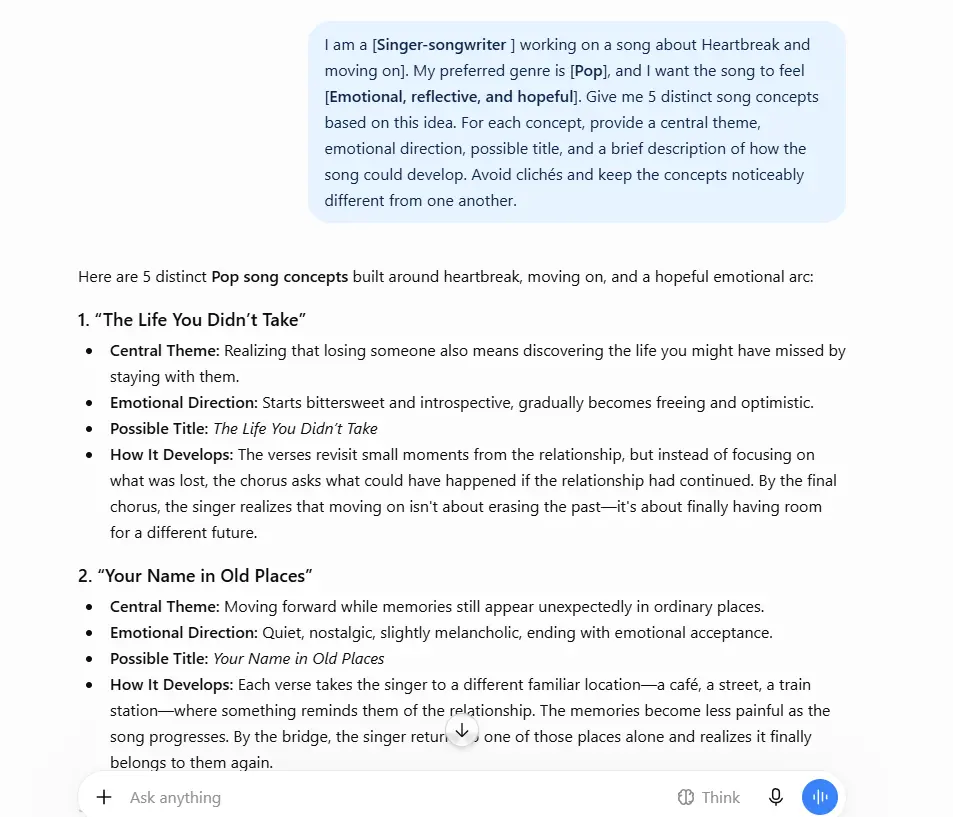
Prompt 1: Turn a Rough Idea Into Song Concepts
I am a [musician/songwriter] working on a song about [topic, emotion, or experience]. My preferred genre is [genre], and I want the song to feel [mood]. Give me 5 distinct song concepts based on this idea. For each concept, provide a central theme, emotional direction, possible title, and a brief description of how the song could develop. Avoid clichés and keep the concepts noticeably different from one another.
Prompt 2: Develop a Song From a Single Phrase
I have the phrase “[phrase]” and want to build a song around it. Treat this phrase as the creative starting point rather than assuming the entire song’s meaning. Give me 5 possible interpretations, themes, and story directions. For each one, suggest what the verses could explore and what emotional shift could happen by the chorus.
Prompt 3: Find a Stronger Song Concept
Here is my current song idea: [describe idea]. Analyze it as a songwriting concept. Identify what makes it interesting, what feels predictable, and where there may be room for stronger imagery or conflict. Then give me 3 ways to make the concept more distinctive while keeping its original emotional core.
Prompt 4: Build a Song Structure
Help me design a structure for a [genre] song about [topic]. I want the song to last approximately [length]. Suggest a practical structure using sections such as intro, verse, pre-chorus, chorus, bridge, instrumental section, and outro where appropriate. Explain the purpose of each section and how the emotional energy could change throughout the song.
Prompt 5: Generate Songwriting Constraints
Give me 10 creative songwriting constraints that could help me write a more original [genre] song. The constraints should affect things such as perspective, imagery, structure, lyrical approach, rhythm, or storytelling rather than simply telling me to “be creative.” For each constraint, explain how I could use it.
ChatGPT can help you explore directions when you have a rough idea but do not know where to take it, especially during the songwriting process.
Lyric Development
ChatGPT can also help you examine lyrics you have already written. This can be more useful than asking it to produce an entire song from scratch because you remain in control of the original idea and voice.
Prompt 6: Improve a Draft Without Losing My Voice
I wrote the following lyrics: [paste lyrics]. Analyze them for clarity, imagery, emotional consistency, repetition, awkward phrasing, and weak lines. Do not completely rewrite the song. Instead, identify specific lines that could be strengthened and give 2–3 alternative directions for each. Preserve the original personality and emotional intention.
Prompt 7: Strengthen Song Imagery
Here are my lyrics: [paste lyrics]. Identify places where the writing relies on generic or abstract language. Suggest more specific sensory imagery, metaphors, or concrete details that could communicate the same emotion. Give several options without forcing every line to rhyme.
Prompt 8: Check Lyric Flow
Review these lyrics for natural flow and singability: [paste lyrics]. Look for lines that may feel too long, too short, difficult to phrase, or rhythmically awkward. Explain the issue and suggest alternative wording while preserving the meaning as much as possible.
Prompt 9: Make a Chorus More Memorable
Here is my current chorus: [paste chorus]. Evaluate its central idea, emotional impact, repetition, phrasing, and memorability. Suggest 5 different ways I could strengthen it without changing the song’s core message. Keep the suggestions appropriate for [genre] and avoid generic pop-style wording unless it fits the song.
Prompt 10: Develop a Song Title
Based on these lyrics or this song concept: [paste lyrics/concept], generate 15 possible song titles. Divide them into three groups: direct titles, metaphorical titles, and unexpected titles. Avoid clichés and avoid titles that sound like common existing songs. Briefly explain why the strongest 5 options could work.
Melody and Musical Direction
If you already have a melody, chord progression, or rough musical idea, ChatGPT can help you think through possibilities. It is usually most useful as a brainstorming partner rather than as a replacement for your own musical judgment.
Prompt 11: Explore Chord Progression Ideas
I am writing a [genre] song in [key]. My current chord progression is [progression]. I want the next section to feel [emotion, such as more tense, uplifting, intimate, or unresolved]. Suggest several theoretical directions I could explore for the next section. Explain the musical purpose of each option rather than simply listing chords.
Prompt 12: Create Contrast Between Song Sections
My song currently has these sections: [describe verse, chorus, bridge, etc.]. The sections feel too similar. Give me practical ways to create musical contrast through harmony, rhythm, dynamics, instrumentation, register, texture, or arrangement. Keep the suggestions appropriate for [genre] and my current musical ability level of [level].
Prompt 13: Develop a Melody From a Lyrical Idea
I have this lyrical section: [paste lyrics]. Help me brainstorm melodic approaches that could fit the words. Discuss possible melodic contour, repeated motifs, rhythmic emphasis, phrase length, and where the emotional peak could occur. Do not assume one specific melody; give me several directions I can experiment with on my instrument or voice.
Prompt 14: Explore Arrangement Possibilities
I have a [genre] song with [describe current instruments or production]. Suggest 3 different arrangement directions: one minimal, one balanced, and one more expansive. For each version, explain what instruments or textures could enter or leave during the intro, verses, choruses, bridge, and ending.
Prompt 15: Create a Dynamic Plan for a Song
Help me create a dynamic map for my song, which has the following structure: [song structure]. The emotional journey should move from [starting emotion] toward [ending emotion]. Suggest where the arrangement should build, pull back, pause, or reach its strongest point. Focus on dynamics, instrumentation, rhythm, texture, and space rather than simply making every section louder.
Using ChatGPT Without Losing Your Musical Identity
AI suggestions become more useful when you treat them as raw material rather than instructions.
If ChatGPT gives you a chord idea, lyric direction, arrangement concept, or title that feels wrong, discard it. If one small part is useful, keep that part and develop it yourself. You can also ask follow-up questions such as:
“Give me three alternatives that are less predictable.”
or:
“Keep the same emotional idea, but make the language more specific and understated.”
The goal is not to make ChatGPT write your music for you. It is to reduce creative friction, give you more directions to explore, and help with the work surrounding your music.
Practice and Skill Development
A musician can know exactly what they want to improve and still struggle to turn that goal into a useful practice routine. ChatGPT can help break a broad objective into smaller sessions, exercises, and checkpoints.
The better approach is to give it your actual situation instead of asking for a generic practice plan.
Prompt 16: Build a Personalized Practice Session
I play [instrument] at a [beginner/intermediate/advanced] level. I have [amount of time] available to practice today. My current priorities are [skills]. Create a focused practice session that includes warm-up, technical work, repertoire, improvisation or creative work, and a short review. Allocate realistic time to each section and explain what I should pay attention to during each exercise.
Prompt 17: Create a Weekly Practice Routine
Create a 7-day practice routine for a [skill level] [instrument] player who wants to improve [goals]. I can practice approximately [minutes] per day. Balance technique, repertoire, ear training, creativity, and review. Give each day a specific purpose and avoid making every session identical.
Prompt 18: Fix an Unproductive Practice Routine
My current practice routine is: [describe routine]. I feel that I am spending time practicing but not making enough progress. Analyze the routine and identify possible problems such as lack of measurable goals, excessive repetition, poor time allocation, or insufficient review. Then redesign it around my goal of [goal].
Prompt 19: Break a Difficult Skill Into Steps
I am struggling with [specific musical skill]. Explain how to approach this skill progressively from my current level of [level]. Divide it into smaller stages and give me a practical exercise for each stage. Include signs that I am ready to move to the next stage.
Prompt 20: Create a Practice Progress Tracker
Design a simple progress-tracking system for my [instrument] practice. My main goals are [goals]. Give me measurable things to track each week, such as tempo, accuracy, endurance, repertoire, technique, or consistency where relevant. Keep the system simple enough that I will actually use it.
Learning Songs and Building Repertoire
Learning a song is more than memorizing notes or chords. Depending on your instrument, you may also need to understand rhythm, structure, dynamics, tone, phrasing, and transitions.
Prompt 21: Create a Song-Learning Plan
I need to learn [song or piece] on [instrument] for [purpose]. I have [amount of time] before I need to perform it. Create a step-by-step learning plan that starts with the most important musical sections and gradually combines them into a complete performance. Include checkpoints for accuracy, memory, timing, and transitions.
Prompt 22: Break a Song Into Practice Sections
I am learning a [genre] song on [instrument]. The song has these sections: [describe sections]. Help me divide it into manageable practice units. Tell me which sections should be learned first, which transitions deserve extra attention, and how I can eventually practice the complete song without losing accuracy.
Prompt 23: Create a Repertoire-Building Strategy
I want to build a repertoire of [number] songs for [purpose, such as gigs, open mics, auditions, or personal development]. My instrument is [instrument], my level is [level], and my preferred genres are [genres]. Suggest a balanced way to choose the repertoire based on difficulty, variety, audience suitability, and opportunities to demonstrate different skills.
Prompt 24: Identify Practice Priorities in a Piece
I am working on [song/piece] and these are the areas I currently find difficult: [list problems]. Help me prioritize what to practice first. Separate the problems into high-priority issues that could affect the whole performance and lower-priority details that can be polished later.
Prompt 25: Prepare a Song for Performance
I can currently play [song/piece] reasonably well during practice, but I want to make it performance-ready. Create a preparation plan that addresses consistency, memory, difficult passages, transitions, dynamics, recovery from mistakes, and full run-throughs. My performance is in [timeframe].
Music Theory and Ear Training
You do not need to turn every practice session into a theory lesson. However, understanding the musical ideas behind what you play can make songwriting, improvisation, arrangement, and communication easier.
Prompt 26: Explain a Theory Concept Through My Instrument
Explain [music theory concept] specifically for someone who plays [instrument]. Start with a simple explanation, then show how the concept appears on my instrument. Give me 3 short exercises I can use to hear and apply it rather than only memorizing the definition.
Prompt 27: Turn Theory Into Practice
I understand the basic idea of [theory topic], but I struggle to use it while actually making music. Give me a practical sequence of exercises that moves from understanding the concept to applying it in chords, melodies, improvisation, or songwriting.
Prompt 28: Build an Ear-Training Routine
Create a [15/20/30]-minute ear-training routine for a [level] musician. My main weaknesses are [intervals/chords/rhythm/melody/harmony/etc.]. Organize the routine from easier exercises to more challenging ones and explain how I can measure improvement without needing expensive equipment.
Prompt 29: Understand a Chord Progression
Analyze this chord progression: [progression]. Explain the likely tonal center, harmonic movement, tension and release, and what makes the progression sound the way it does. Then suggest several ways I could experiment with the same harmonic idea in my own music without simply copying the progression.
Prompt 30: Learn to Hear Rhythm Better
I want to improve my sense of rhythm on [instrument]. Create a progressive practice routine focused on timing, subdivision, accents, rests, and playing with a metronome. Include exercises I can do at different tempos and explain what I should listen for.
If you create music videos, behind-the-scenes clips, or performance videos, these ChatGPT prompts for videographers can also help with creative planning and video content ideas.
For artist announcements, release descriptions, promotional messages, and other marketing copy, these ChatGPT prompts for copywriting can provide additional writing ideas.
Improvisation and Creative Exploration
Improvisation can feel intimidating when you are trying to think about scales, chords, rhythm, phrasing, and musical ideas at the same time. Structured constraints can make improvisation easier to approach.
Prompt 31: Create Improvisation Exercises
I play [instrument] and want to improve my improvisation in [genre/style]. Give me 8 progressive exercises that develop phrasing, rhythm, melodic ideas, space, dynamics, and interaction with the underlying harmony. Start with simple constraints and gradually increase the creative freedom.
Prompt 32: Practice Improvising With Limited Notes
Design an improvisation exercise using only [number] notes over [chord progression/key]. Explain how I can create variety through rhythm, phrasing, repetition, rests, dynamics, and articulation instead of adding more notes.
Prompt 33: Develop Better Musical Phrasing
I often improvise by playing too many notes and want my phrases to sound more intentional. Create a practice routine that focuses on space, repetition, call-and-response, rhythmic motifs, and phrase endings. Include examples of constraints I can impose during practice.
Prompt 34: Create a Call-and-Response Exercise
Design a call-and-response improvisation exercise for [instrument] in [genre]. Give me several ways to practice it alone and with another musician. Focus on developing musical conversation rather than simply increasing technical speed.
Prompt 35: Explore a New Genre
I normally play [genre], but I want to explore [new genre] without losing my own musical identity. Explain the key characteristics I should listen for, including rhythm, harmony, phrasing, instrumentation, dynamics, and arrangement. Then give me 5 practical exercises for experimenting with those characteristics on my instrument.
Rehearsal and Band Preparation
Good rehearsals are not simply longer practice sessions. They work better when everyone knows what needs to be solved.
ChatGPT can help turn a vague rehearsal into a more organized session.
Prompt 36: Create a Band Rehearsal Plan
We are a [number]-piece band preparing for [gig/show/recording]. We have [amount of rehearsal time]. Our current challenges are [list challenges]. Create a rehearsal plan that prioritizes the most important issues first. Include song run-throughs, transitions, difficult sections, communication points, and time for a final performance-style run.
Prompt 37: Prepare a Setlist Rehearsal
We have this setlist: [songs]. Help us design a rehearsal order that allows us to work on difficult material while also practicing the flow of the actual performance. Identify songs or transitions that deserve extra attention and explain why.
Prompt 38: Solve a Rehearsal Problem
During rehearsals, we repeatedly struggle with [specific problem]. Analyze possible causes and suggest practical ways the band can diagnose and fix the issue. Include what each musician should listen for and how we can test whether the problem has actually been solved.
Prompt 39: Improve Band Communication
Our band sometimes loses time during rehearsals because we are unclear about cues, transitions, arrangements, or changes. Create a simple communication system for rehearsals that covers song starts, endings, repeats, transitions, tempo changes, dynamics, and last-minute arrangement decisions.
Prompt 40: Prepare for a Full Run-Through
We are preparing for a live performance and want to simulate the show during rehearsal. Create a realistic full-run rehearsal checklist covering instruments, vocals, transitions, tuning, tempos, cues, stage communication, mistakes, recovery, and performance energy. Keep it focused on things musicians can actually evaluate during a rehearsal.
Preparing for Live Performances
A strong live performance involves more than knowing the songs. Musicians also have to manage transitions, equipment, timing, nerves, and unexpected problems.
The following prompts can help turn preparation into a practical process rather than a last-minute rush.
Prompt 41: Create a Gig Preparation Checklist
I have a [type of performance] coming up on [date/timeframe]. I will be performing as a [role/instrument] and need to prepare [equipment/setup]. Create a chronological preparation checklist covering music practice, equipment, documents or files, transportation, setup, soundcheck, warm-up, and post-performance tasks. Separate tasks by when they should be completed.
Prompt 42: Prepare for Soundcheck
I am performing as a [musician/role] with this setup: [describe setup]. Explain what I should check during soundcheck, including levels, monitoring, vocals or instruments, effects, DI or microphone connections where relevant, and communication with the sound engineer. Organize the advice into a short practical sequence.
Prompt 43: Plan Between-Song Transitions
My live set contains these songs: [list songs]. Help me plan smooth transitions between them. Consider tempo, key, tuning, instrument changes, spoken introductions, silence, audience interaction, and equipment changes. Give me several transition strategies where appropriate.
Prompt 44: Prepare for Performance Nerves
I tend to feel nervous before performing. Create a practical pre-performance routine that helps me focus on controllable actions such as preparation, breathing, warm-up, visualization, attention, and performance cues. Keep it realistic and avoid promising that nervousness can be eliminated completely.
Prompt 45: Create a Mistake-Recovery Plan
I sometimes lose my place or make mistakes during live performances. Give me a practical recovery strategy for a [instrument/vocal role]. Cover what to do if I miss a cue, lose the beat, forget a section, break a string, experience a technical issue, or become distracted. Focus on staying musically connected and recovering without unnecessarily stopping the performance.
Making ChatGPT of a Better Music Workflow
The most useful way to use these prompts is not to run them once and accept the first response. Treat the conversation as an iterative workspace.
For example, you can start with a songwriting prompt, choose one direction, then ask ChatGPT to challenge the idea, identify weak points, or generate contrasting alternatives. You can use the same approach with practice plans, arrangements, rehearsals, and performance preparation.
A simple workflow is:
- Give context — Tell ChatGPT what you play and what you are trying to accomplish.
- Ask for options — Request several distinct approaches instead of one answer.
- Choose a direction — Decide what actually fits your music.
- Refine it — Ask targeted follow-up questions about the selected idea.
- Apply it yourself — Test the suggestion through playing, writing, rehearsing, or performing.
- Review the result — Return to ChatGPT with a specific problem rather than starting from scratch.
This keeps the musician in control while using AI where it is most helpful: organizing ideas, exploring possibilities, and turning broad goals into practical next steps.
Music Production and Recording
Once a song moves from an idea into a recording, musicians face a different set of decisions. Arrangement, track organization, recording preparation, editing, and communication can quickly become complicated.
ChatGPT can help you think through those decisions, especially when you provide details about your setup and the result you are trying to achieve.
Prompt 46: Plan a Home Recording Session
I am recording a [song/demo/EP] at home using [DAW/setup/instruments]. My goal is to capture a [describe sound or mood] recording. Create a practical recording-session plan covering preparation, track setup, recording order, takes, organization, backups, and notes. Keep the workflow realistic for a [beginner/intermediate/advanced] home-recording setup.
Prompt 47: Organize a Recording Project
I am working on a recording project containing [number] songs and these instruments/tracks: [list]. Suggest a clear project organization system for tracks, buses, takes, exports, notes, and versions. The goal is to make the project easy to navigate and reduce mistakes during later editing or mixing.
Prompt 48: Plan the Recording Order
I need to record this song: [describe song and instrumentation]. Suggest a logical recording order for the main instruments and vocals. Consider guide tracks, rhythm sections, harmonic instruments, lead parts, vocals, backing vocals, and overdubs. Explain why each stage should come when it does and mention situations where a different order may make more sense.
Prompt 49: Prepare Before Recording
I am about to record [instrument/vocals]. Give me a pre-recording preparation routine covering instrument setup, tuning, warm-up, room considerations, microphone or interface preparation where relevant, monitoring, reference tracks, and a short test recording. Keep the advice appropriate for my setup: [describe setup].
Prompt 50: Improve a Recording Workflow
Here is my current recording workflow: [describe workflow]. Identify steps that may be causing unnecessary delays, confusion, or repeated work. Suggest a more organized workflow while keeping the tools and equipment I already use. Separate essential improvements from optional refinements.
Arrangement and Instrumentation
A strong song does not necessarily need more instruments. Sometimes the better arrangement comes from deciding what should not be playing.
Prompt 51: Rework an Arrangement
My current arrangement is: [describe arrangement]. The song feels [too crowded/too empty/flat/repetitive/etc.]. Analyze the arrangement and suggest specific changes to instrumentation, density, dynamics, register, rhythm, and section contrast. Preserve the song’s core identity rather than turning it into a completely different track.
Prompt 52: Create an Instrumentation Map
Create an instrumentation map for my [genre] song with this structure: [structure]. The available instruments are [list]. Suggest which instruments or textures could appear in each section and explain their purpose. Include ideas for creating contrast between sections without relying only on volume.
Prompt 53: Make a Chorus Feel Bigger
My chorus does not feel sufficiently different from my verse. The current instrumentation is [describe instrumentation]. Give me several arrangement strategies for making the chorus feel larger or more emotionally significant through harmony, rhythm, texture, register, layering, dynamics, and instrumentation.
Prompt 54: Make a Song Feel More Intimate
I want this song to feel more intimate and less crowded. Here is the current arrangement: [describe arrangement]. Suggest what I could remove, simplify, or change. Focus on space, dynamics, instrumentation, performance choices, and arrangement density rather than simply adding effects.
Prompt 55: Create an Arrangement From a Demo
I have a rough demo with [describe instruments, vocals, chords, and structure]. Help me develop 3 possible arrangements: one minimal, one band-oriented, and one more experimental. For each, explain the role of the main instruments and how the arrangement could evolve from the opening to the ending.
Mixing and Sonic Problem-Solving
Mixing decisions depend heavily on the actual recording, monitoring environment, instruments, and production goals. ChatGPT cannot hear your session unless you provide appropriate audio information, so use these prompts to organize your thinking rather than treating the response as a substitute for listening.
Prompt 56: Diagnose a Muddy Mix
My mix sounds muddy. The main elements are [list instruments/vocals], and the overall arrangement is [describe arrangement]. Help me create a systematic troubleshooting process. Identify possible areas to investigate, such as arrangement density, overlapping frequency ranges, performance, recording choices, EQ, dynamics, or effects. Prioritize listening tests before recommending specific processing.
Prompt 57: Improve Vocal Clarity
My vocal is difficult to hear clearly against this arrangement: [describe instruments]. Create a troubleshooting checklist that starts with performance and arrangement considerations before moving into recording and mixing decisions. Include practical questions I should ask while listening to the vocal in context.
Prompt 58: Balance a Dense Arrangement
My song contains [list instruments/tracks] and the mix feels crowded. Give me a step-by-step approach for improving clarity. Start with arrangement and level decisions, then discuss panning, frequency conflicts, dynamics, and effects where appropriate. Explain why each step should be tested before moving to the next.
Prompt 59: Create a Reference-Listening Workflow
I want to use reference tracks more effectively while producing my music. Create a practical comparison workflow for my [genre/project]. Explain what I should listen for in arrangement, dynamics, tonal balance, vocal or lead placement, stereo image, transitions, and overall energy. Emphasize comparison by listening rather than trying to copy another artist’s exact sound.
Prompt 60: Build a Mix-Revision Checklist
Create a final mix-review checklist for my [genre] project. Organize it into musical balance, arrangement clarity, performance issues, editing, dynamics, tonal balance, stereo image, effects, automation, translation checks, and export preparation. Keep the checklist focused on decisions I can actually evaluate.
Musicians exploring audio content can also find useful ideas in these ChatGPT prompts for podcasts and podcasters, especially for planning, production, promotion, and audience engagement.
Collaboration With Other Musicians
Collaborating becomes easier when everyone understands the creative goal and knows what information they need before contributing.
Prompt 61: Write a Collaboration Brief
I am collaborating with [musician/producer/songwriter/band member] on a [project]. The current idea is [describe idea]. Create a concise collaboration brief covering the song’s concept, genre, mood, structure, creative direction, responsibilities, deadlines, file requirements, and questions that need to be resolved.
Prompt 62: Give Useful Feedback to a Bandmate
I need to give constructive feedback about [specific musical issue] to another musician. Help me communicate the feedback clearly without making it personal or dismissive. Give me several ways to phrase it, ranging from direct to collaborative, while keeping the focus on the music and the desired outcome.
Prompt 63: Prepare for a Co-Writing Session
I have a co-writing session coming up with [type of collaborator]. We have [amount of time] and want to leave with [goal]. Create a flexible session plan that includes idea generation, selecting a direction, writing, experimentation, review, and next steps. Avoid making the process so rigid that it limits creativity.
Prompt 64: Resolve a Creative Disagreement
Two musicians disagree about [creative issue]. One prefers [option A], while the other prefers [option B]. Help us evaluate the disagreement using musical criteria such as the song’s emotional goal, genre, arrangement, audience, performance practicality, and consistency. Suggest a fair way to test both options before deciding.
Prompt 65: Create a Session Handoff Note
I need to send my music project to another musician or producer. Create a concise handoff document that explains the project’s current status, song structure, tempo, key where known, important creative decisions, unfinished sections, required files, naming conventions, and specific questions for the recipient. Leave placeholders where information is missing rather than inventing details.
Artist Bio and Musician Branding
Musicians often need written material for websites, streaming profiles, event organizers, press opportunities, social media, and promotional campaigns.
The strongest AI-assisted bio is based on facts you provide. Avoid asking ChatGPT to invent achievements, performances, awards, collaborations, or career history.
Prompt 66: Draft an Artist Bio From My Facts
Write an artist bio using only the information I provide below. Do not invent achievements, credentials, performances, collaborations, awards, locations, or career milestones. My information is: [paste facts]. Create a [short/medium/long] bio that communicates my musical identity, genre, current work, influences, and relevant background in a natural voice.
Prompt 67: Create Multiple Bio Lengths
Using only these verified facts about me: [paste facts], create three versions of my artist bio: approximately 50 words, 100 words, and 200 words. Keep the central identity consistent across all versions. Do not add unsupported claims or generic achievements.
Prompt 68: Define My Artist Positioning
Here are details about my music, audience, influences, strengths, themes, and current projects: [paste information]. Help me identify 3–5 possible artist-positioning directions. For each, explain the central idea, likely audience connection, visual or messaging themes, and what makes the positioning distinct. Do not invent facts about my career.
Prompt 69: Create an Artist Statement
Based only on the information below, draft an artist statement explaining what I make, what themes I explore, what motivates the work, and what I want listeners to experience: [paste information]. Keep it personal and specific without using exaggerated claims or pretending that my music has achieved results I have not provided.
Prompt 70: Refine My Musician Bio
Here is my current artist bio: [paste bio]. Improve its clarity, structure, rhythm, and readability while preserving all factual information. Remove unnecessary repetition and vague promotional language. Do not add achievements, credentials, collaborations, or claims that are not already present.
Music Promotion and Content Ideas
Promotion is another area where musicians can use AI without giving up creative control. Instead of asking ChatGPT to “make me viral,” give it information about the release, audience, platform, and content you can realistically produce.
Prompt 71: Build a Release Content Plan
I am releasing [single/EP/album] on [date]. The project is about [brief description], and my target listeners are [audience]. Create a practical content plan covering the period before release, release day, and the weeks after release. Suggest content themes for [Instagram/TikTok/YouTube/Facebook/Threads/etc.] without promising viral results.
Prompt 72: Turn a Song Into Content Ideas
My song is about [topic/theme] and sounds [describe style/mood]. Give me 20 content ideas that can promote the song without simply posting the cover art repeatedly. Include ideas based on songwriting, recording, performance, lyrics, behind-the-scenes material, audience interaction, and short-form video.
Prompt 73: Create Social Captions for a Release
I am promoting this release: [song/EP details]. Create 10 social media caption options for [platform]. Keep them conversational and aligned with my artist identity. Avoid exaggerated claims such as “the best song ever” or guaranteed success. Include different approaches such as storytelling, curiosity, behind-the-scenes, direct announcement, and audience question.
Prompt 74: Create a Music Content Calendar
Build a 30-day content calendar for my music project. I am [artist/band/instrumentalist] in the [genre] space. My current release or project is [details]. I can realistically create [types of content]. Give each day one practical content idea, the purpose of the post, a suggested format, and a simple call to action.
Prompt 75: Repurpose One Music Asset
I have one main asset: [music video/song/live performance/rehearsal clip/interview]. Show me how to turn it into at least 10 different pieces of content for different platforms. Keep each idea meaningfully different rather than reposting the same clip with a new caption.
Musicians who also promote their releases on Facebook can use these ChatGPT prompts for Facebook posts to develop announcements, engagement posts, and other social content.
Creating Music Content Without Becoming Repetitive
A musician does not need to turn every post into a direct sales pitch. Audiences can also connect with the process behind the music: the decisions, mistakes, experiments, performances, stories, and small moments that make the work personal.
A useful AI workflow is to give ChatGPT one real piece of material—such as a rehearsal clip, lyric draft, recording session, or song story—and ask it to identify multiple legitimate angles.
For example, one studio session might become:
- A short clip explaining what changed in the arrangement
- A before-and-after comparison
- A story about a difficult section
- A post about the instrument or sound used
- A question asking listeners which version they prefer
- A short educational explanation
- A behind-the-scenes video
- A songwriting lesson
- A rehearsal mistake turned into a relatable post
- A release teaser
The important distinction is that AI should help you find and organize real material, not manufacture a fake story around your music.
Music Marketing and Audience Growth
Creating music and building an audience are different activities, but they can support each other when approached intentionally. ChatGPT can help musicians organize promotional ideas, understand different audience segments, and turn existing music-related material into useful content.
It should not be used to manufacture fake engagement, reviews, testimonials, or achievements. Your real music, story, and audience interactions should remain the foundation.
Prompt 76: Define My Listener Personas
Based on the following information about my music, genre, themes, existing audience, and goals: [paste information], create 3 realistic listener profiles. For each profile, describe what they may connect with in my music, what type of content may interest them, what questions they might have, and what could make them more likely to explore another song. Clearly label assumptions rather than presenting them as facts.
Prompt 77: Find My Music Content Pillars
I am a [musician/band/producer/songwriter] creating [genre/style] music. Based on these details about my music and audience: [information], suggest 5 content pillars I could consistently use. Each pillar should have a clear purpose and include 5 example content ideas. Keep the ideas connected to my actual music rather than generic influencer content.
Prompt 78: Build a Music Promotion Strategy
Help me create a practical promotion strategy for my [single/EP/album/live show]. Here are the details: [paste details]. My available platforms are [platforms], my available time is [hours per week], and my resources are [resources]. Prioritize realistic actions over expensive or complicated tactics. Separate the strategy into preparation, launch, and follow-up stages.
Prompt 79: Analyze My Existing Music Content
Here are examples of my recent music-related posts: [paste posts or describe them]. Analyze them for topic variety, audience value, clarity, consistency, repetition, and opportunities for improvement. Identify what I should continue, what I should reduce, and what new content angles I could test.
Prompt 80: Create a Music Promotion Experiment
I want to test whether [specific promotional idea] helps people discover or engage with my music. Design a small, practical experiment I can run for [time period]. Define what I will change, what I will keep consistent, what signals I should observe, and how I can interpret the results without assuming that one experiment proves a universal rule.
For artist announcements, release descriptions, promotional messages, and other marketing copy, these ChatGPT prompts for copywriting can provide additional writing ideas.
Engaging With Listeners
Audience interaction becomes more meaningful when it starts conversations rather than repeatedly asking people to stream or buy something.
Prompt 81: Create Questions for My Audience
I make [genre/style] music and want to have more meaningful conversations with listeners. Give me 20 audience questions related to music discovery, favorite songs, emotions, creative preferences, live performances, or listening habits. Avoid questions that feel like engagement bait.
Prompt 82: Turn Listener Feedback Into Content
Here is genuine feedback I received from a listener: [paste feedback]. Give me 5 respectful ways I could turn the idea into content without misrepresenting the listener or revealing private information. Keep the focus on the musical conversation created by the feedback.
Prompt 83: Respond to a Music Comment
I received this comment on my music: “[comment].” Give me 5 possible responses that sound natural for an independent musician. Include options that are warm, conversational, thoughtful, humorous where appropriate, and brief. Do not sound overly promotional.
Prompt 84: Create a Fan Community Idea
I want to create a small community around my music without making it feel like a constant sales channel. Based on my genre, audience, and available platforms: [details], suggest 5 community concepts. For each, explain what members would actually get or participate in and what I would need to maintain it consistently.
Prompt 85: Plan a Listener Feedback Session
I want useful feedback on an unfinished song. Create a feedback-session plan that helps me ask listeners about specific aspects such as emotional response, memorable sections, arrangement, lyrics, pacing, and overall impression. Avoid questions that simply ask whether they “like it.”
Booking Gigs and Professional Opportunities
Musicians may spend significant time communicating with venues, event organizers, festivals, collaborators, and other industry contacts. Clear communication can save time and reduce misunderstandings.
Prompt 86: Write a Venue Pitch
Using only the information I provide, draft a concise pitch to a venue about booking me/us for a performance. Details: [artist/band name], [genre], [performance format], [relevant experience], [location], [availability], [links or materials]. Make the message professional and specific. Do not invent achievements or past performances.
Prompt 87: Create a Booking Inquiry
Write a professional booking inquiry for this opportunity: [describe event or venue]. Use these verified details about my music and availability: [details]. Ask the important questions about date, performance length, setup, compensation, equipment, soundcheck, and other relevant logistics without making the email unnecessarily long.
Prompt 88: Follow Up on a Booking Inquiry
I previously contacted [venue/event organizer] about [opportunity] and have not received a response. Draft a polite follow-up message based on this original message: [paste message]. Keep the tone professional and low-pressure. Do not imply that the recipient agreed to anything.
Prompt 89: Prepare Questions Before Accepting a Gig
I have been offered a performance at [event/venue]. Create a practical list of questions I should clarify before confirming. Cover date and schedule, performance length, payment, deposit if applicable, cancellation terms, equipment, soundcheck, stage requirements, travel, accommodation where relevant, and promotional expectations.
Prompt 90: Compare Two Performance Opportunities
I am considering these two opportunities: [Opportunity A] and [Opportunity B]. Here are the details I know: [information]. Create a comparison framework covering financial considerations, audience fit, exposure potential, travel, preparation requirements, artistic value, logistical demands, and risks. Separate confirmed information from assumptions and show me what additional information I should obtain before deciding.
Musician Business and Organization
Creative work often becomes easier when administrative tasks are organized. ChatGPT can help structure information, create templates, and identify questions that need attention.
Prompt 91: Organize My Weekly Music Work
I am balancing these musician responsibilities: [list tasks]. I have approximately [hours] available each week. Help me organize them into creative work, practice, recording, promotion, communication, administration, and rest. Prioritize tasks according to my current goal of [goal]. Do not create an unrealistic schedule that fills every available hour.
Prompt 92: Create a Music Project Task Board
I am working on [project]. Here are all the tasks currently on my mind: [list]. Organize them into categories such as creative, recording, editing, artwork, promotion, communication, distribution, and administration where relevant. Then identify dependencies and suggest a logical order for completing them.
Prompt 93: Turn Music Goals Into Milestones
My main music goal is [goal] and I want to work toward it over [time period]. Break the goal into realistic milestones. For each milestone, suggest measurable actions, a target timeframe, and a simple way to review progress. Do not assume that success is guaranteed.
Prompt 94: Create a Music Project Brief
Create a one-page project brief for my [single/EP/album/live show/content project]. Use only the information I provide: [details]. Include the creative objective, audience, musical direction, important tasks, deadlines, collaborators, deliverables, and open decisions. Mark missing information clearly instead of filling gaps with assumptions.
Prompt 95: Organize Music Files
My current music files are organized like this: [describe system]. Suggest a clean folder and file-naming structure for recordings, stems, mixes, masters, artwork, videos, promotional assets, contracts or documents, and backups where relevant. Keep the system simple enough for a solo musician or small team to maintain.
If you create music videos, behind-the-scenes clips, or performance videos, these ChatGPT prompts for videographers can also help with creative planning and video content ideas.
Professional Communication
A musician may need to communicate with producers, engineers, band members, venues, collaborators, photographers, designers, and event organizers. The right tone depends on the relationship and situation.
Prompt 96: Write a Professional Music Email
Draft a concise professional email to [recipient type] about [purpose]. Use these facts: [details]. The tone should be [friendly/formal/direct/collaborative]. Make the request clear, include only necessary information, and avoid making claims that are not supported by the details I provided.
Prompt 97: Clarify a Project Decision
I need to communicate this decision to my collaborator or team: [decision]. Write a clear message explaining what was decided, why, what needs to happen next, and whether anything still requires discussion. Keep the tone collaborative rather than authoritative.
Prompt 98: Ask for a Revision
I need to ask [collaborator/producer/designer/engineer] to revise [specific work]. Here is the current situation: [details]. Draft a respectful message that clearly explains what needs changing, what should remain unchanged, and when I would ideally like the revision completed.
Prompt 99: Create a Collaboration Meeting Agenda
I am meeting with [collaborator/team] about [music project]. Create a short agenda covering creative decisions, unfinished work, technical issues, responsibilities, deadlines, and next steps. Prioritize decisions that require everyone to be present.
Prompt 100: Summarize a Music Project Discussion
Here are my notes or messages from a discussion about a music project: [paste text]. Turn them into a concise project summary with sections for decisions made, unresolved questions, assigned tasks, deadlines, and next steps. Do not invent information that is not present in the source material.
For booking inquiries, collaboration requests, and professional follow-ups, musicians can also use these ChatGPT prompts for email writing to organize their communication more clearly.
Building a Sustainable Music Workflow
There is a temptation to use AI for every possible part of music creation. That is rarely necessary.
A better workflow is to identify where you repeatedly lose time or get stuck. For one musician, that might be generating songwriting directions. For another, it may be organizing rehearsal sessions, preparing release content, writing booking emails, or keeping track of unfinished projects.
You can then use ChatGPT for those specific friction points.
For example:
Creative stage:
Use AI to explore concepts, constraints, arrangement directions, and questions about a draft.
Practice stage:
Use it to turn broad goals into structured exercises and measurable sessions.
Production stage:
Use it to organize recording plans, troubleshooting processes, and project documentation.
Performance stage:
Use it to prepare rehearsals, setlists, transitions, equipment checklists, and recovery plans.
Promotion stage:
Use it to turn real music assets and stories into multiple content ideas.
Business stage:
Use it to organize opportunities, communication, schedules, and project tasks.
This approach keeps AI in a supporting role instead of allowing it to dictate the creative identity of the musician.
A Simple Rule for Using AI in Music
When you are unsure whether ChatGPT should handle a task, ask yourself one question:
Is this something where I need more ideas, better organization, clearer communication, or a structured way to think?
If the answer is yes, AI may be useful.
If the task depends on your personal artistic judgment—such as deciding whether a melody feels emotionally right, whether a performance has the intended character, or whether a song genuinely represents you—your own judgment should remain central.
ChatGPT Prompts for Musicians: Practical AI Help for Songwriting, Practice, Performance, and Music Promotion
Advanced Creative Workflows for Musicians
By this point, you have prompts for songwriting, practice, recording, collaboration, promotion, performance preparation, and musician administration. The next step is learning how to connect those individual tasks into a repeatable workflow.
ChatGPT becomes more useful when you give it a specific role in your process instead of asking it to handle everything at once.
Prompt 101: Build a Complete Song Development Workflow
I am developing a new song from an initial idea to a finished recording. My current idea is [describe idea], my genre is [genre], and my available resources are [resources]. Create a practical workflow covering concept development, songwriting, arrangement, rehearsal, recording, revision, and release preparation. For each stage, identify the main decision I need to make before moving forward.
Prompt 102: Critique My Song From Multiple Perspectives
Here is my song concept, lyrics, structure, and musical description: [paste information]. Analyze it from four perspectives: songwriter, performer, listener, and arranger. For each perspective, identify what appears strongest, what may need attention, and one practical experiment I could try. Do not assume that your suggestions are automatically better than my original choices.
Prompt 103: Find Weak Points in My Creative Process
Describe my current music-making process: [paste workflow]. Analyze where I may be losing time, abandoning ideas too early, over-editing, repeating unnecessary tasks, or failing to finish projects. Suggest a simpler workflow that protects creative experimentation while helping me complete more work.
Prompt 104: Create a Personal AI Music Assistant System
I want to use ChatGPT as a supporting assistant for my music career. My main responsibilities are [list responsibilities], my current projects are [projects], and my biggest recurring problems are [problems]. Design a practical system showing which tasks I can use AI for, what information I should provide, what tasks should remain under my own judgment, and how I can keep the workflow organized.
Prompt 105: Create a Monthly Music Review
Help me review my music work from the past month. Here are my completed projects, practice notes, unfinished ideas, performances, releases, collaborations, and promotional activities: [paste information]. Organize the review into accomplishments, unfinished work, lessons learned, recurring problems, creative opportunities, and priorities for next month. Do not invent achievements or conclusions that are not supported by my notes.
If you want to explore more use cases beyond music, visit the ChatGPT prompts library for additional prompt ideas covering social media, business, marketing, and other tasks.
Planning Your Music Career
AI can help organize career goals, but career decisions depend on circumstances that cannot always be predicted. Use these prompts to create frameworks for thinking rather than guaranteed formulas for success.
Prompt 106: Turn a Music Goal Into an Action Plan
My long-term music goal is [goal]. My current situation is [describe current position, skills, resources, audience, projects, and limitations]. Create a realistic action plan divided into short-term, medium-term, and longer-term milestones. Identify which actions are within my control and which outcomes depend on external factors.
Prompt 107: Identify My Highest-Priority Music Tasks
Here are all the music-related tasks and opportunities currently competing for my attention: [list]. Help me prioritize them using urgency, importance, creative value, deadlines, dependencies, and potential consequences. Explain the reasoning behind the top priorities and identify tasks that can safely wait.
Prompt 108: Build a Music Career Skills Map
I want to develop as a professional [musician/songwriter/producer/artist]. My current skills are [list skills], and the areas I want to improve are [areas]. Create a skills map covering musical ability, performance, recording, communication, promotion, organization, and business knowledge where relevant. Separate skills I should develop now from those that can wait.
Prompt 109: Review a Music Opportunity
I am considering this opportunity: [describe opportunity]. Here are the facts I know: [details]. Help me evaluate it using artistic fit, financial considerations, time commitment, audience relevance, networking potential, logistical requirements, risks, and opportunity cost. Clearly separate confirmed information from assumptions and tell me what questions I should ask before accepting.
Prompt 110: Create a 90-Day Music Focus Plan
My main music objective for the next 90 days is [objective]. My available time is approximately [hours] per week, and I am currently working on [projects]. Create a focused 90-day plan with monthly priorities, weekly actions, measurable progress indicators, and review points. Keep the plan realistic and leave room for unexpected creative opportunities.
AI-Assisted Music Without Losing Originality
Using AI does not require handing over your creative identity.
A musician can use ChatGPT to brainstorm possibilities, organize information, critique a draft, structure a practice routine, prepare professional communication, or generate content ideas while making the actual artistic decisions independently.
One useful distinction is between generation and direction.
AI can generate possibilities.
You decide the direction.
For example, ChatGPT can suggest several song concepts, but you decide which idea feels authentic. It can identify weak areas in a lyric draft, but you decide which changes belong in the song. It can organize a rehearsal, but the musicians decide what the performance should sound and feel like.
That separation can make AI much more useful.
How to Write Better Music Prompts
A good prompt does not need to be enormous. It needs to contain the information that actually changes the answer.
A useful structure is:
Role + Task + Context + Constraints + Desired Output
For example:
Act as a songwriting coach. I am writing an indie-rock song about reconnecting with an old friend. The song should feel reflective rather than sentimental. My current structure is verse–chorus–verse–chorus–bridge–chorus. Give me five ways to develop the bridge so it introduces a new perspective without changing the central theme. Do not write the complete lyrics for me.
This gives ChatGPT enough direction to produce a more relevant response.
You can also improve an existing response with follow-up instructions such as:
Make the ideas less predictable.
Give me options that require fewer instruments.
Keep the original emotional direction but simplify the language.
Explain the trade-offs between these options.
Challenge this idea instead of automatically agreeing with me.
Give me three approaches that sound noticeably different.
These follow-ups often produce more useful results than trying to write one enormous prompt from the beginning.
When You Should Double-Check AI-Generated Music Information
ChatGPT can be useful for brainstorming and organization, but musicians should not automatically treat every answer as authoritative.
Be especially careful with information involving:
- Copyright and licensing
- Music contracts
- Royalties
- Performance rights
- Distribution agreements
- Tax or financial decisions
- Platform-specific rules
- Current software features
- Technical specifications
- Safety-related equipment advice
Rules and platform features can change, and the consequences of getting important details wrong can be significant.
For those subjects, use AI to help organize questions or explain terminology, then verify important information through appropriate current sources or qualified professionals.
For creative tasks, your ears and judgment remain the final test.
If you are building a longer-term content strategy around your music, these ChatGPT prompts for professionals include ideas for content marketing, social media strategy, and content calendars.
A Practical Musician’s AI Workflow
You do not need to use all 110 prompts.
Choose the areas where AI can actually save you time or help you think more clearly.
A simple workflow could look like this:
Monday — Practice
Use a practice-planning prompt to decide what deserves attention during the week.
Tuesday — Songwriting
Use a concept or lyric-analysis prompt when you are developing new material.
Wednesday — Production
Use a recording, arrangement, or project-organization prompt to prepare your next session.
Thursday — Collaboration
Use AI to organize notes, questions, feedback, or communication with collaborators.
Friday — Promotion
Turn genuine music-related material into several content ideas.
Weekend — Review
Review what you completed, what remains unfinished, and what should receive attention next.
FREE AI TOOLS
Visit Our Free AI tools
Prompts AI Hub Team Has Tailored Their AI Knowledge and Created Tools for You Free of Cost, Enjoy
Frequently Asked Questions
Can musicians use ChatGPT for songwriting?
Yes. Musicians can use ChatGPT for brainstorming song concepts, exploring themes, reviewing lyrics, developing structures, generating creative constraints, and thinking through arrangement ideas. It works best when the musician provides meaningful context and remains responsible for the final creative decisions.
Can ChatGPT write songs for musicians?
It can generate songwriting material, but that does not necessarily make it the best approach for every musician. If maintaining a distinctive artistic voice is important, it can be more useful to use ChatGPT for brainstorming, critique, structure, and alternative directions while developing the final work yourself.
What should I include in a ChatGPT prompt for music?
Include the task, relevant musical context, your goal, important constraints, and the type of response you want. Depending on the task, this might include genre, instrument, skill level, song structure, mood, audience, available equipment, or time available.
Can ChatGPT create a practice schedule for musicians?
Yes. You can provide your instrument, skill level, goals, available practice time, repertoire, and weaknesses. ChatGPT can then organize those factors into a structured practice routine. You should adjust the plan based on how your actual practice sessions and progress develop.
Can ChatGPT help with music promotion?
Yes. It can help generate content ideas, organize release campaigns, draft captions, create audience questions, structure promotional workflows, and repurpose existing music assets. It cannot guarantee streams, followers, bookings, or viral results.
Can musicians use ChatGPT for live performance preparation?
Yes. It can help organize rehearsal plans, setlists, soundcheck questions, equipment checklists, transitions, performance preparation, and recovery strategies for common performance problems.
Can ChatGPT help write an artist bio?
Yes. The safest approach is to provide your actual facts and instruct ChatGPT not to invent achievements, performances, awards, collaborations, or credentials. You can then ask it to improve structure, clarity, tone, and length.
How can I stop ChatGPT from making my music ideas sound generic?
Give it more specific constraints and ask for alternatives that avoid clichés. You can also provide examples of the qualities you want and explicitly tell it to preserve your original voice. Most importantly, edit and select the output yourself rather than accepting the first response.
Should musicians rely on ChatGPT for music theory?
ChatGPT can be useful for explanations and practice ideas, but important theoretical or technical information should still be checked against reliable educational resources when accuracy matters. For practical musical decisions, your own listening and experimentation are also important.
Can ChatGPT replace a music teacher, producer, or other professional?
Not completely. AI can assist with planning, explanation, brainstorming, organization, and some forms of feedback, but it does not replace the judgment, communication, physical observation, listening, collaboration, and specialized expertise that a human professional can provide.
Download All Prompts
To Download 50K Plus Prompts Click Below and Get Them In One Click.
Final Thoughts
ChatGPT can be useful to musicians because music involves much more than simply playing an instrument or writing a song. There are ideas to develop, skills to practice, rehearsals to organize, recordings to manage, collaborators to communicate with, performances to prepare for, and releases to promote.
The strongest use of AI is not to remove the musician from those processes. It is to make the surrounding work easier to organize and give the musician more options to consider.
Use the prompts in this guide as starting points. Add your own musical context, challenge generic suggestions, refine the responses, and keep the decisions that define your sound in your own hands.
When used that way, ChatGPT can become a practical assistant for the work around your music—while your creativity, taste, performance, and artistic identity remain at the center.
For more practical AI prompts and workflows for different professions and creative tasks, explore Prompts AI Hub.

For More Information, About Author Visit Our Team