
ChatGPT Prompts for Journalists: Practical Ways to Research, Write, Edit, and Organize Your Work

A journalist’s workflow rarely ends with writing the first draft. There is research to organize, interview material to review, questions to prepare, facts to check, notes to clean up, headlines to test, and stories to adapt for different audiences.
ChatGPT can assist with many of these tasks, particularly when you give it clear instructions, relevant context, and boundaries. The key is to use it as a support tool rather than a substitute for reporting, source verification, editorial judgment, or firsthand investigation.
The prompts below are designed around real journalism workflows. You can copy them into ChatGPT, replace the placeholders, and adapt the output to your assignment.
For professional communication, these ChatGPT prompts for Email Writing can help you create clearer, more professional emails while reducing the time spent drafting messages.
Explore Our ChatGPT Prompts, Microsoft Copilot Prompts, Google Gemini Prompts Library
How Journalists Can Use ChatGPT Without Losing Editorial Control
ChatGPT is most useful when the journalist remains responsible for the reporting process.
For example, you can use it to:
- Organize research notes
- Prepare interview questions
- Turn rough notes into a structured outline
- Identify gaps in a story
- Improve clarity and readability
- Generate alternative headlines
- Summarize material you provide
- Compare information from multiple documents
- Repurpose published reporting for different formats
- Create checklists for fact-checking and editing
What it should not replace is the work that requires journalistic judgment: contacting sources, confirming information, checking original documents, assessing credibility, establishing context, and deciding what is fair and newsworthy.
A useful workflow is:
Report → Verify → Organize → Draft → Review → Fact-check → Publish
AI can assist with several of the middle stages, but the journalist should retain control over the final result.
Table of Contents
ChatGPT Prompts for journalists
Prompts for Research and Story Preparation
Good reporting often begins long before the first paragraph is written. These prompts can help you organize a developing story and identify what still needs to be investigated.
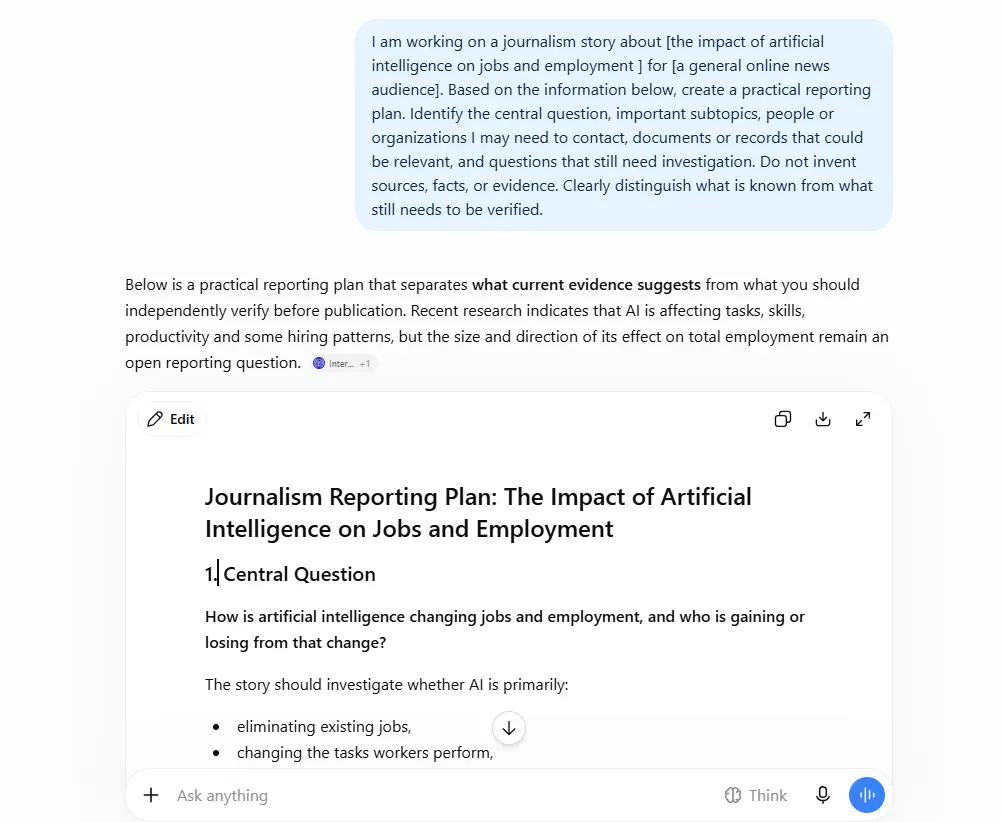
Prompt 1: Turn a Story Idea Into a Reporting Plan
Prompt:
I am working on a journalism story about [topic] for [publication/audience]. Based on the information below, create a practical reporting plan. Identify the central question, important subtopics, people or organizations I may need to contact, documents or records that could be relevant, and questions that still need investigation. Do not invent sources, facts, or evidence. Clearly distinguish what is known from what still needs to be verified.
Story information: [paste notes]
Prompt 2: Identify Reporting Gaps
Prompt:
Review the following story research and identify important information that appears to be missing. Group the gaps into categories such as facts, timeline, affected people, opposing perspectives, documents, data, and unanswered questions. Do not assume that missing information is true or false. Focus on what I may need to investigate further.
Research: [paste research]
Prompt 3: Build a Research Checklist
Prompt:
Create a reporting checklist for a journalist investigating [topic]. Include the key facts to verify, primary sources to seek, documents that may be useful, people or organizations to contact, dates and figures to confirm, and questions that should be answered before publication. Do not fabricate specific sources or records.
Prompt 4: Organize Research Notes by Theme
Prompt:
Organize these journalism research notes into clear themes. Group related facts, statements, names, dates, documents, and open questions together. Preserve the original information and do not add facts that are not present. Create a separate section for information that is unclear or requires verification.
Notes: [paste notes]
Prompt 5: Create a Story Background Brief
Prompt:
Turn the following research into a concise background brief for a journalist preparing to report on [topic]. Include the established background, important developments, key people or organizations mentioned, unresolved questions, and information that requires independent verification. Do not present assumptions as facts.
Research material: [paste material]
If your work involves finding, organizing, or presenting information, these ChatGPT prompts for Academic Research can help make the research process more structured and efficient.
Prompts for Interview Preparation
Interviews are one of the areas where preparation can make a major difference. AI can help generate question ideas, but the questions should ultimately reflect the journalist’s reporting goals and the source’s role in the story.
Prompt 6: Generate Interview Questions
Prompt:
Create a set of thoughtful interview questions for [person/source type] about [topic]. My reporting goal is [goal]. Organize the questions from broad introductory questions to specific follow-ups. Include questions that could clarify facts, timelines, decisions, motivations, and consequences. Avoid leading questions unless they are specifically appropriate to the reporting situation.
Prompt 7: Prepare Questions for an Expert
Prompt:
I am interviewing an expert about [topic] for a journalism story. Generate [number] questions that help a general audience understand the subject without oversimplifying it. Include questions about evidence, uncertainty, limitations, and practical implications. Avoid assuming that the expert agrees with a particular conclusion.
Prompt 8: Prepare Questions for an Eyewitness
Prompt:
Help me prepare neutral interview questions for an eyewitness to [event]. Focus on what the person directly saw, heard, or experienced, including time, location, sequence of events, and details that may help establish what happened. Avoid questions that suggest an answer or turn an unverified assumption into a fact.
Prompt 9: Prepare Follow-Up Questions
Prompt:
Based on the following interview notes, generate useful follow-up questions that could clarify ambiguous statements, missing details, dates, names, claims, or contradictions. Separate factual clarification questions from questions that explore broader context. Do not assume that any disputed statement is true.
Interview notes: [paste notes]
Prompt 10: Create an Interview Brief
Prompt:
Create a one-page interview preparation brief for my conversation with [source] about [topic]. Include the reporting objective, what is already known from the information provided, important questions, potential follow-ups, facts that need confirmation, and areas where the source’s perspective may be particularly relevant.
Available information: [paste information]
You can also use AI to organize your priorities and create actionable plans with these ChatGPT prompts for Goal Setting.
Prompts for Organizing Interview Transcripts
Long interviews can contain valuable details scattered across dozens of pages. ChatGPT can help organize material you provide without deciding what should automatically become part of the final story.
Prompt 11: Summarize an Interview Transcript
Prompt:
Summarize the following interview transcript for journalistic research. Organize the summary into major topics, important statements, factual details, examples, claims made by the interviewee, and unanswered questions. Do not present the interviewee’s claims as independently verified facts. Do not invent quotations.
Transcript: [paste transcript]
Prompt 12: Extract Potential Quotes
Prompt:
Review the following interview transcript and identify potentially useful quotations related to [story topic]. Preserve the wording exactly as provided and include enough surrounding context to understand each quotation. Do not rewrite quotations or create quotations that are not present in the transcript.
Transcript: [paste transcript]
Prompt 13: Organize a Transcript by Topic
Prompt:
Organize this interview transcript into sections based on recurring topics. Under each topic, list the relevant statements and indicate where the interviewee appears to provide factual claims, opinions, personal experiences, or speculation. Preserve the distinction between these categories.
Transcript: [paste transcript]
Prompt 14: Find Contradictions Within an Interview
Prompt:
Review the following interview transcript and identify statements that appear inconsistent with other statements made by the same interviewee. Quote or reference only the material provided. Explain why the statements may need clarification, but do not assume which statement is correct.
Transcript: [paste transcript]
Prompt 15: Create a Source Profile From Provided Material
Prompt:
Create a neutral source profile based only on the information provided below. Include the person’s stated role, relevant background mentioned in the material, relationship to the story, claims they make, and topics they appear qualified or positioned to discuss. Do not add credentials, affiliations, or biographical details that are not provided.
Source material: [paste information]
Prompts for Story Angles and Reporting Questions
A single event can produce several legitimate story angles. Instead of asking AI to decide what is “the best” angle automatically, use it to explore possibilities that you can evaluate as a journalist.
Prompt 16: Generate Possible Story Angles
Prompt:
I am reporting on [topic/event]. Generate several possible journalism story angles based on the information provided. For each angle, explain the central question, who would be affected, what additional reporting would be needed, and what evidence could support the story. Avoid sensationalism and do not invent facts.
Current information: [paste information]
Prompt 17: Find the Human Impact Angle
Prompt:
Review the following reporting material and identify possible human-impact angles. Focus on how the reported issue affects people, communities, workers, consumers, institutions, or other relevant groups. Distinguish documented impacts from issues that would require further reporting.
Material: [paste material]
Prompt 18: Develop a Data-Driven Story Angle
Prompt:
Based on the following information about [topic], suggest potential data-driven reporting questions. Identify what could be measured or compared, what data would be needed, and what conclusions should not be drawn without additional evidence. Do not invent statistics.
Information: [paste information]
Prompt 19: Explore the Accountability Angle
Prompt:
Help me identify potential accountability questions for a journalism story about [topic/event/organization]. Focus on decisions, responsibilities, policies, commitments, outcomes, oversight, and unanswered questions. Separate questions that can be answered from available material from those requiring additional reporting. Do not make accusations or assume wrongdoing.
Prompt 20: Identify Alternative Perspectives
Prompt:
Review the following story material and identify relevant perspectives that may be missing. Consider affected individuals, officials, organizations, independent experts, critics, supporters, and other stakeholders where appropriate. Explain why each perspective could matter to the story. Do not manufacture viewpoints or assume that every perspective is equally supported by evidence.
Story material: [paste material]
A Practical Rule for Using AI in Journalism
The safest and most useful approach is to treat AI output as working material, not automatically publishable reporting.
If ChatGPT helps you summarize notes, generate questions, organize research, or improve a draft, check the underlying material yourself before relying on the output. A polished sentence can still contain a misunderstanding, omit an important qualification, or incorrectly connect two pieces of information.
For journalists, the distinction is simple:
AI can help organize information. Reporting determines whether that information is trustworthy.
Prompts for Turning Reporting Into a Story Structure
Once the reporting is gathered, the next challenge is deciding what belongs in the story and in what order. ChatGPT can help you test structures without taking over the editorial decision.
Prompt 21: Build a Story Outline
Prompt:
Create a detailed outline for a journalism story about [topic] using the reporting material below. Identify the proposed opening, nut graf, major sections, supporting evidence, relevant source material, and possible ending. Base the outline only on the information provided and flag any section that needs additional reporting or verification.
Reporting material: [paste material]
Prompt 22: Find the Central Narrative
Prompt:
Review the following reporting notes and identify the central narrative that appears to connect the strongest verified information. Explain the main question the story could answer, the key development or tension, and the evidence supporting it. Separate established information from assumptions or unresolved issues.
Notes: [paste notes]
Prompt 23: Write a Nut Graf
Prompt:
Based only on the verified information below, draft several possible nut grafs for a journalism story about [topic]. Each version should clearly explain why the story matters and provide enough context for the reader. Do not exaggerate the significance or introduce facts that are not provided.
Verified information: [paste information]
Prompt 24: Create a Logical Story Order
Prompt:
Review these reporting notes and suggest a logical order for presenting them in a news story. Consider reader understanding, chronology, importance, evidence, and context. Explain briefly why each major section belongs where you placed it. Do not remove important qualifications or present unverified claims as facts.
Notes: [paste notes]
Prompt 25: Identify the Strongest Opening
Prompt:
Generate [number] possible openings for a journalism story based only on the reporting material provided. Explore different approaches such as a strong verified fact, scene, person-centered opening, revealing detail, or concise news lead where appropriate. Do not invent scenes, emotions, dialogue, or details that are not in the source material.
Reporting material: [paste material]
Prompts for Drafting News Stories
The quality of an AI-assisted draft depends heavily on the quality of the material you provide. Give ChatGPT verified facts and clear editorial instructions rather than asking it to fill gaps.
Prompt 26: Draft a Straight News Story
Prompt:
Using only the verified reporting below, draft a clear straight-news story for [publication/audience]. Lead with the most important verified development, provide necessary context, attribute claims appropriately, and maintain a neutral journalistic tone. Do not invent facts, quotations, sources, or background information. Flag any missing information rather than filling the gaps.
Reporting: [paste material]
Prompt 27: Draft a Feature Story
Prompt:
Turn the following verified reporting into a feature-style story for [publication/audience]. Develop a clear narrative while preserving factual accuracy and appropriate attribution. Use only scenes, observations, quotations, and details supplied in the material. Do not invent atmosphere, emotions, dialogue, or firsthand experiences.
Reporting material: [paste material]
Prompt 28: Draft a Profile
Prompt:
Draft a journalistic profile of [person] using only the supplied reporting and verified background. Focus on the person’s role in [story/topic], relevant experiences, decisions, work, and perspectives. Clearly attribute statements and avoid unsupported judgments or characterizations.
Material: [paste material]
Prompt 29: Write a News Brief
Prompt:
Turn the following verified information into a concise news brief of approximately [word count] words. Include the essential who, what, when, where, why, and how information available in the material. Remove unnecessary detail without losing important context or qualifications.
Information: [paste reporting]
Prompt 30: Turn Reporting Into a Q&A
Prompt:
Convert the following interview or reporting material into a clear Q&A format for [publication/audience]. Preserve the meaning of answers, distinguish direct quotations from paraphrases, remove unnecessary repetition, and do not invent responses. Identify any answer that needs clarification before publication.
Source material: [paste material]
Prompts for Investigative and Accountability Reporting
Investigative journalism often requires careful separation between allegations, evidence, documentation, and conclusions. AI can help organize that material, but it should not determine whether an allegation is true.
Prompt 31: Build an Accountability Timeline
Prompt:
Create a chronological timeline from the following reporting material. Include dates, events, decisions, statements, documents, and developments where provided. Mark uncertain or conflicting dates separately. Do not infer events that are not documented.
Reporting material: [paste material]
Prompt 32: Map Claims to Evidence
Prompt:
Create an evidence map for this journalism investigation. For each major claim, list the supporting document, source, quotation, data point, or other evidence provided. Identify claims that currently lack sufficient supporting material. Do not determine that an unsupported claim is true.
Claims and evidence: [paste material]
Prompt 33: Identify Questions for Officials
Prompt:
Based on the following reporting, create a focused list of questions for [official/organization/company]. Prioritize questions about decisions, dates, policies, responsibilities, evidence, inconsistencies, and unanswered issues. Keep the questions specific and fair. Do not state allegations as established facts.
Reporting: [paste material]
Prompt 34: Compare Public Statements
Prompt:
Compare the following public statements made by [person/organization] at different times. Identify changes in wording, factual claims, commitments, explanations, and areas that appear inconsistent. Quote only from the supplied material and avoid assuming why the statements changed.
Statements: [paste statements]
Prompt 35: Review an Investigation for Missing Evidence
Prompt:
Review the following investigative reporting notes and identify areas where stronger evidence, additional documentation, independent confirmation, or another source may be needed. Organize the gaps by importance and explain what kind of verification could address each gap. Do not invent evidence or sources.
Investigation notes: [paste notes]
Prompts for Fact-Checking and Verification
Fact-checking is one of the most important stages in journalism. AI can help identify statements that deserve attention, but it should not be treated as proof that a claim is accurate.
Prompt 36: Create a Fact-Checking List
Prompt:
Extract every factual claim from the following draft that should be checked before publication. Organize the claims by category, such as names, dates, numbers, locations, quotes, statistics, historical claims, descriptions, and statements attributed to sources. Do not determine whether the claims are true unless supporting evidence is provided.
Draft: [paste draft]
Prompt 37: Check Claims Against Source Material
Prompt:
Compare the following article draft with the source material provided. Identify statements in the draft that are unsupported, overstated, incomplete, or inconsistent with the source material. For each issue, quote or identify the relevant passage and explain what needs review.
Draft: [paste draft]
Source material: [paste source]
Prompt 38: Check Numbers and Statistics
Prompt:
Review the following journalism draft for numerical claims, percentages, dates, totals, rankings, measurements, and statistical statements. Create a verification checklist showing each claim and the source or calculation that should be checked. Do not correct a number unless reliable supporting information is provided.
Draft: [paste draft]
Prompt 39: Review Attribution
Prompt:
Review the following article for attribution. Identify claims that appear to need a source, statements where attribution is unclear, and places where the wording may make a source’s claim sound like an established fact. Suggest clearer attribution while preserving the reporting.
Draft: [paste draft]
Prompt 40: Check Quotations
Prompt:
Compare the quotations in this draft against the original transcript or source material. Identify any quotation that differs from the supplied wording, changes the meaning through omission, or lacks enough context. Do not rewrite quotations. Preserve the original wording when suggesting what needs correction.
Draft: [paste draft]
Original source: [paste transcript/source]
Prompts for Editing and Improving Drafts
A strong edit should make a story clearer without changing what the reporting actually establishes.
Prompt 41: Edit for Clarity
Prompt:
Edit the following journalism draft for clarity, grammar, sentence structure, and readability. Preserve all verified facts, quotations, attribution, and intended meaning. Do not add information or alter the strength of factual claims. Flag anything that appears unclear rather than guessing.
Draft: [paste draft]
Prompt 42: Remove Repetition
Prompt:
Review this journalism draft and identify repeated facts, ideas, phrases, or explanations. Suggest where repetition can be removed or consolidated while preserving necessary context. Do not remove information simply because it appears more than once if repetition is necessary for reader understanding.
Draft: [paste draft]
Prompt 43: Tighten a News Story
Prompt:
Tighten this news story while preserving the most important verified information. Remove unnecessary words, repetition, weak transitions, and redundant explanations. Maintain attribution and qualifications. Do not introduce new facts or make claims stronger than the original reporting supports.
Draft: [paste draft]
Prompt 44: Improve Story Flow
Prompt:
Review the structure and flow of this journalism draft. Identify abrupt transitions, misplaced information, unnecessary detours, weak sections, or missing context. Suggest a clearer order where appropriate, but preserve the factual reporting and original meaning.
Draft: [paste draft]
Prompt 45: Edit for a Specific Audience
Prompt:
Adapt the following journalism story for [audience/publication]. Adjust vocabulary, level of explanation, context, and sentence length to suit the intended readers while preserving the factual reporting, attribution, and editorial meaning. Do not simplify away important qualifications.
Draft: [paste draft]
Prompts for Headlines, Decks, and Story Packaging
A headline needs to attract attention while accurately representing what the story establishes. AI can generate options, but the journalist or editor should make the final decision.
Prompt 46: Generate News Headlines
Prompt:
Generate [number] accurate headline options for the following journalism story. Keep them specific, concise, and faithful to the reporting. Avoid clickbait, exaggeration, unsupported conclusions, and language that makes an allegation sound proven. Highlight the most important verified development.
Story: [paste story]
Prompt 47: Write a Headline and Deck
Prompt:
Create [number] headline-and-deck combinations for this story. The headline should communicate the central news development, while the deck should add useful context without simply repeating the headline. Stay strictly within the verified reporting.
Story: [paste story]
Prompt 48: Test Headline Accuracy
Prompt:
Review this headline against the full story. Determine whether the headline accurately reflects the reporting or whether it exaggerates, oversimplifies, omits important context, or turns an allegation into a factual conclusion. Explain the issue and suggest more accurate alternatives.
Headline: [headline]
Story: [paste story]
Prompt 49: Create SEO-Friendly Headlines
Prompt:
Generate several search-friendly headline options for this journalism story while keeping them natural and editorially accurate. Incorporate the central topic or recognizable search phrase where it fits naturally. Do not sacrifice accuracy or turn the headline into keyword-stuffed copy.
Story: [paste story]
Prompt 50: Write a Story Summary
Prompt:
Write a concise summary of this journalism story for a publication page, newsletter, or article preview. Explain what happened, why it matters, and what the story reveals using only verified information from the draft. Avoid sensational language and do not introduce new claims.
Story: [paste story]
Prompts for Explaining Complex Topics
Journalists often have to make complicated subjects understandable without distorting them. These prompts are useful when working with technical, scientific, economic, political, or specialized material.
Prompt 51: Explain a Complex Topic Simply
Prompt:
Explain [topic] in clear language for a general-news audience. Start with the basic concept, then explain the most important details, implications, and limitations. Avoid unnecessary jargon, but do not oversimplify information in a way that becomes inaccurate. Base the explanation on the following verified material:
Material: [paste material]
Prompt 52: Translate Technical Language
Prompt:
Convert the following technical explanation into plain language suitable for a general audience. Preserve the factual meaning, important qualifications, and uncertainty. Define specialized terms where necessary rather than replacing them with misleading simplifications.
Technical text: [paste text]
Prompt 53: Create a Backgrounder
Prompt:
Create a concise backgrounder on [topic] using the supplied verified information. Organize it into what the topic is, why it matters, important context, key terms, relevant developments, and unanswered questions. Do not add information beyond the material provided.
Source material: [paste material]
Prompt 54: Explain Competing Claims
Prompt:
Explain the competing claims surrounding [issue] using the material provided. For each position, identify who makes the claim, what evidence or reasoning is offered, what remains uncertain, and what information would help evaluate it. Do not present competing claims as equally supported unless the evidence indicates that.
Material: [paste material]
Prompt 55: Create a Reporter Briefing
Prompt:
Create a concise reporter briefing on [topic] using the following material. Include essential background, terminology, key developments, important people or organizations, major questions, and facts that require confirmation. Clearly distinguish verified information from claims or unresolved issues.
Material: [paste material]
Prompts for Working With Documents
Journalists may need to review reports, court documents, public statements, meeting records, policy documents, research papers, or other source material. AI can make large documents easier to navigate when the original material remains available for checking.
Prompt 56: Summarize a Long Document
Prompt:
Summarize the following document for a journalist preparing a story. Identify its purpose, main findings or arguments, important dates, named entities, significant figures, limitations, and sections that may warrant closer review. Do not add information that is absent from the document.
Document: [paste text]
Prompt 57: Find Newsworthy Details in a Document
Prompt:
Review this document and identify details that could be relevant to a journalism story. Group them into major findings, new information, notable figures, decisions, contradictions, unusual details, and unanswered questions. Do not label something as newsworthy solely because it sounds surprising; explain why it may warrant journalistic attention.
Document: [paste document]
Prompt 58: Extract Dates and Events
Prompt:
Extract every meaningful date and related event from the following document. Present them chronologically and preserve uncertainty where the source uses approximate or unclear dates. Do not infer missing dates.
Document: [paste document]
Prompt 59: Extract Names and Organizations
Prompt:
Identify the people, organizations, agencies, companies, institutions, and other named entities in the following document. For each, include the role or relationship described in the source. Do not add outside information or assume that similarly named entities are the same.
Document: [paste document]
Prompt 60: Compare Two Documents
Prompt:
Compare these two documents and identify meaningful similarities, differences, additions, omissions, changes in wording, dates, figures, responsibilities, or stated positions. Present the findings clearly and distinguish direct differences from interpretations.
Document A: [paste document]
Document B: [paste document]
Prompts for Building Stronger Reporting From Existing Material
Once you have interviews, documents, research notes, and source material, the next step is often connecting those pieces without overstating what they prove. These prompts can help you examine the material from different reporting angles while keeping verification at the center.
Prompt 61: Create a Source Comparison Matrix
Prompt:
Create a comparison matrix for the sources in the following reporting material. For each source, identify their role, relevant perspective, claims they make, evidence they provide, potential areas of expertise or direct knowledge, and questions that remain unanswered. Do not make judgments about credibility unless the supplied material provides evidence for doing so.
Source material: [paste material]
Prompt 62: Identify Primary and Secondary Sources
Prompt:
Review the following research material and classify the sources as primary, secondary, or unclear based only on the information provided. Explain briefly why each source falls into that category and identify which claims may benefit from checking the original source.
Research: [paste research]
Prompt 63: Build a Source-Claim Map
Prompt:
Create a source-claim map from this reporting material. For every major factual claim, identify which source supports it and whether the source appears to have direct knowledge, is repeating information from elsewhere, or has an unclear relationship to the claim. Do not determine whether a claim is true unless the evidence provided supports that conclusion.
Reporting material: [paste material]
Prompt 64: Identify Independent Confirmation Needs
Prompt:
Review the following reporting and identify claims that currently rely on only one source or one type of evidence. Create a list of claims that may benefit from independent confirmation and suggest what kind of additional evidence could strengthen the reporting. Do not invent specific sources.
Reporting: [paste reporting]
Prompt 65: Separate Facts, Claims, and Analysis
Prompt:
Categorize the statements in the following reporting notes as verified fact, attributed claim, opinion, interpretation, or unresolved information based only on the material provided. Flag statements that cannot be confidently categorized. Do not upgrade an attributed claim into a verified fact.
Notes: [paste notes]
Prompts for Chronology and Timeline Reporting
A clear timeline can reveal developments, inconsistencies, and unanswered questions that are difficult to see when information is scattered across notes and documents.
Prompt 66: Build a Detailed Story Timeline
Prompt:
Construct a detailed chronological timeline from the following reporting material. Include dates, events, decisions, statements, documents, and relevant developments. Where sources disagree, show the conflicting versions rather than choosing one. Do not fill missing dates with assumptions.
Material: [paste material]
Prompt 67: Identify Timeline Gaps
Prompt:
Review this timeline and identify periods where important information appears to be missing. For each gap, explain what question the missing information creates and what type of reporting or documentation might help clarify it. Do not assume what happened during the gap.
Timeline: [paste timeline]
Prompt 68: Compare Two Timelines
Prompt:
Compare these two timelines and identify differences in dates, sequence, events, or descriptions. Clearly separate factual differences from differences caused by wording or level of detail. Do not determine which timeline is correct without supporting evidence.
Timeline A: [paste timeline]
Timeline B: [paste timeline]
Prompt 69: Turn a Timeline Into a Story Framework
Prompt:
Use the following verified timeline to create a potential story framework. Identify the most significant turning points, relevant context, and unanswered questions. Suggest where additional reporting may be needed. Do not introduce events that are not present in the timeline.
Timeline: [paste timeline]
Prompt 70: Find the Most Important Turning Points
Prompt:
Review this chronology and identify the major turning points relevant to a journalism story about [topic]. For each turning point, explain what changed and why it may matter based on the supplied evidence. Avoid describing an event as a turning point unless the material supports that interpretation.
Chronology: [paste chronology]
Prompts for Data Journalism and Spreadsheet Analysis
Data can help journalists identify patterns and questions, but a pattern in a dataset does not automatically establish a cause or explain why something happened.
Prompt 71: Understand a Dataset
Prompt:
Review the following dataset description and sample data. Explain what each column appears to represent, identify missing or unclear fields, and suggest useful questions a journalist could investigate with the data. Do not infer meanings that are not supported by the provided information.
Dataset: [paste data]
Prompt 72: Identify Patterns Worth Investigating
Prompt:
Analyze the following dataset for notable patterns, changes, outliers, or differences that may warrant journalistic investigation. For each finding, explain what the data shows and what it does not establish. Do not infer causation from correlation.
Data: [paste dataset]
Prompt 73: Generate Data Reporting Questions
Prompt:
Based on this dataset about [topic], generate [number] specific reporting questions that could lead to a data-driven story. Include the data needed to answer each question and identify possible limitations of the existing dataset.
Dataset information: [paste information]
Prompt 74: Check a Data Analysis
Prompt:
Review the following data analysis for possible calculation errors, misleading comparisons, missing context, inappropriate percentages, or unsupported conclusions. Show which parts should be recalculated or independently checked. Do not invent corrected figures.
Analysis: [paste analysis]
Prompt 75: Explain Statistics for Readers
Prompt:
Explain the following statistical result in plain language for a general-news audience. Describe what the number means, what it does not mean, and any limitations or context provided by the source. Avoid turning correlation into causation or implying certainty beyond the evidence.
Statistical information: [paste information]
Prompts for Investigative Document Review
Large collections of records can contain repeated names, dates, financial figures, policy changes, and other details that become useful only after they are organized.
Prompt 76: Find Recurring Names or Entities
Prompt:
Review the following collection of documents and identify people, organizations, companies, agencies, projects, or other entities that appear repeatedly. Count or list the occurrences where possible using only the material provided, and explain what context surrounds each recurring entity.
Documents: [paste documents]
Prompt 77: Find Repeated Themes
Prompt:
Analyze the following documents for recurring themes, concerns, decisions, descriptions, or claims. Group similar material together and identify which documents contain each theme. Do not treat repetition as proof that a claim is true.
Documents: [paste documents]
Prompt 78: Find Changes Between Versions
Prompt:
Compare these versions of a document and identify substantive changes in wording, dates, figures, responsibilities, policies, commitments, or other meaningful details. Ignore purely cosmetic formatting changes unless they affect meaning.
Earlier version: [paste]
Later version: [paste]
Prompt 79: Identify Potentially Significant Omissions
Prompt:
Compare the following documents and identify information present in one version but absent from another. Separate obvious omissions from differences that may simply result from the documents serving different purposes. Do not assume that an omission indicates wrongdoing.
Documents: [paste documents]
Prompt 80: Create an Investigative Document Index
Prompt:
Create an organized index for the following collection of journalism documents. Include document title or identifier, date, type, key people or organizations, major subjects, important claims or findings, and potential relevance to the investigation. Do not invent missing metadata.
Documents: [paste documents]
Prompts for Public Records and Official Information
Public records can provide important evidence, but understanding what a record actually establishes is just as important as finding it.
Prompt 81: Summarize an Official Record
Prompt:
Summarize this official record for a journalist. Identify its purpose, date, issuing body, major decisions or findings, relevant figures, named entities, and limitations. Clearly distinguish what the record directly states from interpretations that may require additional reporting.
Record: [paste record]
Prompt 82: Extract Decisions and Commitments
Prompt:
Review the following meeting minutes, policy document, official statement, or public record. Extract decisions made, commitments announced, deadlines mentioned, responsible parties identified, and unresolved questions. Use only information directly supported by the document.
Document: [paste document]
Prompt 83: Compare Official Statements With Records
Prompt:
Compare the following official statement with the underlying record. Identify claims that are directly supported, claims that are not clearly supported, differences in wording, missing context, and questions that require further verification. Do not label a statement false unless the supplied record clearly contradicts it.
Official statement: [paste statement]
Record: [paste record]
Prompt 84: Extract Policy Changes
Prompt:
Review the following policy documents and identify changes between the previous and current versions. Focus on changes that could affect [people/program/industry/topic]. Include the original wording, new wording, effective dates if provided, and questions that require clarification.
Documents: [paste documents]
Prompt 85: Build Questions From Public Records
Prompt:
Generate focused reporting questions based on the following public records. Prioritize unexplained decisions, missing information, conflicting statements, changes over time, financial figures, timelines, and commitments that may warrant follow-up. Do not assume wrongdoing or invent allegations.
Records: [paste records]
Prompts for Journalism Ethics and Fairness Checks
AI can help identify places where a draft deserves closer editorial attention, particularly around attribution, framing, privacy, and potentially misleading wording.
Prompt 86: Review a Story for Loaded Language
Prompt:
Review this journalism draft for loaded, emotional, judgmental, or unnecessarily inflammatory language. Identify the wording and explain how it could influence reader perception. Suggest more precise alternatives that preserve the factual meaning without artificially neutralizing legitimate criticism or evidence.
Draft: [paste draft]
Prompt 87: Check for Unfair Framing
Prompt:
Review the following story for possible framing issues. Identify places where the selection or ordering of information could create a misleading impression, where relevant context is missing, or where one perspective receives substantially more treatment without an apparent editorial reason. Base your observations only on the supplied story.
Draft: [paste story]
Prompt 88: Review Allegation Language
Prompt:
Review this story for allegations or accusations. Identify places where allegations may be presented too strongly, where attribution is unclear, or where the wording could make an unproven claim appear established. Suggest precise alternatives that preserve the reporting and clearly identify who is making each allegation.
Draft: [paste draft]
Prompt 89: Identify Potential Privacy Concerns
Prompt:
Review the following journalism draft for potentially sensitive personal information. Identify details that may require editorial consideration before publication, such as unnecessary identifying information, private details, or information about vulnerable individuals. Do not make a legal determination. Focus on whether each detail appears necessary to the story based on the supplied context.
Draft: [paste draft]
Prompt 90: Check for Missing Context
Prompt:
Review this story and identify context that a reasonable reader may need to understand the reported issue accurately. Focus on definitions, relevant history, timeline, numbers, competing explanations, limitations, and important qualifications. Do not add unrelated background simply to make the article longer.
Draft: [paste draft]
Prompts for Opinion, Analysis, and Commentary
Journalistic analysis and opinion require a clear distinction between factual reporting and interpretation. These prompts can help structure that distinction.
Prompt 91: Separate Reporting From Analysis
Prompt:
Review the following draft and divide its content into factual reporting, attributed statements, analysis, interpretation, and opinion. Identify places where interpretation is presented too much like established fact. Suggest wording that makes the distinction clearer without weakening supported analysis.
Draft: [paste draft]
Prompt 92: Build an Analysis Framework
Prompt:
Create an analytical framework for a journalism piece about [topic] using the verified information below. Identify the established facts, competing explanations, important trends, uncertainties, and reasonable questions for analysis. Do not present speculation as fact.
Material: [paste material]
Prompt 93: Challenge the Argument
Prompt:
Act as a critical editorial reviewer of the following argument. Identify assumptions, unsupported conclusions, missing evidence, counterarguments, logical gaps, and places where the evidence does not fully support the conclusion. Do not invent counterevidence.
Argument: [paste argument]
Prompt 94: Identify Counterarguments
Prompt:
Identify the strongest reasonable counterarguments to the position expressed in the following commentary. Base them on the information provided and clearly distinguish factual objections from matters of interpretation or opinion. Do not create a weak opposing position simply to make the original argument appear stronger.
Commentary: [paste commentary]
Prompt 95: Strengthen an Analysis Draft
Prompt:
Review this analysis draft and suggest improvements to its reasoning, evidence, structure, transitions, and distinction between fact and interpretation. Preserve the author’s actual position and do not add unsupported evidence or conclusions.
Draft: [paste draft]
ChatGPT can make content creation easier by helping you develop ideas, organize your thoughts, and create engaging drafts. If you want more practical ideas, explore our ChatGPT prompts for social media marketing.
Prompts for Multimedia Journalism
Modern journalism may involve text, photographs, video, audio, graphics, newsletters, and social platforms. AI can help plan how the same verified reporting might work across formats.
Prompt 96: Create a Multimedia Story Plan
Prompt:
Create a multimedia journalism plan for a story about [topic]. Based on the reporting material below, suggest appropriate roles for written text, photographs, video, audio, graphics, timelines, maps, or other formats. Explain what each format could add without recommending visuals that would require invented or unavailable material.
Reporting: [paste material]
Prompt 97: Create Video Interview Questions
Prompt:
Create a concise set of questions for a filmed interview with [source] about [topic]. Prioritize questions that produce clear, useful answers for a general audience. Include possible follow-ups and avoid leading questions unless the reporting purpose requires them.
Interview context: [paste context]
Prompt 98: Write a Video Script From Verified Reporting
Prompt:
Turn the following verified reporting into a short journalism video script of approximately [duration]. Include narration, suggested transitions, on-screen text, and places where supplied interview clips or visuals could be used. Do not invent footage, quotations, scenes, or facts.
Reporting: [paste material]
Prompt 99: Create a Newsletter Version
Prompt:
Adapt this reported story into a concise newsletter item for [audience]. Highlight the central development, explain why it matters, and include only the most useful supporting context. Preserve attribution and factual qualifications. Do not introduce new information.
Story: [paste story]
Prompt 100: Create Social Posts From a Reported Story
Prompt:
Create platform-specific social media copy based only on this published or verified journalism story. For each post, provide a concise summary, an appropriate hook, and a way to direct readers toward the full story. Do not exaggerate the findings, remove important context, or turn allegations into facts.
Story: [paste story]
If you want to turn your ideas into engaging social media content, these ChatGPT prompts for Instagram posts and captions can help you create content more efficiently.
Prompts for Journalists Working With Audio and Transcripts
Audio interviews, press conferences, podcasts, public meetings, and recorded events can contain more information than is practical to review repeatedly. AI can help organize transcripts and identify material worth revisiting, while the original recording remains the source of truth for quotations and context.
Prompt 101: Clean Up a Transcript for Review
Prompt:
Clean up the following transcript for easier journalistic review. Remove obvious filler words, repeated fragments, and transcription errors where the intended wording is clear. Do not change the meaning, add words, or silently rewrite substantive statements. Mark anything that is unclear rather than guessing.
Transcript: [paste transcript]
Prompt 102: Identify Important Moments in Audio
Prompt:
Review this transcript and identify sections that may deserve closer review by a journalist. Look for important factual claims, significant announcements, notable statements, changes in position, unanswered questions, contradictions, and potentially useful quotations. Include the relevant passage and explain why it may warrant attention.
Transcript: [paste transcript]
Prompt 103: Create a Press Conference Brief
Prompt:
Summarize this press conference transcript into a journalist’s briefing. Include major announcements, important claims, questions asked, answers provided, notable quotations, unresolved issues, and statements that require independent verification. Do not treat a speaker’s claims as independently established facts.
Transcript: [paste transcript]
Prompt 104: Extract Reporter Follow-Ups From Audio
Prompt:
Review the following transcript and create a list of follow-up reporting questions. Focus on unclear claims, missing evidence, unexplained figures, unanswered questions, contradictions, and statements that would benefit from independent confirmation. Do not assume that any claim is true simply because it was stated.
Transcript: [paste transcript]
Prompt 105: Compare Two Interview Transcripts
Prompt:
Compare these two interview transcripts about [topic]. Identify areas of agreement, disagreement, different accounts of events, conflicting dates or figures, and questions that require additional reporting. Preserve the distinction between what each person claims and what has been independently established.
Transcript A: [paste transcript]
Transcript B: [paste transcript]
Prompts for Local and Community Journalism
Local reporting often depends on understanding how a broader issue affects a particular place or community. These prompts can help organize community-focused reporting without inventing local perspectives.
Prompt 106: Develop Community Reporting Questions
Prompt:
I am reporting on [issue] in [community/location]. Based on the information below, generate focused reporting questions about local impact, affected groups, public services, businesses, residents, decision-makers, and community response. Distinguish questions that can be answered from the supplied material from those requiring additional reporting.
Current information: [paste information]
Prompt 107: Identify Local Stakeholders
Prompt:
Review the following reporting material and identify categories of local stakeholders who may have relevant knowledge or perspectives about [topic]. For each category, explain what they may be able to contribute to the reporting. Do not invent names or assume that a particular person represents an entire community.
Material: [paste material]
Prompt 108: Create a Community Story Outline
Prompt:
Create a story outline focused on how [issue] affects [community/location]. Use the supplied reporting to identify the central local question, key evidence, affected groups, relevant context, and unanswered questions. Do not invent community reactions or experiences.
Reporting: [paste reporting]
Prompt 109: Identify Local Data Questions
Prompt:
Generate specific data-reporting questions about [topic] in [location]. Identify what local data would be useful, possible comparisons, relevant time periods, and limitations to consider. Do not invent local statistics or assume that national trends apply locally.
Topic and available data: [paste information]
Prompt 110: Find the Local Angle in a National Story
Prompt:
Review this national or international story and identify potential questions for reporting its local relevance in [location]. Separate what is already established from what would require local reporting, interviews, records, or data. Do not assume that the local impact is identical to the broader trend.
Story: [paste story]
Entrepreneurs can also use AI to explore new opportunities and develop practical concepts with these ChatGPT prompts for Generating Business Ideas.
Prompts for Breaking News Workflows
Breaking news requires speed, but speed should not replace verification. These prompts are useful for organizing developing information while making uncertainty visible.
Prompt 111: Create a Breaking News Checklist
Prompt:
Create a breaking-news reporting checklist for [event]. Include the essential facts to confirm, sources to contact, details to verify, questions to answer, updates to monitor, and information that should not be published until independently confirmed. Keep the checklist practical for a fast-moving newsroom environment.
Prompt 112: Separate Confirmed and Unconfirmed Information
Prompt:
Organize the following breaking-news information into three categories: confirmed, attributed but unconfirmed, and unclear/needs verification. Explain why each item belongs in its category based only on the material provided. Do not upgrade an unverified claim to confirmed information.
Information: [paste updates]
Prompt 113: Create a Live Update Structure
Prompt:
Create a clear structure for live updates covering [event]. Suggest how to organize confirmed developments, timestamps, official statements, eyewitness information, corrections, and important context. Make it clear how unverified information should be labeled or withheld until confirmed.
Prompt 114: Draft a Breaking News Update
Prompt:
Draft a concise breaking-news update using only the confirmed information below. Clearly attribute statements and identify what remains unknown. Avoid speculation, dramatic language, and unsupported conclusions. If an important detail is missing, leave a placeholder or flag it rather than inventing one.
Confirmed information: [paste information]
Prompt 115: Prepare a Breaking News Correction
Prompt:
Draft a clear correction for the following previously published error. State what was incorrect, provide the corrected information, and avoid unnecessary explanation or defensiveness. Use only the verified correction details supplied below.
Original error: [describe]
Correct information: [provide]
Prompts for Newsroom Productivity
Journalists frequently manage multiple assignments at different stages. AI can help turn scattered tasks into an organized workflow.
Prompt 116: Prioritize Reporting Tasks
Prompt:
Organize the following journalism tasks into a practical priority list. Consider deadline, reporting importance, dependencies, verification requirements, and potential consequences of delay. Do not remove tasks unless you clearly identify them as optional.
Task list: [paste tasks]
Prompt 117: Create a Daily Reporting Plan
Prompt:
Create a realistic daily work plan for a journalist handling these assignments: [assignments]. Include reporting, interviews, research, writing, editing, fact-checking, communication, and deadline buffers where appropriate. Prioritize tasks without assuming that every assignment has the same urgency.
Prompt 118: Create an Assignment Tracker
Prompt:
Create a simple assignment-tracking system for a journalist managing multiple stories. Include fields for story title, editor, deadline, reporting status, sources contacted, documents needed, interviews completed, verification status, draft status, and next action. Make it easy to copy into a spreadsheet.
Prompt 119: Organize an Editorial Meeting
Prompt:
Create an editorial meeting agenda for a newsroom covering [topics/beat]. Include story pitches, developing stories, reporting needs, deadlines, verification concerns, follow-ups, and decisions that require editorial attention. Keep the agenda focused and practical.
Prompt 120: Create a Story Handoff Brief
Prompt:
Create a concise handoff brief for another journalist taking over this story. Include the story angle, confirmed facts, sources contacted, interviews completed, documents reviewed, outstanding questions, verification issues, deadline, and next recommended reporting steps. Do not add information that is not provided.
Story information: [paste notes]
Professionals looking to streamline repetitive tasks can find more useful ideas in these ChatGPT prompts for Professionals, designed to support productivity across different types of work.
Prompts for Journalism Research Management
A reporter may collect information from dozens of places before writing a story. A consistent research structure can make it easier to return to the evidence later.
Prompt 121: Create a Research Database Structure
Prompt:
Design a practical research database structure for a journalist covering [beat/topic]. Suggest useful fields for sources, documents, dates, claims, contacts, story ideas, verification status, and follow-up actions. Keep the structure simple enough to maintain regularly.
Prompt 122: Create a Source Contact Log
Prompt:
Create a source-contact log template for a journalism assignment. Include fields for source name or identifier, role, contact date, method, subject discussed, response status, follow-up needed, relevant documents, and verification notes. Include privacy-conscious options for sensitive reporting.
Prompt 123: Organize Story Research by Evidence Type
Prompt:
Organize the following research into categories such as interviews, public records, official statements, documents, data, observations, background research, and unresolved claims. Preserve source attribution and identify material that requires verification.
Research: [paste research]
Prompt 124: Create a Verification Tracker
Prompt:
Build a verification tracker for the following journalism story. For each major factual claim, include the claim, current supporting source, verification status, additional confirmation needed, responsible person, and notes. Do not mark a claim as verified unless the supplied information supports that status.
Story material: [paste material]
Prompt 125: Create a Research Handoff System
Prompt:
Design a handoff format that allows one journalist to transfer research to another without losing context. Include sections for story purpose, key facts, sources, documents, timeline, verified claims, unresolved questions, contacts, and next steps.
Prompts for Long-Form and Feature Journalism
Long-form stories require structure without losing the human and factual details that make the reporting meaningful.
Prompt 126: Plan a Long-Form Narrative
Prompt:
Create a structure for a long-form journalism story about [topic] using the reporting below. Identify the central narrative, major sections, possible transitions, supporting characters or sources, key evidence, and points where additional context should be introduced. Use only documented material and do not invent scenes.
Reporting: [paste reporting]
Prompt 127: Find Narrative Threads
Prompt:
Review these reporting notes and identify the strongest narrative threads connecting the material. For each thread, explain the central question, supporting evidence, relevant sources, and unanswered questions. Do not create connections that are not supported by the reporting.
Notes: [paste notes]
Prompt 128: Organize a Character-Based Story
Prompt:
Help organize a character-centered journalism story using the supplied reporting about [person/community]. Identify relevant background, scenes or events actually documented, quotations, conflicts, decisions, and broader context. Do not invent emotions, dialogue, motivations, or experiences.
Reporting: [paste material]
Prompt 129: Balance Narrative With Context
Prompt:
Review this long-form draft and identify places where narrative material may need additional factual context, and places where background information may interrupt the narrative unnecessarily. Suggest ways to balance storytelling with evidence while preserving the reporting.
Draft: [paste draft]
Prompt 130: Strengthen a Feature Ending
Prompt:
Suggest several possible endings for this feature story using only the reporting provided. Consider a relevant verified detail, quotation, unresolved question, return to an earlier theme, or meaningful development. Do not manufacture a scene or create a dramatic conclusion that the reporting does not support.
Story: [paste story]
Prompts for Journalism Copy Editing
Small changes in wording can affect accuracy, tone, and reader understanding. These prompts are useful for a final editorial pass.
Prompt 131: Check Grammar Without Changing Meaning
Prompt:
Proofread this journalism draft for grammar, punctuation, spelling, sentence structure, and obvious typographical errors. Preserve the factual meaning, quotations, attribution, and editorial voice. Do not rewrite substantive claims or add information.
Draft: [paste draft]
Prompt 132: Check for Ambiguous Wording
Prompt:
Identify sentences in this journalism draft that could reasonably be interpreted in more than one way. Explain the ambiguity and suggest clearer wording that preserves the intended factual meaning.
Draft: [paste draft]
Prompt 133: Review Passive Voice Where It Matters
Prompt:
Review this journalism draft for passive constructions that obscure who performed an action or make responsibility unclear. Identify only cases where active wording would improve clarity or accountability. Do not change passive voice when the actor is genuinely unknown or when the construction is more accurate.
Draft: [paste draft]
Prompt 134: Check Consistency
Prompt:
Review this article for internal consistency in names, titles, dates, locations, numbers, terminology, capitalization, and descriptions. List any inconsistencies and identify the relevant passages. Do not choose the correct version unless the supplied material provides enough evidence.
Draft: [paste draft]
Prompt 135: Perform a Final Copy Edit
Prompt:
Perform a final copy-editing review of this journalism story. Check grammar, spelling, punctuation, clarity, repetition, attribution, internal consistency, transitions, and obvious factual red flags. Separate language edits from issues that require reporting or fact-checking. Do not invent corrections.
Draft: [paste draft]
Prompts for Journalism Education and Training
Editors, journalism instructors, and experienced reporters can use AI to create exercises that teach reporting skills without encouraging shortcuts around verification.
Prompt 136: Create a Reporting Exercise
Prompt:
Create a journalism training exercise about [topic/skill] for [beginner/intermediate/advanced] reporters. Include the assignment, reporting objectives, source material or scenario, questions to investigate, and criteria for evaluating the work. Do not require fabricated reporting or firsthand experiences.
Prompt 137: Analyze a Published Story Structure
Prompt:
Analyze the structure of the following journalism article. Identify the lead, nut graf, major sections, transitions, evidence, attribution, context, and ending. Focus on structure and reporting technique rather than judging the publication’s editorial position.
Article: [paste article]
Prompt 138: Create a Fact-Checking Exercise
Prompt:
Create a journalism fact-checking exercise using the following draft. Identify factual claims that a trainee should verify and provide a checklist of what evidence they would need to confirm each claim. Do not reveal unsupported corrections unless the supporting evidence is included.
Draft: [paste draft]
Prompt 139: Create an Interview Practice Exercise
Prompt:
Create an interview practice scenario for a journalism student or trainee covering [topic]. Provide the source’s role, reporting objective, background information, and realistic complications that require follow-up questions. Do not provide fabricated real-world credentials or claim that the scenario represents an actual person.
Prompt 140: Review a Journalism Assignment
Prompt:
Review the following journalism assignment or reporting plan. Assess whether the reporting objective is clear, whether the questions are specific, whether relevant perspectives are considered, and whether the verification plan is sufficient. Identify practical improvements without inventing additional facts.
Assignment: [paste assignment]
Prompts for Translating and Adapting Journalism Content
Journalists working across languages need to preserve meaning, attribution, tone, and uncertainty rather than simply replacing individual words.
Prompt 141: Translate a Reported Story
Prompt:
Translate the following journalism story from [source language] into [target language]. Preserve factual meaning, names, dates, quotations, attribution, uncertainty, and editorial tone. Do not add explanations or alter claims. Flag any phrase whose meaning is genuinely ambiguous rather than guessing.
Story: [paste story]
Prompt 142: Adapt a Story for a New Audience
Prompt:
Adapt this journalism story for [audience] while preserving the original reporting. Adjust explanations, terminology, context, and sentence structure to improve accessibility. Do not remove qualifications or introduce information that is not in the original.
Story: [paste story]
Prompt 143: Create a Plain-Language Version
Prompt:
Rewrite this journalism article in plain language for readers who may not be familiar with the subject. Preserve all important facts, qualifications, attribution, and uncertainty. Explain specialized terms rather than replacing them with inaccurate simplifications.
Article: [paste article]
Prompt 144: Create a Bilingual Glossary
Prompt:
Create a bilingual glossary of important terms from this journalism story. For each term, provide the original term, translation, plain-language explanation, and any context needed to use it accurately. Do not introduce terminology that is not relevant to the story.
Story: [paste story]
Prompt 145: Review a Translation for Accuracy
Prompt:
Compare the original journalism text with its translation. Identify omissions, additions, mistranslations, changes in tone, altered attribution, or wording that changes the degree of certainty. Suggest corrections while preserving the original meaning.
Original: [paste original]
Translation: [paste translation]
If you are building an online presence, these ChatGPT prompts for Building a Website can help you plan website content, structure pages, and develop useful ideas more efficiently.
Prompts for Investigative Journalism and Accountability Reporting
Investigative reporting often involves large amounts of documentation, competing accounts, complex timelines, and claims that require careful verification. AI can help organize this material, but journalists should continue to make independent editorial and reporting judgments.
Prompt 146: Build an Investigative Reporting Plan
Prompt:
Create a structured investigative reporting plan for [topic] based on the information below. Identify the central reporting question, known facts, major claims, potential evidence, people or organizations whose perspectives may be relevant, documents to seek, unanswered questions, and verification steps. Clearly distinguish established information from allegations or assumptions.
Background: [paste information]
Prompt 147: Map a Complex Story
Prompt:
Create a reporting map for this complex story. Organize the material into people, organizations, events, documents, claims, relationships, dates, and unresolved questions. Preserve source attribution and identify connections that require additional reporting rather than treating them as established facts.
Research: [paste research]
Prompt 148: Identify Accountability Questions
Prompt:
Review the following reporting material and generate focused accountability questions. Consider decisions made, responsibilities, policies, public statements, available evidence, consequences, and unanswered questions. Avoid assuming wrongdoing where the supplied material does not establish it.
Material: [paste reporting]
Prompt 149: Examine Conflicting Accounts
Prompt:
Compare the following accounts of [event or issue]. Create a structured analysis showing what each source says, where the accounts agree, where they differ, what evidence supports each claim, and what additional reporting could help resolve the differences. Do not decide which account is correct without sufficient evidence.
Accounts: [paste accounts]
Prompt 150: Create an Investigative Evidence Matrix
Prompt:
Create an evidence matrix for this investigation. For each major claim, list the supporting evidence, source, date, reliability considerations based on the supplied information, contradictory evidence if any, and verification still needed. Do not assign certainty beyond what the evidence supports.
Investigation material: [paste material]
Prompts for Data Journalism and Document Analysis
Data and documents can reveal patterns that are difficult to identify manually. AI is useful for organizing information and suggesting questions, but calculations, source documents, and underlying datasets should be independently checked.
Prompt 151: Analyze a Dataset for Reporting Questions
Prompt:
Review the following dataset description or data and suggest journalism questions worth investigating. Identify notable patterns, comparisons, changes over time, missing information, possible anomalies, and questions that require further verification. Do not claim that a pattern proves causation.
Data: [paste data]
Prompt 152: Create a Data Reporting Checklist
Prompt:
Create a checklist for reporting a story based on [dataset/report/statistical release]. Include checks for definitions, methodology, sample or population, time period, missing data, calculations, comparisons, source documentation, and limitations. Make the checklist appropriate for a journalist rather than a statistician.
Prompt 153: Explain a Statistical Finding
Prompt:
Explain the following statistical finding in clear language suitable for a general news audience. Preserve the exact meaning and important qualifications. Distinguish correlation from causation and identify any context a journalist should verify before publication.
Finding: [paste finding]
Prompt 154: Turn Data Into Interview Questions
Prompt:
Review these data findings and create specific interview questions for [official, researcher, organization, expert, or affected stakeholder]. Connect each question to a particular finding or uncertainty rather than asking generic questions.
Data findings: [paste findings]
Prompt 155: Identify Data Limitations
Prompt:
Review the following dataset or statistical report and identify limitations that could affect how a journalist should interpret or describe the findings. Focus on methodology, definitions, missing data, time periods, comparisons, sample limitations, and other issues explicitly supported by the material.
Source: [paste report/data]
Prompts for Editorial Review and Publication Readiness
Before publication, a strong editorial review should distinguish between writing problems and reporting problems. These prompts can help create that separation.
Prompt 156: Conduct a Pre-Publication Review
Prompt:
Review this journalism draft before publication. Divide your findings into writing issues, factual questions, attribution issues, missing context, verification needs, legal or ethical concerns requiring human/editorial review, and unresolved reporting questions. Do not make legal conclusions or invent missing facts.
Draft: [paste article]
Prompt 157: Check Attribution
Prompt:
Review this article for attribution. Identify claims that appear to require attribution, quotations that need clear sourcing, statements that may sound like established facts but are actually someone’s claims, and places where attribution could be clearer. Do not add sources that are not provided.
Article: [paste article]
Prompt 158: Review the Lead
Prompt:
Review the lead of this journalism story for clarity, accuracy, relevance, and reader understanding. Explain whether it accurately represents the strongest verified information in the story and suggest improvements without exaggerating the significance of the reporting.
Lead and story: [paste text]
Prompt 159: Check for Missing Context
Prompt:
Review this article and identify context that a reasonable reader may need to understand the story accurately. Focus on definitions, relevant background, chronology, affected parties, important qualifications, and information necessary to avoid a misleading impression. Do not add unrelated background.
Article: [paste article]
Prompt 160: Create a Publication Readiness Checklist
Prompt:
Create a final publication-readiness checklist for this journalism story. Include checks for factual verification, attribution, quotations, names, dates, numbers, links or source documents, fairness, context, privacy, corrections, headlines, captions, and unresolved reporting questions. Make clear which items require human editorial judgment.
Story: [paste story]
When you face a complex task, AI can also help you break the problem into manageable steps using these ChatGPT prompts for Problem Solving.
For everyday writing tasks, you can save time by using these ChatGPT prompts for Text Editing to improve clarity, structure, and overall readability.
Prompts for Headlines, Captions, and News Packaging
The headline and supporting elements should accurately represent the reporting rather than exaggerate it.
Prompt 161: Generate Accurate Headlines
Prompt:
Generate [number] accurate headline options for this journalism story. Prioritize clarity and the most important verified development. Do not exaggerate, imply certainty that the reporting does not support, or introduce information that is absent from the story.
Story: [paste story]
Prompt 162: Write a News Deck
Prompt:
Write [number] concise news-deck options to accompany this headline: [headline]. Each should add useful context without repeating the headline or introducing unsupported claims.
Story context: [paste context]
Prompt 163: Create a Photo Caption
Prompt:
Write an accurate journalism photo caption using only the verified information provided. Include who or what is shown, what is happening, where and when it occurred if known, and relevant context. Do not identify people or infer details that are not confirmed.
Photo information: [paste details]
Prompt 164: Create Social Headlines From a News Story
Prompt:
Create [number] social-media headline options for this journalism story. Keep them accurate, specific, and suitable for [platform]. Do not use clickbait, exaggeration, or claims that go beyond the reporting.
Story: [paste story]
Prompt 165: Write a Search-Friendly News Headline
Prompt:
Create several search-friendly headline options for this news story. Include the most important identifiable topic, person, organization, location, or event when relevant. Keep the wording natural and accurate rather than forcing keywords into the headline.
Story: [paste story]
Prompts for Source Interviews and Expert Conversations
Good interviews depend on preparation and thoughtful follow-ups rather than simply producing a long list of questions.
Prompt 166: Build an Interview Question Set
Prompt:
Create a focused interview question set for [source role] about [topic]. Begin with broad questions and progress toward specific factual issues, evidence, decisions, contradictions, and unresolved points. Avoid leading questions unless there is a clear reporting reason to use them.
Background: [paste background]
Prompt 167: Generate Follow-Up Questions
Prompt:
Based on this interview transcript, generate follow-up questions that would help clarify incomplete answers, unsupported claims, contradictions, important details, and unanswered issues. Reference the relevant statement when useful.
Transcript: [paste transcript]
Prompt 168: Prepare Questions for a Public Official
Prompt:
Prepare specific questions for [official/agency] about [issue] using the information below. Focus on decisions, timelines, responsibilities, evidence, public statements, policies, and unresolved questions. Avoid assuming misconduct unless supported by the reporting.
Reporting: [paste information]
Prompt 169: Prepare Questions for an Expert
Prompt:
Create interview questions for an expert about [topic]. Separate questions about established evidence, interpretation, limitations, uncertainty, and practical implications. Avoid asking the expert to confirm a conclusion that the reporting has not established.
Background: [paste background]
Prompt 170: Turn Research Into Interview Preparation
Prompt:
Turn the following research into an interview preparation brief. Include what is known, what is uncertain, key questions, possible follow-ups, documents or evidence to ask about, and details that should be independently checked after the interview.
Research: [paste research]
Prompts for Journalism Ethics and Responsible AI Use
AI can assist with journalism workflows, but it should not replace verification, editorial judgment, source protection, or ethical decision-making.
Prompt 171: Review an AI-Assisted Reporting Workflow
Prompt:
Review this proposed AI-assisted journalism workflow and identify points where human verification, editorial judgment, source protection, privacy review, or additional reporting should occur. Focus on practical safeguards rather than assuming that AI output is accurate.
Workflow: [paste workflow]
Prompt 172: Identify Potential Privacy Concerns
Prompt:
Review the following reporting workflow for potential privacy and confidentiality concerns. Identify information that may be sensitive, unnecessary to share with an AI system, or in need of additional protection. Do not provide legal conclusions; flag issues for appropriate editorial, legal, or organizational review.
Workflow: [paste workflow]
Prompt 173: Create an AI Verification Checklist
Prompt:
Create a verification checklist for journalism content produced or assisted by AI. Include checks for factual claims, quotations, names, dates, statistics, citations, source attribution, context, fabricated details, and unsupported conclusions. Make the checklist practical for a newsroom workflow.
Prompt 174: Review AI-Generated Reporting Notes
Prompt:
Review these AI-generated reporting notes and identify statements that may be assumptions, unsupported interpretations, possible hallucinations, or claims requiring verification. Separate them from information directly supported by the supplied source material.
Notes: [paste notes]
Prompt 175: Create an Editorial AI Use Policy Outline
Prompt:
Create an outline for an internal newsroom policy covering responsible use of generative AI in journalism. Include acceptable uses, prohibited or restricted uses, verification requirements, privacy and confidential-source considerations, disclosure practices, human oversight, corrections, and staff training. Keep the policy adaptable to the organization’s own legal and editorial requirements.
When you need fresh content ideas, ChatGPT can help you brainstorm topics, organize your thoughts, and develop useful material with these ChatGPT prompts for Food Bloggers.
Prompts for Building a Personal Journalism Knowledge System
Journalists often develop specialized knowledge over years of reporting. A structured system can make previous research easier to find and reuse without treating old information as automatically current.
Prompt 176: Build a Beat Knowledge Base
Prompt:
Design a knowledge-base structure for a journalist covering [beat]. Include categories for key people and organizations, recurring issues, background documents, timelines, previous stories, terminology, data sources, story ideas, and verification notes. Include a simple system for identifying information that may need updating.
Prompt 177: Organize Previous Reporting
Prompt:
Organize the following previous reporting into a searchable reference system. Group related material by topic, person, organization, event, date, document, and potential follow-up story. Preserve source information and flag details that may have become outdated.
Previous reporting: [paste material]
Prompt 178: Generate Follow-Up Story Ideas
Prompt:
Review these previous stories and reporting notes and generate specific follow-up story ideas. Focus on unanswered questions, developments that may warrant checking, unresolved issues, new reporting opportunities, and useful local or public-interest angles. Do not assume that an old issue is still current without verification.
Previous reporting: [paste material]
Prompt 179: Create a Source Background Brief
Prompt:
Create a concise background brief from the supplied verified material about [person/organization]. Include role, relevant history, statements or actions directly documented in the material, previous coverage, and questions that may be useful for future reporting. Do not add biographical information that is not provided.
Material: [paste information]
Prompt 180: Build a Story Idea Database
Prompt:
Create a practical database structure for storing journalism story ideas. Include fields for idea, central question, public-interest relevance, reporting needed, potential sources, documents or data, deadline or timeliness, current status, related stories, and next action. Keep the system simple enough for regular newsroom use.
How to Get Better Results From Journalism Prompts
The quality of an AI response depends heavily on the quality and clarity of the material you provide. A vague request can produce a generic result, while a focused prompt gives the model a clearer reporting task.
A useful workflow is:
Source material → specific task → constraints → structured output → human verification
For example, instead of asking:
“Summarize this interview.”
you can specify what you actually need:
“Summarize this interview into major claims, notable quotations, unanswered questions, and statements that require independent verification. Preserve attribution and do not treat the interviewee’s claims as established facts.”
That small change gives the AI a defined journalistic purpose.
Give the AI the Right Context
When appropriate, include:
- The story topic
- Your reporting goal
- The intended audience
- Relevant background
- Source material
- Required output format
- Important limitations
- What the AI should not assume
You do not need to provide every detail. Give enough context for the task without overwhelming the prompt with irrelevant information.
Separate Reporting From Writing
One of the most useful habits is to avoid asking AI to simultaneously discover facts, decide what is true, and write the final article.
A safer workflow is:
- Gather and verify information.
- Organize the material with AI if useful.
- Identify unanswered questions.
- Verify important claims against original sources.
- Draft the story.
- Perform a separate fact-check and editorial review.
This keeps AI in a supporting role rather than treating it as the reporting authority.
Use Original Sources for Verification
If an AI response contains a name, quotation, statistic, date, study finding, or other important factual detail, check it against the original source before publication.
This is particularly important when working with:
- Interview transcripts
- Court or government documents
- Research papers
- Statistical reports
- Historical information
- Public records
- Breaking news
- Complex technical subjects
An organized AI response can look convincing even when an underlying detail is incomplete or incorrect.
Protect Sensitive Reporting Information
Journalists may handle confidential sources, unpublished documents, personal information, or sensitive investigation material. Before putting such information into any AI system, follow your newsroom’s policies and applicable privacy and confidentiality requirements.
When possible, remove unnecessary identifying information and use placeholders such as [SOURCE], [ORGANIZATION], or [DOCUMENT] when the identity is not necessary for the task.
A Practical Journalism Prompt Formula
For recurring work, you can build your own prompts using this structure:
Role + Reporting Task + Context + Source Material + Constraints + Output Format
For example:
Act as a reporting assistant. Review the following interview transcript about [topic]. Identify the interviewee’s major factual claims, notable quotations, unanswered questions, and statements requiring independent verification. Preserve attribution, do not assume claims are true, and present the results in a table with columns for claim, source passage, verification status, and follow-up question.
The goal is not to make every prompt longer. The goal is to give AI enough direction to perform the specific task you actually need.
FREE AI TOOLS
Visit Our Free AI tools
Prompts AI Hub Team Has Tailored Their AI Knowledge and Created Tools for You Free of Cost, Enjoy
Frequently Asked Questions
Can journalists use ChatGPT for reporting?
Yes. ChatGPT can assist with tasks such as organizing notes, preparing interview questions, summarizing supplied documents, brainstorming reporting questions, restructuring drafts, and identifying material that may need verification. It should not be treated as an independent source of truth.
Can ChatGPT write a news article?
It can help draft or structure an article from information you provide, but the journalist remains responsible for reporting, verification, attribution, accuracy, context, and editorial judgment. AI-generated details should not be assumed to be factual simply because they appear plausible.
How can journalists use ChatGPT for interviews?
Journalists can use it to prepare question sets, develop follow-up questions, organize background research, summarize transcripts, and identify unanswered issues. Providing the reporting objective and relevant context generally produces more useful interview preparation than asking for generic questions.
Can ChatGPT summarize interview transcripts?
Yes. It can organize a supplied transcript into themes, claims, quotations, unanswered questions, or other categories. However, journalists should check important quotations and details against the original recording or transcript before publication.
Can ChatGPT help with fact-checking?
It can help identify claims that appear to require verification and create fact-checking checklists. It should not be considered the final fact-checking authority. Important claims should be checked against reliable primary or authoritative sources.
Should journalists put confidential sources into ChatGPT?
Journalists should follow their newsroom’s confidentiality, privacy, security, and AI-use policies before entering sensitive information into an AI system. If identifying information is unnecessary for the task, removing or replacing it with a placeholder can reduce unnecessary exposure.
What is the best way to prompt ChatGPT as a journalist?
Be specific about the reporting task, provide relevant context and source material, define the desired output, and state important constraints. Instructions such as “do not invent missing information,” “preserve attribution,” and “flag claims that require verification” can help keep the output aligned with responsible reporting.
Can ChatGPT replace a journalist?
No. Journalism involves reporting, source relationships, observation, verification, judgment, accountability, ethics, and editorial decisions. AI can support parts of that workflow, but it does not replace the journalist’s responsibility for the finished work.
Download All Prompts
To Download 50K Plus Prompts Click Below and Get Them In One Click.
Final Takeaway
ChatGPT is most useful to journalists when it handles the organizational and drafting work around reporting rather than replacing the reporting itself.
Use it to turn messy notes into structured material, prepare sharper questions, compare supplied accounts, organize research, improve drafts, and create verification checklists. Then return to the original sources, confirm important facts, and apply human editorial judgment.
The strongest workflow is not AI writes → journalist publishes.
It is:
Report → organize → question → verify → write → edit → publish.
With that approach, these prompts can become a practical newsroom toolkit for research, interviews, writing, editing, data work, and day-to-day journalism workflows.

For More Information, About Author Visit Our Team