ChatGPT Prompts for Singers: Practical AI Help for Songwriting, Practice, Performance, and Music Promotion
Singing involves far more than standing behind a microphone and delivering the right notes. Singers work on lyrics, vocal practice, song interpretation, stage confidence, rehearsal routines, audience engagement, content ideas, and music promotion. AI can help organize many of these tasks—but the useful part is knowing what to ask for.
The following ChatGPT prompts are designed around real situations singers may encounter, from developing vocal practice routines to shaping song ideas and preparing for performances. You can copy a prompt, replace the details in brackets, and adjust the output to fit your voice, genre, experience, and goals.
Getting Better Results From ChatGPT as a Singer
A vague request such as “Help me improve my singing” gives ChatGPT very little information to work with. A better prompt explains what you sing, your current level, what you want to improve, and what kind of response you need.
For example, instead of asking for a generic vocal routine, you can specify your genre, available practice time, current challenge, and whether you want exercises, a schedule, or progress-tracking ideas.
A useful singer-focused prompt often includes:
- Your role: singer, vocalist, songwriter, performer, recording artist, or vocal student
- Your style: pop, rock, R&B, jazz, country, classical, musical theatre, or another genre
- Your experience: beginner, intermediate, or advanced
- Your goal: improve control, prepare for a performance, develop lyrics, create content, or promote music
- Your limitations: practice time, equipment, rehearsal schedule, or creative preferences
- Desired output: routine, checklist, ideas, table, questions, lyrics framework, or step-by-step plan
ChatGPT can help with planning, brainstorming, organization, and creative development, but it should not replace qualified vocal instruction when you need individualized assessment of vocal technique or persistent voice problems.
Explore Our ChatGPT Prompts, Microsoft Copilot Prompts, Google Gemini Prompts Library
Table of Contents
ChatGPT Prompts for Singers
Vocal Practice and Skill Development
One of the simplest ways to use ChatGPT is to turn a broad singing goal into a structured practice session. Instead of repeatedly doing random exercises, you can describe the skill you want to work on and ask for a routine that fits your available time.
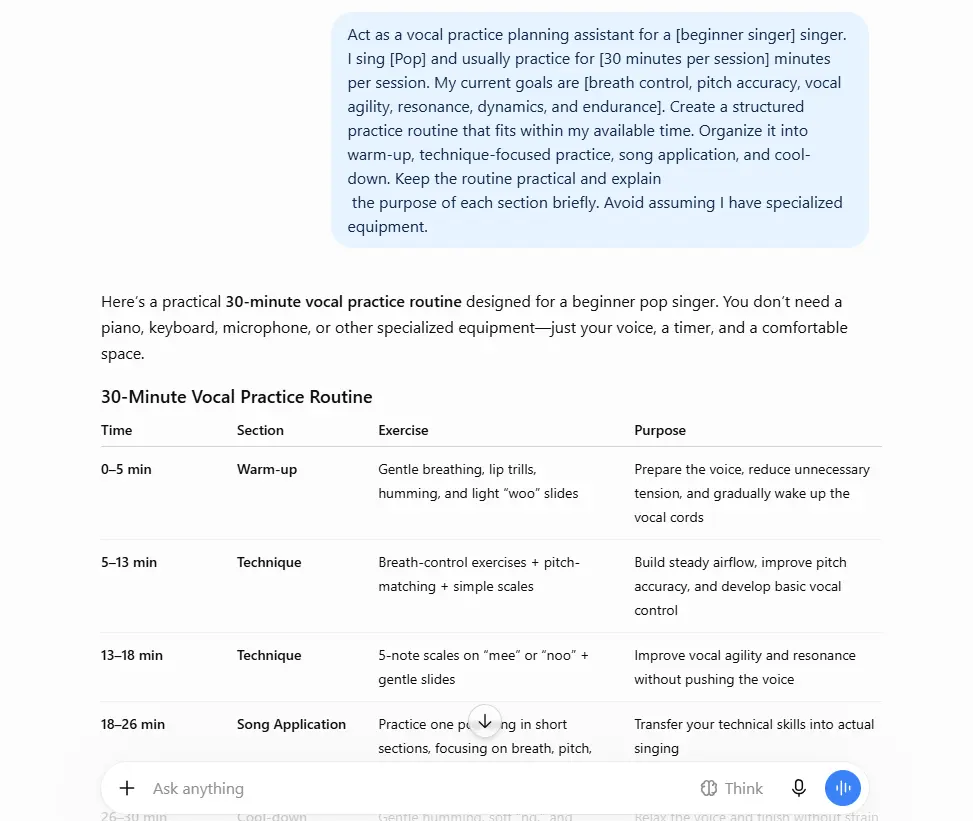
Prompt 1: Build a Personalized Vocal Practice Routine
Act as a vocal practice planning assistant for a [beginner/intermediate/advanced] singer. I sing [genre/style] and usually practice for [X] minutes per session. My current goals are [breath control/pitch accuracy/vocal agility/resonance/dynamics/endurance/other]. Create a structured practice routine that fits within my available time. Organize it into warm-up, technique-focused practice, song application, and cool-down. Keep the routine practical and explain the purpose of each section briefly. Avoid assuming I have specialized equipment.
Prompt 2: Create a Weekly Singing Practice Schedule
Help me create a 7-day singing practice schedule for a [skill level] vocalist who sings [genre]. My main goals are [goal 1], [goal 2], and [goal 3]. I can practice for [X] minutes on [number] days per week. Vary the focus across the week so I am not repeating the same session every day. Include lighter practice or recovery-focused days where appropriate and show exactly what I should work on during each session.
Prompt 3: Focus on Pitch Accuracy
Act as a singing practice coach and design exercises that can help me work on pitch accuracy. I am a [beginner/intermediate/advanced] singer who mainly performs [genre]. I struggle most with [staying on pitch during sustained notes/jumping between notes/starting notes accurately/singing in tune without an instrumental guide]. Create a progressive practice session from easier exercises to more challenging ones. Include ways I can monitor my progress without assuming access to expensive equipment.
Prompt 4: Improve Breath Management
Create a practical singing practice session focused on breath management for a [skill level] singer. I perform [genre] and notice that I struggle with [running out of breath during phrases/maintaining consistency/controlling long phrases/other]. Give me exercises I can practice safely and explain what each exercise is intended to develop. Then show me how to transfer the skill into an actual song. Do not make medical claims or diagnose any vocal issue.
Prompt 5: Work on Vocal Agility
Design a progressive practice routine for improving vocal agility in a [genre] singer. My current level is [beginner/intermediate/advanced], and I want to become more comfortable with [runs/melismas/quick note changes/ornamentation]. Start with manageable exercises and gradually increase the difficulty. Include a short section on how to practice agility accurately before increasing speed. Keep the routine within [X] minutes.
Using ChatGPT to Study and Interpret Songs
Learning a song is not only about memorizing its words and melody. Singers also need to understand phrasing, emotional direction, dynamics, character, and the relationship between lyrics and musical delivery.
ChatGPT can help you break a song into smaller analytical questions and rehearsal targets.
If you provide the song lyrics yourself, you can ask ChatGPT to work from that material rather than expecting it to reproduce copyrighted lyrics.
Prompt 6: Analyze a Song for Performance
I am preparing to perform a song in the [genre] style. Here are the lyrics and any notes I have about the song: [paste your material]. Analyze the song from a singer’s performance perspective. Identify the emotional progression, important lyrical ideas, potential changes in intensity, sections that may require extra vocal or emotional attention, and opportunities for expressive phrasing. Do not rewrite the lyrics unless I specifically ask you to.
Prompt 7: Find the Emotional Arc
Help me map the emotional arc of this song for a live vocal performance. I will provide the lyrics below: [paste lyrics you are authorized to use]. Divide the song into logical sections and describe the emotional intention I could explore in each section. Suggest where the performance might become more intimate, restrained, energetic, vulnerable, or powerful based on the meaning of the lyrics. Focus on interpretation rather than changing the words.
Prompt 8: Practice Difficult Song Sections
I am learning a song and these are the sections I find difficult: [describe sections or paste short excerpts you are authorized to use]. Help me create a focused rehearsal strategy. For each difficult section, identify what I should pay attention to, such as timing, pitch, breathing, diction, phrasing, transitions, or emotional delivery. Then create a short practice sequence that lets me isolate the difficult section before returning to the complete song.
Preparing for a Live Performance
A strong performance involves preparation beyond vocal practice. Singers may need to think about setlists, rehearsal order, transitions, stage movement, audience interaction, microphone technique, and what to do if something goes wrong.
ChatGPT can turn those considerations into a practical rehearsal checklist.
Prompt 9: Prepare for a Live Show
Act as a performance preparation assistant for a singer getting ready for a [type of event] on [date/timeframe]. I will perform approximately [number] songs in the [genre/style]. Create a preparation plan covering the days leading up to the performance, including song rehearsal, setlist review, equipment checks, stage preparation, rest, hydration, arrival timing, and mental preparation. Keep the advice practical and avoid medical or guaranteed-performance claims.
Prompt 10: Build a Rehearsal Checklist
Create a detailed rehearsal checklist for my upcoming singing performance. The show includes [number] songs, [live band/backing tracks/acoustic accompaniment/other], and approximately [duration] of performance time. Include musical preparation, lyrics and arrangements, microphone checks, entrances and exits, transitions between songs, stage movement, communication with other performers, and backup plans for common performance problems. Format it as a checklist I can use during rehearsal.
Prompt 11: Improve Stage Presence
Help me develop a stage-presence practice routine for a singer who performs [genre]. I currently feel [too still/nervous/overactive/unsure where to look/uncertain how to use the stage]. Give me practical exercises I can rehearse without an audience. Include guidance for facial expression, posture, eye direction, movement, interaction with the microphone, and matching physical expression to the mood of the song. Keep the suggestions authentic rather than theatrical for its own sake.
Prompt 12: Handle Performance Mistakes
Create a practical recovery guide for singers who make mistakes during live performances. Cover situations such as forgetting a lyric, entering a section late, missing a note, losing track of the arrangement, microphone problems, backing-track issues, or unexpected audience distractions. For each situation, explain how to recover calmly and continue the performance without drawing unnecessary attention to the mistake.
Turning Practice Into Measurable Progress
Singing improvement can become difficult to evaluate when every practice session feels similar. A simple tracking system can help you identify what you are actually working on and where your routine needs adjustment.
Prompt 13: Create a Vocal Practice Tracker
Design a simple vocal practice tracking system for me as a [skill level] singer. My main goals are [goal 1], [goal 2], and [goal 3]. Create daily fields for practice duration, exercises completed, songs practiced, areas that felt easier, areas that felt difficult, and notes for the next session. Add a weekly review section that helps me identify patterns and decide what to focus on next. Keep it simple enough to use consistently.
Prompt 14: Review My Singing Practice
Help me review my recent singing practice based on the notes below: [paste practice notes]. Identify recurring challenges, improvements I appear to be working toward, exercises or areas receiving too much or too little attention, and useful questions I should consider for my next practice session. Do not claim that I have improved unless the information actually supports that conclusion. Separate observations from suggestions.
Prompt 15: Create a 30-Day Singing Goal Plan
Help me turn these singing goals into a realistic 30-day practice plan: [list goals]. I currently consider myself [skill level], I sing [genre], and I can practice approximately [X] minutes per day on [number] days each week. Break the month into manageable phases with specific practice priorities. Include simple progress checks so I can evaluate whether I am following the plan without assuming that improvement will happen at a guaranteed rate.
The key is to treat these prompts as starting points rather than fixed instructions. The more accurately you describe your genre, experience, goals, rehearsal schedule, and current challenges, the more useful the resulting ideas are likely to be.
For singers, ChatGPT is particularly useful when it turns a vague goal—such as “I want to become a better vocalist”—into a specific task that can actually be practiced, reviewed, or prepared.
Songwriting, Lyrics, and Creative Development
For singers who also write music, ChatGPT can function as a brainstorming partner without taking over the creative process. You can use it to explore themes, organize ideas, challenge weak concepts, develop song structures, or generate directions when you feel stuck.
The strongest results usually come from giving the AI your own starting point. A rough theme, personal experience, genre, mood, or even a few original lines can give the conversation much more direction than a generic request to “write a song.”
Prompt 16: Develop a Song Concept
Act as a songwriting brainstorming partner. I am developing a song in the [genre] style about [theme/topic]. The emotional tone should feel [emotion/mood], and I want the song to communicate [main idea]. Give me 5 distinct song concepts, each with a different emotional or storytelling angle. For each concept, explain the central idea, possible conflict or tension, and how the idea could develop across verses and chorus. Keep the concepts original and avoid copying any existing artist’s work.
Prompt 17: Turn an Idea Into a Song Structure
Help me organize this original song idea into a clear structure: [describe your idea]. I want the song to feel [emotional quality] and fit a [genre/style] arrangement. Suggest a suitable structure such as verse, pre-chorus, chorus, bridge, or outro, and explain what each section should accomplish emotionally or narratively. Do not write complete lyrics unless I specifically request them.
Prompt 18: Brainstorm Chorus Ideas
I am writing an original [genre] song about [topic]. The main message is [message], and I want the chorus to feel [emotion]. Give me several different creative directions for the chorus, focusing on memorable concepts, emotional contrast, imagery, and a strong central idea. Do not imitate any existing songwriter or artist. Help me identify which direction might work best for a listener-friendly chorus and explain why.
Prompt 19: Strengthen My Song Concept
Review my original song concept below and act as a constructive songwriting editor: [paste your concept]. Identify what feels distinctive, what could be clearer, where the emotional stakes could become stronger, and which parts may feel generic. Give me specific revision options without replacing my creative voice. Separate your critique from your suggested improvements.
Prompt 20: Create a Songwriting Brainstorm Session
Guide me through a 20-minute songwriting brainstorming session. My starting point is [idea/theme/emotion]. Ask me focused questions one at a time that help me explore the story, conflict, imagery, perspective, emotional turning point, and central message. After the questions, organize my answers into a potential songwriting direction. Do not write the song for me unless I ask you to.
When you need fresh creative direction, ChatGPT prompts for musicians can help you explore song concepts, practice ideas, performance preparation, and music-related projects
Lyric Development and Editing
ChatGPT can also be useful after you have written a first draft. Instead of asking it to create everything from scratch, you can use it as an editor that helps you spot repetition, unclear imagery, awkward phrasing, or sections that do not support the song’s central idea.
Prompt 21: Review Original Lyrics
Act as a constructive lyric editor. I wrote these original lyrics: [paste your lyrics]. Analyze them for clarity, emotional consistency, imagery, repetition, rhythm, word choice, and connection between sections. Identify the strongest elements first, then point out areas that could be improved. Do not rewrite the entire song. Give specific revision suggestions while preserving my intended voice and message.
Prompt 22: Improve Lyric Imagery
Review these original lyrics: [paste lyrics]. Identify lines or ideas that rely on generic language and suggest alternative imagery or concepts that could make the writing more specific and memorable. Keep the emotional meaning intact. Give multiple directions where useful, but do not imitate a particular artist, songwriter, or copyrighted style.
Prompt 23: Check Lyric Consistency
Analyze my original song lyrics for consistency. Here is the draft: [paste lyrics]. Check whether the perspective, tense, emotional tone, imagery, and central message remain coherent from beginning to end. Highlight sections that feel disconnected and explain how I could create stronger transitions without rewriting the entire song.
Prompt 24: Find Repetitive Ideas
Review these original lyrics and identify repeated ideas, phrases, images, or emotional points: [paste lyrics]. Distinguish between repetition that strengthens a song and repetition that may weaken it. Suggest where I could introduce contrast or development while keeping intentional chorus repetition intact.
Prompt 25: Build a Better Pre-Chorus
I have an original verse and chorus but the transition between them feels weak. Here is my material: [paste your original sections]. Analyze why the transition may not feel effective and suggest several approaches for a stronger pre-chorus. Focus on emotional escalation, anticipation, lyrical contrast, and momentum rather than copying any existing song structure.
ChatGPT prompts for copywriting can also help singers create clearer promotional messages, campaign copy, and audience-focused marketing content
Finding Your Vocal Identity
A singer’s identity is shaped by more than vocal range. Genre choices, interpretation, tone, storytelling, repertoire, visual presentation, and the emotions they consistently communicate all contribute to how listeners perceive an artist.
ChatGPT can help you explore these elements by asking structured questions and organizing your answers.
Prompt 26: Explore My Artist Identity
Help me explore my identity as a singer and developing artist. Ask me a structured series of questions about the genres I enjoy, the emotions I naturally communicate, the themes I care about, artists who influence me, my strengths, the type of audience I want to connect with, and what I want listeners to remember about my performances. After I answer, summarize recurring themes and suggest several possible artistic directions without forcing me into a label.
Prompt 27: Identify My Musical Strengths
Based on the information below, help me identify my potential strengths as a singer: [describe your experience, repertoire, performance style, feedback you have received, and areas you enjoy]. Separate observable information from assumptions. Organize the results into vocal/technical strengths, performance strengths, creative strengths, and areas worth developing. Do not claim abilities that are not supported by the information I provide.
Prompt 28: Define My Audience
Help me think through the audience I may naturally connect with as an independent singer. My music is [describe genre, themes, mood, sound, and artistic identity]. Suggest several possible audience profiles based on musical interests, listening habits, emotional preferences, and content interests. Explain what assumptions you are making and give me questions I can use to validate these ideas with real audience data.
Prompt 29: Develop a Singer’s Brand Voice
Create a practical brand-voice framework for my music project. Here is my artistic direction: [describe your music, personality, themes, audience, and visual identity]. Define 4–6 characteristics for my communication style, examples of language that fits, language to avoid, and sample messaging for social posts, artist introductions, and music announcements. Keep the voice authentic rather than overly promotional.
Rehearsing for Different Singing Situations
A singer may sound comfortable in a practice room but face different demands when recording, performing live, auditioning, or singing with other musicians. ChatGPT can help you prepare for those situations by turning the event into smaller rehearsal tasks.
For singers looking to make AI part of their everyday workflow, ChatGPT prompts for musicians offer practical ideas for songwriting, practice, performance, and music promotion
Prompt 30: Prepare for an Audition
Help me prepare for a singing audition for [type of opportunity]. I have [X] days to prepare and plan to perform [song/type of material]. Create a preparation checklist covering song selection, memorization, rehearsal, performance choices, timing, introduction, clothing considerations, arrival preparation, and questions I may need to answer. Keep the advice practical and avoid assuming requirements that I have not provided.
Prompt 31: Practice an Audition Introduction
Help me prepare a natural 20–30 second introduction for a singing audition. My name is [name], I am auditioning for [opportunity], and I will perform [song or type of song]. My relevant background is [brief background]. Give me three versions: conversational, confident, and concise. Keep them natural and avoid exaggerated claims.
Prompt 32: Prepare for Singing With a Band
Create a rehearsal preparation guide for a singer working with a live band for the first time. The performance includes [genre] songs and approximately [number] musicians. Cover communication about keys, arrangements, song endings, transitions, tempo, cues, backing vocals, dynamics, count-ins, and handling changes during rehearsal. Include questions I should ask the band before the first full rehearsal.
Prompt 33: Prepare for a Studio Recording Session
Help me prepare for a vocal recording session. I will record [genre/style] music and have approximately [timeframe] available in the studio. Create a preparation checklist covering song familiarity, lyrics, arrangement notes, rehearsal priorities, communication with the producer or engineer, takes, harmonies, and session organization. Distinguish between things I can prepare beforehand and decisions that may need to happen in the studio.
Prompt 34: Organize Vocal Harmonies
I am arranging backing vocals for an original song. The main vocal follows this general structure: [describe structure]. The song is in [key/tonal information if known] and the style is [genre]. Suggest a framework for deciding where harmonies could enter, where they could remain sparse, and where layered vocals could create contrast. Focus on arrangement concepts rather than generating a complete copyrighted musical arrangement.
Creating a Repertoire That Fits You
Choosing songs strategically can help singers build a more useful repertoire instead of collecting songs that sound impressive but do not fit their current goals or performance context.
Prompt 35: Build a Personal Repertoire
Help me create a repertoire-building strategy as a [skill level] singer. I mainly perform [genre/styles], my comfortable singing characteristics are [describe them], and my goals are [live performance/audition/content creation/recording/other]. Give me criteria for selecting songs based on suitability, variety, emotional range, audience context, and performance development. Then create a simple system for evaluating potential songs before I add them to my repertoire.
Prompt 36: Evaluate a Song for My Voice
Help me evaluate whether this song is a suitable choice for my current singing goals. Song: [title]. My voice and experience: [describe]. My intended setting is [live performance/audition/recording/practice]. Create an evaluation framework covering range, tessitura, phrasing demands, emotional interpretation, stamina, arrangement, and audience suitability. Clearly distinguish between information I provide and factors that would require actual vocal assessment.
Prompt 37: Create a Balanced Setlist
Help me design a balanced setlist for a [length]-minute performance. I expect to perform approximately [number] songs in the [genre/style]. My available songs are: [list songs]. Organize them to create variety in energy, mood, tempo, and audience engagement. Consider the opening, middle section, transitions, and closing moment. Explain the reasoning behind the sequence without assuming details about the songs that I have not provided.
Prompt 38: Refresh an Existing Setlist
Review my current setlist: [paste setlist]. The performance is for [event/audience/context] and lasts approximately [duration]. Identify possible issues with pacing, repetition of mood or tempo, transitions, and overall energy. Suggest several alternative sequencing strategies while keeping my available songs unchanged unless I ask for replacements.
Content creators can also learn from structured ChatGPT prompts for food bloggers, especially when turning one piece of content into multiple social media and promotional formats
Making AI More Useful During Your Creative Process
The biggest advantage of these prompts is not simply getting more ideas. It is using ChatGPT at the right stage of your workflow.
For example, you can use it to brainstorm before writing, critique after drafting, organize rehearsal before practicing, and turn performance goals into checklists. That keeps your own musical judgment at the center while using AI for structure and idea development.
A useful workflow might look like this:
Idea → Brainstorm → Write → Review → Rehearse → Perform → Reflect → Refine
ChatGPT can support several steps in that process, but the singer remains responsible for the artistic decisions.
Content Creation for Singers
For many singers, creating music is only part of the work. Building an audience often means sharing rehearsal clips, performance moments, songwriting ideas, behind-the-scenes content, educational posts, and updates about new releases.
The challenge is keeping content connected to your music instead of posting random ideas simply to stay active. ChatGPT can help you turn your existing musical activities into content angles while keeping your own personality at the center.
Prompt 39: Create a Singer Content Strategy
Act as a content planning assistant for an independent singer. My genre is [genre], my current audience is [describe audience], and my main goals are [grow awareness/promote music/build community/get performance opportunities/etc.]. Create a practical content strategy built around my actual music activities. Include content pillars, suitable formats, recurring themes, and examples of topics I could create without pretending to have experiences or results I do not have. Keep the strategy authentic and manageable for one person.
Prompt 40: Generate Social Media Ideas
Give me 20 social media content ideas specifically for a singer who performs [genre]. My current focus is [new single/live performances/songwriting/vocal practice/artist growth]. Divide the ideas into educational, entertaining, behind-the-scenes, community-focused, and music-promotion categories. Make each idea specific enough to turn into a post, short video, carousel, or story. Avoid generic ideas that could apply to any business.
Prompt 41: Turn a Rehearsal Into Content
I recently rehearsed [song/performance/project]. Help me turn this real activity into several pieces of social media content. Suggest ideas for short-form video, a photo post, a story, a behind-the-scenes caption, and a question that encourages genuine audience interaction. Use only the information I provide and do not invent what happened during the rehearsal.
Prompt 42: Create Behind-the-Scenes Content
Create 15 behind-the-scenes content ideas for my singing career. I can show [recording sessions/rehearsals/songwriting/setlist preparation/studio setup/travel to performances/etc.]. For each idea, explain what I could show, what story the content could communicate, and what simple audience interaction could accompany it. Keep the ideas realistic for an independent singer with [available resources].
Prompt 43: Build a Weekly Content Calendar
Create a 7-day social media calendar for my singer profile. I perform [genre], my current priority is [goal], and I can realistically create [number] pieces of content per week. Use a mix of music-focused, personal-but-relevant, educational, behind-the-scenes, and promotional content. For each day, provide the content idea, suggested format, purpose, and a simple call to action. Avoid making every post promotional.
Singers can also explore ChatGPT prompts for professionals for ideas around content planning, communication, media strategy, and audience engagement
Promoting New Music
When a singer releases a single, EP, album, cover, or music video, promotion works better when the audience gets multiple ways to connect with the release rather than seeing the same announcement repeatedly.
ChatGPT can help create a release workflow around the information you already have.
Prompt 44: Create a Music Release Plan
Help me create a practical promotional plan for my upcoming music release. I am releasing a [single/EP/album/music video] called “[title]” on [date]. The genre is [genre], and the main theme or story is [describe]. My available promotional channels are [Instagram/TikTok/YouTube/YouTube Shorts/Facebook/Threads/X/website/email/etc.]. Create a timeline for before release, release day, and after release. Focus on realistic content and communication rather than promising specific results.
Prompt 45: Build a Pre-Release Content Sequence
Create a pre-release content sequence for my upcoming song “[title].” It will be released on [date]. The song is about [theme], sounds like [describe sound], and I can share [teasers/cover art/behind-the-scenes clips/lyrics snippets that I own or am authorized to share/studio footage/etc.]. Give me a sequence of content ideas that gradually introduces the song without revealing everything at once. Include suggested audience questions and soft calls to action.
Prompt 46: Write a Music Announcement
Write a natural social media announcement for my new song “[title].” It is a [genre] track about [theme], and it will be available on [date/platforms]. My preferred tone is [warm/emotional/confident/casual/minimal]. Keep the message personal without exaggerating the song’s importance or making unsupported claims. End with a simple invitation for people to listen or share their reaction.
Prompt 47: Create Multiple Release Angles
Give me 12 different promotional angles for my song “[title].” The song is [describe genre, theme, inspiration, and mood]. Each angle should highlight a different aspect such as the story behind the song, songwriting process, production, emotional meaning, performance, visual concept, or listener connection. For each angle, suggest one short-form content idea and one caption direction.
Prompt 48: Plan Release-Day Content
Create a release-day content plan for my new [single/EP/album]. Include ideas for a main announcement, short-form video, story updates, audience engagement, behind-the-scenes material, and an evening follow-up post. My release details are: [provide details]. Avoid repeating the same announcement in every format and keep each piece suited to its platform.
Singers can also use ChatGPT prompts for musicians to develop songwriting ideas, explore creative directions, and organize their music projects
Singers who want to build a professional online presence can use ChatGPT prompts for building a website to plan pages, content, and website features.
Short-Form Video Ideas for Singers
Short videos can showcase a singer’s personality and musical ability without requiring a full production every time. The best concept depends on what you actually have available to film.
Prompt 49: Generate Singing Video Concepts
Give me 20 short-form video concepts for a singer in the [genre] space. My strengths are [describe strengths], and I can film using [phone/home studio/stage/studio/band/etc.]. Mix performance clips, educational content, storytelling, challenges, songwriting, rehearsal footage, and audience interaction. Make every idea specific and explain the hook, what happens in the video, and how it can end.
Prompt 50: Turn a Song Into Short Videos
Help me create 10 short-form video concepts around my song “[title].” Here is the song context: [describe theme, story, genre, and available footage]. Suggest different approaches rather than simply telling me to post the chorus repeatedly. Include performance, storytelling, behind-the-scenes, educational, and audience-participation concepts where appropriate.
Prompt 51: Create a Vocal Education Series
Design a 10-part educational short-video series for my singer profile. The audience is [beginner singers/intermediate singers/music fans/general audience]. My topics could include [pitch/breathing/practice habits/song interpretation/performance/etc.]. For each episode, provide a specific topic, opening hook, 2–3 teaching points, a simple example, and a closing invitation to engage. Avoid presenting individualized vocal or medical advice as a substitute for professional assessment.
Prompt 52: Improve a Video Hook
Here is the concept for my singing video: [describe video]. Give me 10 different opening hooks that could make viewers understand the video’s value or curiosity within the first few seconds. Keep the hooks natural to a singer rather than using exaggerated clickbait. Group them into curiosity, educational, emotional, and performance-focused styles.
Prompt 53: Create a Performance Clip Strategy
I have footage from a [concert/rehearsal/studio session/live session]. Help me identify different short-form clips I could create from it. Suggest possible moments to highlight, text-overlay ideas, captions, and audience questions. Do not assume details about the footage that I have not described. Give me options for both strong vocal moments and storytelling moments.
Captions and Audience Engagement
A caption does not need to explain everything about a song. Depending on the post, it might provide context, tell a short story, invite conversation, or simply give the audience a reason to listen.
Prompt 54: Write a Singer’s Caption
Write 5 social media caption options for this singer-related post: [describe post]. My tone is [tone], my genre is [genre], and the goal is [engagement/promotion/storytelling/community]. Keep the captions natural and avoid generic influencer language. Make each option meaningfully different in style and length.
Prompt 55: Create Audience Questions
Generate 20 genuine audience questions I can use around my music content. My genre is [genre], and I want to encourage conversations about [music/songwriting/performance/lyrics/emotions/listening habits]. Avoid questions that feel like engagement bait. Make the questions easy for followers to answer and varied enough to support different types of posts.
Prompt 56: Respond to Music Comments
Help me create natural responses to comments I receive on my singing content. Give me response approaches for: a compliment, a question about the song, someone sharing an emotional reaction, constructive criticism, a request for another song, a repeat listener, and someone discovering my music for the first time. Keep the responses warm and conversational rather than overly promotional.
YouTube and Long-Form Music Content
Long-form video can give singers room to explain their creative process, perform complete songs, document their journey, or teach aspects of singing and songwriting.
Prompt 57: Plan a Singer YouTube Channel
Help me plan a YouTube content strategy for my singer channel. I create [original music/covers/vocal education/performance videos/songwriting content/behind-the-scenes content]. My target audience is [describe audience], and I can realistically publish [frequency]. Create 4–6 content pillars and explain what role each pillar could play. Include examples of recurring video series that I could continue without constantly needing expensive production.
Prompt 58: Create a Music Video Outline
Help me outline a YouTube video about my song “[title].” The purpose is [introduce the song/explain the story/show the recording process/share a live performance/etc.]. Here is the available material: [describe footage and information]. Create a logical structure with an opening, main sections, transitions, and ending. Keep the story grounded in the information I provide and do not invent behind-the-scenes details.
Prompt 59: Plan a Vocal Tutorial
Create an educational YouTube video outline about [singing topic]. My intended audience is [beginner/intermediate/advanced singers]. Cover the concept, why it matters, practical examples, common misunderstandings, and a safe way to structure practice. Clearly distinguish general educational information from individualized vocal assessment. Include a concise introduction and conclusion without unnecessary filler.
Prompt 60: Repurpose a Long Video
I have a long-form video about [topic/performance/project]. Help me repurpose it into smaller pieces of content. Suggest short-form clips, quote or idea-based posts, story content, carousel concepts, and community questions. Use only the material contained in my description or transcript: [paste material]. Make each piece serve a different purpose rather than simply cutting the same section repeatedly.
Building a More Sustainable Music Content Workflow
Posting consistently does not require creating completely new ideas every day. Singers can often create several pieces of content from one real activity.
For example, a single recording session could produce:
- A behind-the-scenes clip
- A short performance moment
- A story about the song
- A studio photo
- A songwriting lesson
- A release-related post
- A longer YouTube video
That approach keeps content connected to the actual music rather than forcing the singer to constantly invent unrelated topics.
The most useful role for ChatGPT here is organization: give it the material you already have and ask it to find different legitimate ways to present that material.
Music Promotion Without Losing Your Identity
Promotion becomes easier to manage when every post does not have to say “listen to my song.” Instead, content can show why the song exists, how it was created, what it means to you, or what listeners can discover inside it.
That creates a broader content ecosystem around the music.
For example:
Song → Story → Rehearsal → Performance → Behind the Scenes → Audience Conversation → Release Reminder
This gives you more opportunities to talk about the same musical project without making every post feel identical.
Collaboration and Working With Other Musicians
Singers rarely work in isolation. Depending on the project, you may collaborate with songwriters, producers, instrumentalists, vocalists, video creators, event organizers, or other artists.
ChatGPT can help you prepare for those conversations, organize ideas, and make sure important project details are not overlooked. It should support communication—not replace agreements, contracts, or professional advice where those are needed.
Prompt 61: Prepare for a Music Collaboration
Help me prepare for a collaboration with a [producer/songwriter/instrumentalist/singer/artist]. The project is [describe project], the musical style is [genre], and my role is [role]. Create a collaboration brief covering the creative direction, responsibilities, deliverables, timeline, communication preferences, file organization, credits, and questions we should resolve before starting. Clearly separate creative discussion points from business or legal matters that may require professional advice.
Prompt 62: Brainstorm Collaboration Ideas
Give me 10 collaboration concepts for a singer working with a [musician/producer/artist/content creator]. My genre is [genre], my musical strengths are [strengths], and the other person’s work can be described as [description]. Make the ideas genuinely different and explain the creative concept, potential audience appeal, and what each person could contribute. Avoid suggesting that a collaboration will automatically produce specific results.
Prompt 63: Prepare Questions for a Producer
Create a practical list of questions I should discuss with a music producer before starting a vocal recording project. Cover the musical direction, references, arrangement, vocal expectations, recording process, revisions, file delivery, timeline, credits, communication, and project scope. Separate creative questions from financial, contractual, or rights-related questions that should be formally clarified.
Prompt 64: Organize a Co-Writing Session
Help me structure a songwriting session with another writer. We have approximately [X] hours and want to create an original [genre] song around [theme]. Create a flexible session flow covering idea generation, concept selection, structure, writing, review, and next steps. Include ways to handle creative disagreement without letting one person dominate the session.
Prompt 65: Give Constructive Feedback to a Collaborator
Help me give constructive feedback on a music collaboration. Here is the situation: [describe situation]. My concerns are [concerns]. Write a clear feedback message that identifies the specific issue, explains what I would prefer, acknowledges what is already working, and invites discussion. Keep the tone respectful and collaborative rather than accusatory.
Professional Communication for Singers
A singer may need to communicate with venues, producers, event organizers, clients, managers, musicians, and collaborators. Clear communication can reduce confusion about schedules, requirements, deliverables, and expectations.
Prompt 66: Write a Performance Inquiry
Draft a professional but friendly inquiry to [venue/event organizer] about a potential singing performance. Here are the details I know: [event information]. I want to ask about availability, performance requirements, expected set length, compensation structure, sound equipment, arrival time, and next steps. Keep the message concise and avoid making assumptions about terms that have not been discussed.
Prompt 67: Create a Performance Proposal
Help me create a concise performance proposal for a [venue/event/client]. My act is [solo singer/duo/band/etc.], my musical style is [genre], and I can provide [services/equipment]. The event is [type of event] on [date]. Organize the proposal into an introduction, performance description, requirements, available options, questions, and next steps. Leave unknown pricing or contractual terms as placeholders rather than inventing them.
Prompt 68: Follow Up After a Performance Inquiry
Write a polite follow-up message regarding a singing performance inquiry I previously sent. The original inquiry was about [event/opportunity], and I sent it [timeframe]. I want to remain professional without sounding impatient or demanding. Create a short message that confirms my continued interest and makes it easy for the recipient to respond.
Prompt 69: Create a Music Collaboration Introduction
Write a concise introduction message to a potential music collaborator. I am a [genre] singer, and I am interested in their work because [specific reason]. I would like to explore [collaboration idea]. Keep the message personal and specific rather than sounding like a mass-produced networking message. Do not exaggerate my experience or achievements.
Prompt 70: Prepare a Professional Artist Bio
Help me create a short artist bio using only the information I provide below: [background, genre, music, notable projects, influences, goals, performances, releases]. Create short, medium, and extended versions. Do not invent achievements, publications, awards, collaborations, venues, or experience. Keep the language specific and avoid generic promotional claims.
When communicating with different audiences, ChatGPT prompts for translators can also provide useful ideas for adapting written messages while preserving their intended meaning
Music Career Organization
As your projects grow, keeping track of songs, rehearsals, releases, collaborations, content, and opportunities can become difficult. ChatGPT can help turn scattered notes into organized systems.
Prompt 71: Organize My Music Projects
Help me organize my current music projects from the information below: [paste projects and notes]. Categorize each project by status, priority, deadline, collaborators, next action, and potential blockers. Then create a simple weekly review system that helps me decide what deserves attention first. Do not invent deadlines or priorities that I have not provided.
Prompt 72: Create a Singer’s Weekly Workflow
Design a realistic weekly workflow for an independent singer who needs to balance vocal practice, songwriting, recording, content creation, music promotion, collaboration, administrative tasks, and rest. My available time is [X hours/days], and my current priorities are [priorities]. Organize the week around those priorities rather than assuming every activity deserves equal time.
Prompt 73: Prioritize Music Tasks
Here is my current list of music-related tasks: [paste list]. Help me prioritize them using urgency, importance, deadline, creative impact, and dependencies. Put the tasks into clear priority groups and explain the reasoning briefly. Do not assume that a task is urgent simply because it sounds important.
Prompt 74: Create a Release Checklist
Create a practical checklist for preparing an independent music release. My release type is [single/EP/album], and the planned release date is [date]. Include creative preparation, final files, artwork, metadata, promotional assets, content planning, communication, and post-release follow-up. Mark areas that may require platform-specific requirements or professional/legal verification rather than inventing requirements.
Prompt 75: Track Music Opportunities
Design a simple opportunity-tracking system for my singing career. I want to track [auditions/gigs/collaborations/festivals/venues/other]. Include fields for opportunity name, contact, deadline, status, requirements, follow-up date, outcome, and notes. Then suggest a weekly review process that helps me avoid missing important follow-ups.
From planning releases to creating promotional ideas, ChatGPT prompts for musicians can help singers organize different parts of their music promotion strategy
A structured content workflow, similar to the approach used in ChatGPT prompts for food bloggers, can help singers turn one idea into multiple useful pieces of content.
Improving Performance Confidence
Performance confidence is not simply about “being fearless.” Preparation, familiarity with the material, rehearsal under realistic conditions, and having a plan for unexpected situations can all make performance preparation more manageable.
ChatGPT can help you turn nervousness into specific preparation tasks, but it should not be used to diagnose anxiety or other mental-health conditions.
Prompt 76: Create a Pre-Performance Routine
Help me design a simple pre-performance routine for a singer. I usually feel [describe your experience before performing], and my main concerns are [concerns]. The performance begins at approximately [time], and I will arrive at the venue [timeframe] beforehand. Create a practical routine covering preparation, quiet time, reviewing the setlist, logistical checks, and mental focus. Keep it flexible rather than treating it as a guaranteed method for eliminating nervousness.
Prompt 77: Rehearse Under Performance Conditions
Design a mock-performance rehearsal for me. I am preparing to perform [number] songs in [setting]. I normally practice [describe current practice setup], but I want to make rehearsal more realistic. Create a sequence that includes standing performance, microphone use, transitions, limited stopping, unexpected distractions, and a full run-through. Include a post-rehearsal review so I can identify what needs further work.
Prompt 78: Prepare for Stage Nerves
Help me create a practical preparation plan for managing pre-performance nerves as a singer. I tend to experience [describe what happens]. Focus on preparation, rehearsal, attention management, realistic expectations, and having recovery strategies for mistakes. Avoid medical advice, diagnosis, or claims that a particular technique will eliminate nervousness.
Prompt 79: Build a Performance Review
Create a post-performance review template for a singer. I want to evaluate my performance without judging myself only on whether it felt good or bad. Include sections for preparation, vocal execution, musical accuracy, interpretation, stage presence, audience interaction, technical issues, unexpected problems, strengths, lessons learned, and specific actions for the next performance.
Prompt 80: Turn Performance Feedback Into Action
Here is feedback I received after my singing performance: [paste feedback]. Help me organize it into three categories: useful observations, subjective preferences, and unclear comments that need clarification. Then turn the actionable observations into specific rehearsal tasks. Do not assume every piece of feedback is objectively correct, and do not treat subjective opinions as technical facts.
Creating Better Practice Around Real Songs
Generic vocal exercises have their place, but singers also need to apply skills within actual repertoire. ChatGPT can help create a bridge between isolated practice and musical performance.
Prompt 81: Connect Technique to Repertoire
My current vocal practice goal is [goal], and I am working on these songs: [song list]. Help me identify practical ways to apply the skill to my repertoire. For each song, suggest what I could listen for or observe during practice, such as phrasing, breath planning, dynamics, articulation, pitch transitions, or emotional delivery. Do not assume technical details about the songs that I have not provided.
Prompt 82: Create a Song-Specific Rehearsal Plan
Create a focused rehearsal plan for my original song “[title].” Here is the information about the song: [structure, genre, lyrics, difficult sections, arrangement, performance goal]. Divide the rehearsal into preparation, difficult-section work, full-song practice, performance run, and review. Give each stage a clear purpose and suggest what I should record or note for the next session.
Prompt 83: Analyze My Rehearsal Notes
Review these rehearsal notes from my singing practice: [paste notes]. Identify recurring patterns, unfinished tasks, sections I may need to revisit, and questions I should answer before the next rehearsal. Organize the result into “Continue,” “Change,” and “Investigate.” Do not infer technical problems that cannot reasonably be determined from the notes.
Building a Long-Term Development Plan
A singer’s goals can change over time. You may begin by focusing on vocal consistency and later shift toward songwriting, live performance, recording, or building an audience.
Instead of trying to improve everything simultaneously, ChatGPT can help you organize priorities into manageable phases.
Prompt 84: Create a Six-Month Singer Development Plan
Help me create a six-month development plan as a [skill level] singer. My current priorities are [list priorities], my available practice or project time is [time], and my longer-term goal is [goal]. Divide the plan into practical phases with a small number of priorities for each phase. Include milestones based on completed work and habits rather than guaranteeing a specific level of artistic or vocal improvement.
Prompt 85: Identify My Next Best Focus
Based on the information below, help me identify the most useful area to focus on next: [describe current skills, challenges, recent practice, performances, songs, and goals]. Compare the possible priorities and explain the trade-offs. Recommend one primary focus and up to two secondary areas. Make clear which conclusions come directly from my information and which are suggestions.
Keeping Creativity and AI in Balance
AI can be useful for generating options, organizing thoughts, and challenging your first draft. But singers should still make the final artistic decisions.
A useful approach is to treat ChatGPT as a creative assistant rather than the artist.
You can ask it to:
- Give you several directions instead of one answer.
- Critique your draft instead of replacing it.
- Organize your rehearsal notes.
- Turn your own experiences into content ideas.
- Help you prepare professional communication.
- Build systems around your music projects.
- Identify questions you may have overlooked.
Then use your own taste, musical judgment, experience, and audience feedback to decide what stays.
That distinction becomes particularly important when working on songwriting and artistic identity. AI can generate possibilities, but your personal perspective is what makes a song, performance, or artist project yours.
Music Content, Promotion, and Audience Growth
Once you have songs, performances, and creative material to share, the next challenge is deciding what to do with it. Singers often have plenty of material but struggle to turn it into a consistent workflow.
ChatGPT can help you organize that material into practical content and promotional tasks without making every post sound like an advertisement.
Prompt 86: Create a Music Content Repurposing System
I create [original songs/live performances/covers/songwriting videos/studio content] and want to repurpose my existing material efficiently. Here is what I currently have: [describe content]. Build a repurposing system that turns each major piece of content into several smaller content opportunities for [platforms]. Give each format a different purpose so I am not simply reposting the same message. Prioritize authentic material I have actually created or recorded.
Prompt 87: Plan a Month of Music Content
Create a 30-day content plan for my singer profile. My genre is [genre], my current priority is [release/performance/audience building/songwriting/etc.], and I have these available assets: [list assets]. Mix performance, educational, behind-the-scenes, storytelling, community, and promotional content. Keep the workload realistic and avoid requiring new music or expensive production every day.
Prompt 88: Create a Music Promotion Funnel
Help me organize a simple audience journey around my music. My goal is [introduce a new artist/promote a single/build listeners/promote performances/etc.]. My available platforms are [platforms]. Create stages such as discovery, interest, connection, listening, and continued engagement. For each stage, suggest appropriate singer-focused content and a natural call to action. Do not assume that followers will automatically become listeners or customers.
Prompt 89: Improve My Music Profile Bio
Write several versions of my singer profile bio using only the information below: [genre, location if I choose to include it, music style, themes, releases, performances, personality, current project]. Create short versions suitable for social profiles and a slightly longer version for an artist website. Do not invent achievements, credentials, awards, or audience numbers. Keep the language specific and natural.
Prompt 90: Create a Music Content Audit
Review my recent music content based on this information: [paste posts, captions, video titles, or content list]. Identify recurring themes, content gaps, overly repetitive topics, strong areas, and opportunities for improvement. Separate observations from recommendations. Then suggest 10 new content ideas that build on what I am already doing rather than completely changing my identity.
Prompts for Songwriting Blocks
Creative blocks can happen at any stage of songwriting. Sometimes the problem is not a lack of ideas but having too many possible directions and not knowing which one to pursue.
Instead of asking ChatGPT to “write a song,” give it a specific creative problem.
Prompt 91: Break Through a Songwriting Block
I am stuck while writing an original song. Here is what I currently have: [describe or paste your original material]. The part I cannot solve is [specific problem]. Give me 8 different ways to approach the problem. Some should be structural, some lyrical, some emotional, and some conceptual. Do not finish the song for me. Help me find directions that I can develop in my own voice.
Prompt 92: Find a Stronger Song Perspective
I am writing an original song about [topic]. My current perspective is [describe perspective]. Give me several alternative perspectives from which the same subject could be explored, such as first-person reflection, direct address, observation, memory, contradiction, or a future-looking perspective. Explain how each perspective could change the emotional impact of the song.
Prompt 93: Develop Song Imagery
Help me brainstorm original imagery for a song about [theme/emotion]. Generate categories of imagery involving places, objects, physical sensations, movement, weather, time, memories, or everyday details. Avoid clichés and avoid imitating any particular songwriter. The goal is to give me raw material that I can develop myself.
Prompt 94: Create a Song Revision Checklist
Create a revision checklist for my original song. I want to evaluate the lyrics, structure, emotional progression, imagery, repetition, chorus, verses, transitions, title, and overall message. Make the checklist suitable for a songwriter reviewing a first or second draft. Include questions that encourage me to make deliberate creative decisions rather than automatically changing every imperfect line.
Prompts for Covers and Interpretation
Singers who perform covers can still bring their own interpretation to a song. The goal is not necessarily to reproduce another performer’s delivery exactly.
ChatGPT can help you think through interpretation, arrangement choices, and performance concepts using information you provide.
Prompt 95: Develop My Own Interpretation
I am preparing my own interpretation of “[song title].” I want to respect the original song while developing a performance that fits my voice and artistic direction. Based on the information I provide below [describe arrangement, tempo, vocal qualities, performance setting, and creative ideas], suggest different interpretation approaches involving dynamics, phrasing, emotional emphasis, arrangement, and stage presentation. Do not tell me to imitate another singer.
Prompt 96: Create a Cover Performance Concept
Help me develop a performance concept for my cover of “[song title].” My setting is [acoustic session/live show/social video/audition/etc.], my genre direction is [genre], and I want the performance to feel [mood]. Suggest several concepts for arrangement, opening, dynamics, visual presentation, and emotional progression. Keep the suggestions realistic for the equipment and setting I describe.
Prompt 97: Compare Different Arrangement Directions
I want to perform a cover of “[song title]” in a different arrangement. Give me several broad arrangement directions, such as stripped-down acoustic, intimate piano, band-driven, slower reinterpretation, or another suitable approach. For each direction, explain how it could change the emotional character of the performance and what practical considerations I should think about. Do not reproduce copyrighted lyrics or musical notation.
Prompts for Singer Networking and Opportunities
Finding opportunities often involves more than performing. Singers may need to introduce themselves, follow up with contacts, maintain professional relationships, and keep track of potential opportunities.
Prompt 98: Create a Networking Strategy
Help me create a realistic networking strategy for my singing career. My current stage is [beginner/developing/established], my genre is [genre], and I want to connect with [producers/songwriters/musicians/venues/artists/event organizers/etc.]. Suggest ways to build genuine professional relationships through relevant activities, conversations, collaborations, and follow-ups. Avoid spam-style outreach and focus on mutual value.
Prompt 99: Organize Follow-Ups
Here is a list of people and music opportunities I need to follow up on: [paste list]. Organize them by follow-up date, relationship, opportunity, current status, and next action. Then suggest short, personalized follow-up approaches for each category. Do not invent previous conversations or commitments.
Prompt 100: Prepare for a Music Networking Conversation
Help me prepare for a conversation with [type of music professional]. My background is [brief information], and I am interested in [goal]. Give me a concise introduction, 5 thoughtful questions, 3 useful topics I can discuss, and several ways to continue the conversation naturally if there is mutual interest. Avoid making the interaction sound like a sales pitch.
Advanced Prompt: Make ChatGPT Work From Your Own Material
One of the most useful ways singers can improve AI responses is to stop treating ChatGPT as a source of generic answers.
Instead, provide the material you already have.
That might include:
- Your rehearsal notes
- Original lyrics
- Song concepts
- Setlists
- Performance goals
- Content drafts
- Release information
- Audience questions
- Collaboration notes
- Your own artist bio
Then tell ChatGPT exactly what you want done with that material.
Prompt 101: Analyze My Complete Music Project
Act as an organized creative planning assistant for my music project. Here is the information I currently have: [paste project notes]. Analyze it and organize the information into: creative direction, music tasks, rehearsal tasks, content opportunities, promotional tasks, collaboration needs, deadlines, unresolved questions, and immediate next actions. Do not invent missing information. Clearly label assumptions or decisions that I still need to make.
Prompt 102: Build a Personal AI Workflow for Me as a Singer
Help me design a repeatable ChatGPT workflow around my singing career. My main activities are [singing practice/songwriting/recording/live performance/content creation/music promotion/collaboration/etc.]. Identify which tasks ChatGPT can reasonably help with, what information I should provide for each task, and reusable prompt templates I can save. Also identify tasks where human judgment, professional expertise, or direct musical assessment is more appropriate than AI assistance.
Prompt 103: Turn My Goals Into Weekly Actions
Here are my current goals as a singer: [list goals]. Turn them into a practical weekly action system. For each goal, identify one or more actions, the frequency, a simple completion measure, and what I should review at the end of the week. Prioritize actions I can realistically control rather than promising specific career outcomes.
Prompt 104: Review My Overall Singer Workflow
Review the way I currently manage my singing career based on these notes: [paste workflow, schedule, projects, practice habits, content routine, and goals]. Identify unnecessary repetition, missing steps, bottlenecks, unclear priorities, and tasks that could be organized more efficiently with ChatGPT. Then suggest a simplified workflow that preserves my creative priorities. Do not assume that every task should be automated.
Prompt 105: Create My Master Singer Prompt
Create a reusable master prompt that I can use with ChatGPT for my singing-related work. My profile is: [genre, experience, goals, vocal priorities, songwriting interests, performance goals, content platforms, audience, current projects]. The master prompt should instruct ChatGPT to ask for missing information when it genuinely matters, avoid inventing facts or experiences, preserve my artistic voice, give practical suggestions, distinguish ideas from facts, and adapt its responses to the specific task I provide. Make the prompt flexible enough to use for songwriting, rehearsal planning, content creation, performance preparation, and music organization.
How to Customize These Singer Prompts
The prompts above become more useful when you replace generic placeholders with information that actually describes your situation.
For example, instead of:
“Create a practice plan for me.”
Try:
“I am an intermediate pop singer preparing for a 30-minute acoustic set. I have four weeks to prepare and can rehearse four days per week for 45 minutes. I want to improve consistency across my set and become more comfortable performing while standing with a microphone.”
The second version gives ChatGPT a much clearer job.
Give ChatGPT Context
Useful context can include:
- Your genre
- Experience level
- Performance setting
- Available practice time
- Current project
- Specific challenge
- Intended audience
- Available equipment
- Deadline
- Desired response format
You do not need to include every detail in every prompt. Give the information that affects the particular task.
Ask for a Specific Output
If you want a checklist, say so.
If you want a rehearsal schedule, specify the time available.
If you want brainstorming options, ask for multiple directions.
If you want feedback, provide the material and tell ChatGPT what aspects you want reviewed.
The more precise the task, the less likely you are to receive a generic response.
A Simple AI Workflow for Singers
You do not need dozens of separate AI conversations to make these prompts useful. A simple workflow can connect several tasks.
1. Plan
Start with a specific goal:
“What am I trying to accomplish?”
Use prompts for practice planning, songwriting development, release preparation, or performance organization.
2. Create
Use ChatGPT to brainstorm possibilities while keeping your own artistic decisions at the center.
For example:
Idea → Concepts → Select direction → Write → Revise
3. Practice
Turn the selected idea or song into specific rehearsal tasks.
Instead of practicing everything equally, identify the sections or skills that actually need attention.
4. Perform or Record
Use preparation prompts to organize the practical details before a performance or recording session.
5. Review
Afterward, record what happened and what you learned.
You can then give those notes to ChatGPT and ask it to organize the observations into useful next steps.
6. Repurpose
Turn genuine activities into content:
Songwriting → rehearsal → recording → performance → behind-the-scenes → audience conversation
This creates a content system around your actual music rather than forcing you to invent unrelated posts.
What ChatGPT Should Not Replace
AI can help singers organize information, brainstorm ideas, prepare content, and structure practice. But there are areas where direct human expertise matters.
For example, a singer with persistent vocal discomfort, pain, or other concerning voice symptoms should not rely on ChatGPT to diagnose the cause. Appropriate professional evaluation may be necessary.
Similarly, ChatGPT should not be treated as a substitute for:
- Individualized vocal assessment
- Professional medical or voice-health evaluation
- Formal legal advice
- Contract review
- Copyright or rights clearance
- Professional accounting or tax advice
- Actual musical rehearsal with collaborators
- Human judgment about artistic decisions
Use AI to support the process, not to pretend it can observe or assess things it cannot actually observe.
FREE AI TOOLS
Visit Our Free AI tools
Prompts AI Hub Team Has Tailored Their AI Knowledge and Created Tools for You Free of Cost, Enjoy
Frequently Asked Questions
Can ChatGPT help singers improve their vocals?
Yes. It can help organize practice routines, create skill-focused exercises to discuss with a qualified teacher, build rehearsal schedules, track goals, and turn broad objectives into structured practice tasks. However, it cannot physically hear and assess your voice unless you use a tool or workflow that provides appropriate audio information, and even then its feedback should not be treated as a substitute for qualified professional assessment.
What should I include in a ChatGPT prompt as a singer?
Include the information that affects the task: your genre, experience level, goal, current challenge, available time, performance context, and desired output. For songwriting, adding your own original ideas or draft material can make the response much more relevant.
Can ChatGPT write songs for singers?
ChatGPT can help brainstorm themes, concepts, structures, imagery, and lyric ideas. If you are creating original music, it is often more useful to use AI as a brainstorming or editing partner while maintaining your own creative direction and reviewing the output carefully.
Can singers use ChatGPT for songwriting?
Yes. Singers can use it for brainstorming song concepts, exploring perspectives, reviewing original lyrics, identifying repetitive ideas, organizing song structures, developing imagery, and overcoming specific creative blocks.
Can ChatGPT help me prepare for a singing performance?
It can help create rehearsal schedules, setlist organization, performance checklists, stage-presence exercises, mock-performance plans, and post-performance review systems. Give it details about the event and your available preparation time for a more useful plan.
Can ChatGPT help promote a singer’s music?
Yes. It can help develop content calendars, release plans, caption ideas, short-form video concepts, audience questions, artist bios, promotional angles, and content-repurposing systems. It cannot guarantee streams, followers, bookings, or other specific results.
Should I use the same prompt every time?
Not necessarily. Reusable templates are useful for recurring tasks, but your prompts should change when the goal, song, performance, audience, or project changes. Adding relevant context generally produces more useful results than repeatedly sending the same generic instruction.
How can I make ChatGPT’s answers less generic?
Give it specific context and constraints. Explain your genre, experience, goal, audience, available resources, deadline, and desired output. You can also ask it to challenge your idea, compare alternatives, identify assumptions, or work directly from your own material.
Is ChatGPT useful for independent singers?
It can be particularly useful for organizing the many non-performance tasks involved in an independent music project. Singers can use it for planning, songwriting support, content development, release organization, professional communication, rehearsal preparation, and workflow management.
Download All Prompts
To Download 50K Plus Prompts Click Below and Get Them In One Click.
Final Thoughts
For singers, the most useful AI prompts are not necessarily the longest ones. They are the prompts that clearly describe a real task and provide enough context for ChatGPT to understand what you are trying to accomplish.
You can use AI to structure a rehearsal, explore a song concept, review original lyrics, prepare for a performance, plan a release, create content from a recording session, organize collaborations, or turn a collection of music goals into weekly actions.
The important part is keeping the creative decisions connected to you.
Your voice, interpretation, musical taste, experiences, and artistic perspective are not interchangeable with an AI-generated response. ChatGPT works best as a tool that helps you think, organize, explore, and prepare—while you remain the singer and artist making the final decisions.
If you want more practical AI resources for creative work and other professions, explore Prompts AI Hub for additional prompt ideas and AI-focused workflows.

For More Information, About Author Visit Our Team