ChatGPT Prompts for Sous Chefs: Practical AI Help for Kitchen Prep, Menu Planning, and Service
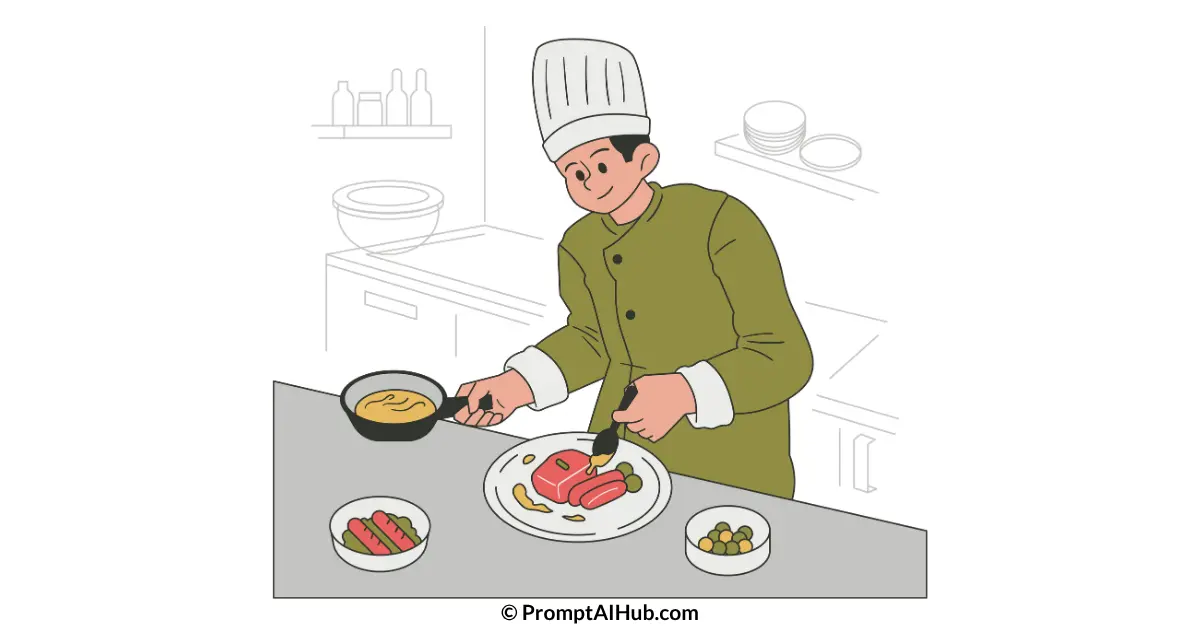
A sous chef has to keep a lot moving at once: prep lists, station organization, recipe adjustments, inventory, staff coordination, plating standards, and the constant pressure of service. ChatGPT can help with many of the planning and communication tasks around that work, especially when you give it enough context about your kitchen.
The key is not to ask AI vague questions such as “Help me plan dinner service.” A better prompt tells it what kind of kitchen you are working in, how many covers you expect, what ingredients are available, what constraints you have, and what kind of output you need.
The prompts below are designed around practical situations a sous chef may encounter before, during, and after service. You can copy them as a starting point and replace the details in brackets with your own information.
Explore Our ChatGPT Prompts, Microsoft Copilot Prompts, Google Gemini Prompts Library
Table of Contents
Start With Better Kitchen Context
Before using any prompt, give ChatGPT useful information about your operation. For example, mention the cuisine, service style, number of covers, available equipment, staffing level, dietary requirements, and time available.
That context can make the difference between a generic answer and something you can actually work with.
Kitchen Planning and Daily Organization
Prompt 1: Build My Daily Kitchen Plan
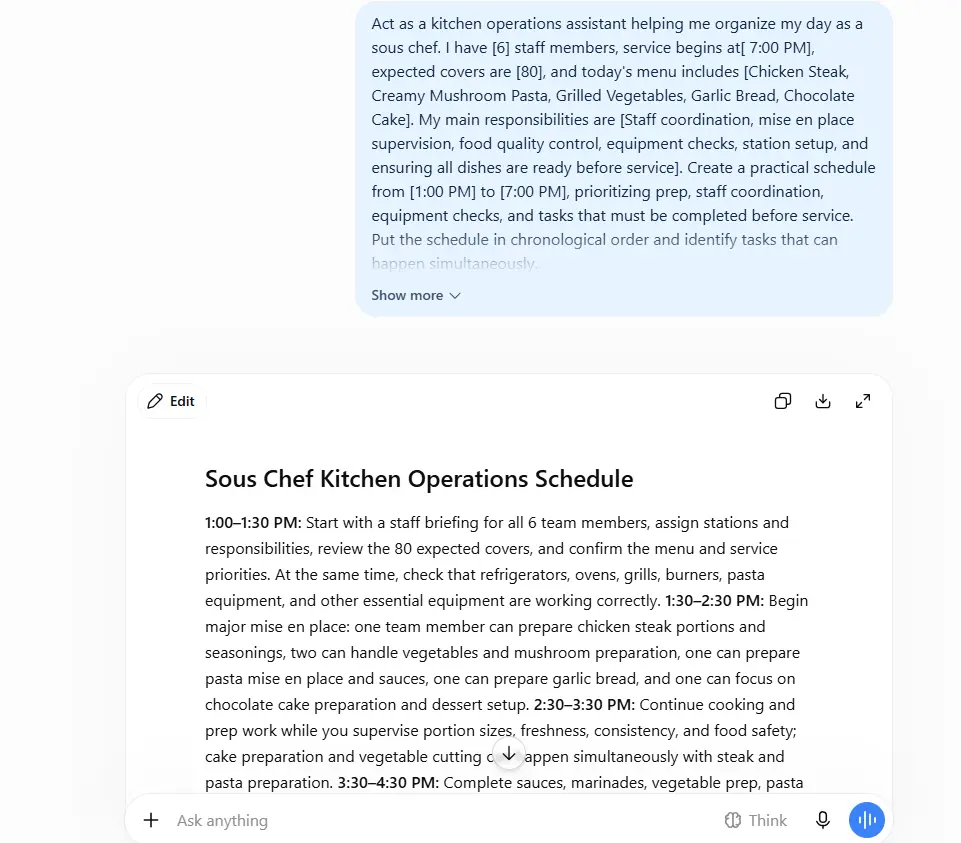
Act as a kitchen operations assistant helping me organize my day as a sous chef. I have [number] staff members, service begins at [time], expected covers are [number], and today’s menu includes [menu items]. My main responsibilities are [responsibilities]. Create a practical schedule from [start time] to [service time], prioritizing prep, staff coordination, equipment checks, and tasks that must be completed before service. Put the schedule in chronological order and identify tasks that can happen simultaneously.
For broader kitchen planning, menu development, and daily culinary workflows, you can also explore these ChatGPT prompts for chefs.
Prompt 2: Turn My Prep Notes Into a Prep List
Turn the following kitchen notes into a clear prep list for my team: [paste notes]. Organize the tasks by station and prioritize them based on urgency and service requirements. Include quantities where provided, preparation methods, storage requirements, and any tasks that should be completed first. Keep the list practical enough to use during a busy kitchen shift.
Prompt 3: Prioritize an Overloaded Prep List
I am a sous chef preparing for service and my current prep list is too large for the available time. Here is the list: [paste list]. We have [number] cooks and [hours/minutes] before service. Rank the tasks by priority, identify what can be delegated, combine tasks that can be performed efficiently together, and flag anything that may need to be postponed or simplified without compromising food quality or safety.
Prompt 4: Create a Station-by-Station Prep Breakdown
Organize today’s preparation for these stations: [stations]. The menu is [menu]. Expected covers are [number], and we have [number] cooks with [amount of prep time] available. Create a station-by-station breakdown showing what each person should prepare, approximate quantities, important finishing steps, and what must be ready before service begins.
Prompt 5: Plan Prep Around Limited Staff
Help me create a realistic prep plan for a kitchen with only [number] cooks today. We need to prepare [menu/items] for approximately [number] covers. We have [hours] before service. Identify the highest-priority tasks, assign them logically according to skill level, and suggest where tasks can overlap. Do not assume we have extra staff or unlimited equipment.
Recipe and Mise en Place Support
Prompt 6: Create a Mise en Place Checklist
Create a mise en place checklist for a sous chef preparing [dish/menu/station]. Include ingredients that need to be washed, cut, portioned, cooked, chilled, labeled, or held; sauces and garnishes; equipment requirements; and final pre-service checks. Organize the checklist so it can be reviewed quickly before service.
Prompt 7: Break a Recipe Into Production Steps
Take this recipe and convert it into a professional kitchen production workflow: [paste recipe]. Separate the process into preparation, cooking, cooling or holding, storage, reheating if applicable, and final plating. Highlight steps that can be completed ahead of service and identify dependencies where one task must happen before another.
Prompt 8: Scale a Recipe for Service
Help me scale this recipe from [original yield] to approximately [target yield/number of portions]. Recipe: [paste recipe]. Show the adjusted ingredient quantities clearly and flag any ingredients or techniques that may require practical adjustment when scaling. Do not assume that every ingredient should be increased in exactly the same way; explain where culinary judgment may be needed.
Prompt 9: Organize Components for a Complex Dish
I need to prepare this dish for service: [dish]. Its components are [list components]. Create a production plan showing which components should be prepared first, which can be prepared in advance, how they should be stored or held, and what needs to happen during final pickup. Keep the workflow focused on consistency and efficient service.
Prompt 10: Identify Missing Mise en Place
Review this dish and its current mise en place: [dish and current prep]. Identify anything important that appears to be missing before service. Consider sauces, garnishes, vegetables, proteins, seasoning components, finishing ingredients, serving vessels, and equipment. Separate your response into “ready,” “needs preparation,” and “verify before service.”
Menu Planning Assistance
A sous chef is often involved in translating a chef’s menu concept into something the kitchen can execute consistently. AI can help organize that thinking, but the final decisions should still account for your kitchen’s actual equipment, suppliers, staff skills, costs, and food-safety requirements.
Prompt 11: Develop Supporting Components for a Menu Item
I am developing a dish centered around [main ingredient/dish concept]. Suggest several complementary components that could work with it, considering flavor balance, texture, acidity, richness, seasonality, and visual presentation. Keep the ideas practical for a professional kitchen and avoid components that would require unnecessarily complicated preparation.
Prompt 12: Review a Menu for Kitchen Workload
Review this menu from a kitchen-production perspective: [paste menu]. Identify dishes or components that may create bottlenecks during prep or service. Look for repeated use of the same equipment, labor-intensive garnishes, overlapping cooking times, complicated pickups, and components that may be difficult to execute consistently. Suggest practical ways to simplify the workflow without changing the overall character of the menu.
Prompt 13: Find Ingredient Overlap Across a Menu
Analyze this menu: [paste menu]. Identify ingredients and components that can be used across multiple dishes without making the menu feel repetitive. Group the overlaps by ingredient and explain how they could improve purchasing, prep efficiency, storage, and waste reduction. Do not recommend changes that would compromise the identity of individual dishes.
Prompt 14: Create a Seasonal Menu Brainstorm
Help me brainstorm a seasonal menu for a [restaurant type] serving [cuisine/style] during [season]. The menu should account for [number] appetizers, [number] mains, [number] sides, and [number] desserts. Focus on practical combinations of ingredients, contrasting textures, balanced flavors, and realistic kitchen execution. Present the ideas as concepts rather than finalized recipes.
If your responsibilities also include desserts and baked items, these ChatGPT prompts for pastry chefs can provide additional ideas for recipe development and production planning.
Prompt 15: Stress-Test a New Dish Before Service
Act as a sous chef reviewing a new dish before it goes into service. The dish is [dish description], with these components: [components]. Analyze the likely preparation challenges, pickup time, equipment requirements, consistency risks, ingredient dependencies, and possible bottlenecks. Then give me a short pre-service checklist of what the kitchen should test before putting the dish on the menu.
Using ChatGPT Without Losing Kitchen Judgment
These prompts work best as a planning aid rather than a replacement for culinary experience. A response can help you organize information, identify overlooked tasks, or generate alternatives, but you still need to check the result against your actual recipes, equipment, staffing, supplier availability, kitchen procedures, and applicable food-safety requirements.
For recipes and production quantities especially, verify the output before putting it into service. AI can help with calculations and organization, but it does not know what is actually happening in your kitchen unless you provide that context.
The more specific your input, the more useful the response is likely to be.
ChatGPT Prompts for Sous Chefs
Turning Service Pressure Into a Clear Plan
Once prep is underway, a sous chef’s job shifts quickly from planning to coordination. A good kitchen plan has to survive changing covers, delayed deliveries, missing prep, staff call-outs, equipment problems, and unexpected rushes.
ChatGPT can be useful here as a second set of eyes for organizing information. Give it the actual situation rather than asking for generic kitchen advice.
Prompt 16: Build a Pre-Service Briefing
Create a concise pre-service briefing for my kitchen team. Today’s menu is [menu], expected covers are [number], service style is [style], and the team consists of [roles/staff]. Important points include [specials, allergies, VIPs, 86’d items, equipment issues, or other notes]. Organize the briefing into menu priorities, station responsibilities, important communication points, potential bottlenecks, and reminders for consistency.
Prompt 17: Assign Responsibilities Across the Team
I have the following kitchen staff available today: [list staff and skill levels]. We need to prepare and serve [menu] for approximately [number] covers. Create a practical responsibility assignment for each person based on their station, experience, and the workload involved. Identify any responsibilities that need a backup person and explain where I should personally focus as the sous chef.
Prompt 18: Adjust the Plan After a Staff Call-Out
One member of my kitchen team called out shortly before service. The missing position is [position], and today’s menu includes [menu]. We have [number] remaining staff members and approximately [time] before service. Reorganize the workload, identify the highest-risk tasks, and suggest a realistic redistribution of responsibilities. Prioritize maintaining food quality and service flow rather than trying to complete every task exactly as originally planned.
Prompt 19: Prepare for a High-Cover Service
Help me prepare my kitchen team for a high-volume service. We are expecting approximately [number] covers between [start time] and [end time], with this menu: [menu]. Identify likely pressure points, prep priorities, station responsibilities, batch-production opportunities, communication points, and tasks that should be checked before service begins.
Prompt 20: Create a Service Contingency Plan
Create a contingency plan for today’s service based on this setup: [menu, staffing, covers, equipment, and service style]. Identify the most likely operational problems and provide a practical response for each one. Focus on situations such as delayed prep, sudden volume increases, missing ingredients, equipment limitations, staff shortages, and communication failures.
Managing Station Flow
A busy station can become a bottleneck even when the overall kitchen appears well prepared. Breaking down the workflow can help reveal where time is being lost.
Prompt 21: Analyze a Busy Station
Analyze this station setup from a sous chef’s perspective: [describe station, menu items, equipment, mise en place, and staff]. Identify potential bottlenecks during service and explain how the station could be organized for faster and more consistent execution. Consider ingredient placement, equipment access, pickup sequence, communication, and unnecessary movement.
Prompt 22: Improve a Pickup Sequence
Review the pickup process for this dish: [dish and current pickup method]. Break the process into logical steps from ticket arrival to plate leaving the pass. Identify steps that can happen simultaneously, steps that create delays, and points where communication between stations is important. Suggest a cleaner sequence without compromising the intended dish.
Prompt 23: Organize a Station for Speed
Help me reorganize this kitchen station for a busy service. Current equipment and ingredients are: [list]. The station handles these dishes: [dishes]. Identify where each major ingredient, utensil, pan, container, and finishing component should ideally be positioned based on frequency of use and workflow. Explain the reasoning behind the proposed arrangement.
Prompt 24: Find Repeated Kitchen Movements
Review this station workflow: [describe workflow]. Identify unnecessary movements, repeated trips, duplicated tasks, or poorly positioned ingredients and equipment. Suggest ways to reduce wasted movement while keeping the station safe, organized, and easy for the cook to maintain during service.
Prompt 25: Create a Station Reset Routine
Create a quick station-reset routine for between service periods. My station is responsible for [dishes/tasks]. Include checks for mise en place, containers, utensils, towels, equipment, labels, waste, cleanliness, replenishment, and communication with other stations. Keep it short enough for a cook to follow during a busy shift.
Inventory and Ingredient Management
Inventory decisions are closely connected to prep, purchasing, menu planning, and waste. ChatGPT can help organize the information you already have, but physical counts and actual product conditions still need to be verified by the kitchen team.
Prompt 26: Turn an Inventory Count Into a Useful Summary
Organize this inventory count into a practical kitchen summary: [paste inventory]. Group items by category and identify products that appear low, products that may need to be used soon, and items that require follow-up. Do not invent quantities or assume product quality. Only use the information I provide.
Prompt 27: Identify Ingredients at Risk of Waste
Review this list of ingredients and quantities: [inventory]. Identify which items may be at higher risk of waste based on their quantity, likely usage, or limited menu applications. Suggest practical ways to prioritize their use in existing dishes or prep, without recommending unnecessary menu changes.
Prompt 28: Plan Prep Around Available Inventory
Here is what we currently have available: [inventory]. Here is the menu for the next service: [menu]. Help me map available ingredients to the required prep and identify any apparent shortages or ingredients that need to be checked. Separate confirmed information from assumptions and do not invent inventory quantities.
Prompt 29: Create a Receiving Checklist
Create a receiving checklist for a professional kitchen receiving these products: [list products]. Include checks for quantity, packaging condition, temperature where applicable, product quality, labeling, dates, damage, and documentation. Keep the checklist practical for use during a busy delivery.
Prompt 30: Compare Inventory With a Menu
Compare this inventory list with this menu: [inventory] and [menu]. Identify ingredients that appear to support multiple menu items, ingredients that may be insufficient based on the information provided, and ingredients that have limited menu use. Do not estimate consumption unless I provide portion or usage information.
For additional AI ideas related to inventory, purchasing, and supply coordination, explore these ChatGPT prompts for supply chain managers.
Food Cost and Portion Planning
A sous chef may also help monitor portion consistency and food usage. AI can assist with calculations and organization, but actual costs should be based on current supplier prices and verified recipe yields.
Prompt 31: Calculate Recipe Cost
Help me calculate the ingredient cost for this recipe. Here are the ingredients, quantities, and current unit prices: [paste data]. Calculate the cost of each ingredient, the total recipe cost, and the approximate cost per portion if the finished recipe yields [number] portions. Show the calculation clearly and flag any missing price or quantity instead of guessing.
Prompt 32: Compare Portion Sizes
I want to compare the food cost implications of these portion sizes: [portion options]. Here are the ingredient costs and recipe information: [data]. Calculate the approximate ingredient cost for each option and explain how changing the portion affects cost. Do not make assumptions about selling price unless I provide it.
Prompt 33: Find High-Cost Components
Analyze this recipe cost breakdown: [paste breakdown]. Identify the ingredients or components contributing most to the total cost. Then suggest practical areas to review, such as portion size, preparation method, ingredient substitution, trim utilization, or purchasing. Do not recommend substitutions that would fundamentally change the dish without clearly explaining the trade-off.
Prompt 34: Build a Portion Control Guide
Create a simple portion-control guide for this dish: [dish]. The target portion is [quantity/size], and the components are [components]. Organize the guide by component and explain how the kitchen can maintain consistency during prep and plating. Keep the instructions practical for line cooks.
Prompt 35: Review Recipe Yield Assumptions
Review this recipe and yield information: [recipe]. I expect it to produce approximately [number] portions. Check the arithmetic and identify any information needed to verify the expected yield. Separate calculations you can confirm from assumptions that require an actual kitchen test.
For additional ideas on analyzing costs and making structured business decisions, explore these ChatGPT prompts for business analysis.
Communication With the Kitchen Team
Clear communication is one of the most useful areas for AI assistance because a sous chef often has to turn a large amount of information into something cooks can understand quickly.
Prompt 36: Rewrite Instructions for a Busy Kitchen
Rewrite these kitchen instructions so they are concise, specific, and easy to follow during a busy shift: [paste instructions]. Preserve the meaning and all important operational details. Remove unnecessary wording and organize the information into clear action points.
Prompt 37: Create a Shift Handover Note
Turn these notes into a concise kitchen shift handover: [paste notes]. Include completed prep, unfinished tasks, low-stock items, equipment concerns, important menu information, staff issues that need attention, and priorities for the next shift. Do not add information that is not in my notes.
Prompt 38: Create a Clear Recipe Brief
Turn this recipe information into a concise kitchen recipe brief: [paste recipe]. Organize it into ingredients, preparation, cooking process, yield, storage or holding information provided, finishing instructions, and key consistency points. Keep the language practical for professional kitchen use.
Prompt 39: Prepare a Training Brief for a New Cook
Create a short training brief for a new cook responsible for [station/dish]. Include the key tasks, expected standards, preparation sequence, common errors to watch for, and questions they should ask if they are unsure. Keep the instructions practical and avoid assuming they already know our kitchen’s procedures.
Prompt 40: Turn Chef Feedback Into Action Items
Here is feedback from the chef after service: [paste feedback]. Turn it into a clear list of actionable improvements for the kitchen. Group the feedback into prep, cooking, plating, timing, communication, cleanliness, and consistency where relevant. Do not change the meaning or add criticisms that were not stated.
You can also organize guest comments and identify recurring issues with these ChatGPT prompts for customer feedback.
A Better Way to Use These Prompts During Service
The most useful approach is to treat ChatGPT as a planning and organization tool, not as the final authority on kitchen decisions.
For example, if a station is falling behind, give the model the actual station setup, staffing, menu, remaining prep, and time available. The resulting suggestions will be much more useful than asking a broad question about “improving kitchen efficiency.”
Likewise, when working with recipes, inventory, yields, or food costs, provide the actual numbers. If an important number is missing, a good prompt should tell ChatGPT to identify the gap instead of filling it with a guess.
That habit helps keep AI output grounded in the reality of your kitchen.
The next section will move beyond daily organization into more specialized sous chef tasks, including menu development, recipe refinement, service troubleshooting, and handling common operational challenges.
ChatGPT Prompts for Sous Chefs
The most useful kitchen prompts are often the ones that help you think through a problem before it becomes a service problem. A sous chef may need to refine a dish, troubleshoot a weak component, adjust a menu around available ingredients, or help the team recover when service starts moving faster than expected.
The prompts in this section focus on those more involved decisions.
Recipe Development and Refinement
Prompt 41: Improve a Dish Concept
I am developing a dish based on this concept: [dish concept]. The main ingredient is [ingredient], and the intended style is [cuisine/style]. Help me evaluate the concept for flavor balance, texture, acidity, richness, aroma, temperature, and presentation. Suggest several practical directions for refinement while keeping the main identity of the dish intact.
Prompt 42: Balance a Dish That Feels Too Rich
This dish currently feels too rich: [describe dish and components]. Analyze which elements may be contributing to the heaviness and suggest practical ways to introduce balance through acidity, bitterness, freshness, texture, seasoning, or portion adjustment. Keep the suggestions appropriate for the existing style of the dish.
Prompt 43: Fix a Dish That Lacks Flavor Contrast
Review this dish: [dish and components]. The main problem is that the flavors feel flat or lack contrast. Identify where additional contrast could come from, such as acidity, salinity, sweetness, bitterness, spice, freshness, aroma, or texture. Give several options and explain what each would contribute.
Prompt 44: Develop Variations of a Dish
Take this dish concept: [dish]. Create [number] distinct variations that maintain the same core ingredient or culinary identity. Vary the supporting flavors, textures, sauces, garnishes, or preparation techniques while keeping each version realistic for a professional kitchen.
Prompt 45: Evaluate a New Sauce
I am testing this sauce: [recipe or description]. Evaluate it for flavor balance, texture, consistency, versatility, and suitability for [dish]. Identify anything that may need adjustment and explain what I should test during a kitchen trial. Do not assume ingredients or quantities that I have not provided.
Prompt 46: Create Garnish Options
The main dish is [dish], and its existing components are [components]. Suggest several garnish concepts that contribute flavor, texture, color, or aroma rather than simply decorating the plate. Prioritize options that are practical to prep and execute during service.
Prompt 47: Improve Texture Contrast
Analyze the textures in this dish: [dish/components]. Identify whether the plate has enough contrast and suggest practical ways to introduce elements such as crispness, creaminess, tenderness, chew, crunch, or freshness. Keep the recommendations compatible with the dish’s existing flavors.
Prompt 48: Compare Two Preparation Methods
I am deciding between these two preparation methods for [ingredient/dish]: [method A] and [method B]. Compare them in terms of texture, flavor development, consistency, labor, equipment, prep time, holding considerations, and service practicality. Based only on the information provided, explain which method may be more suitable for this kitchen and what should be tested before deciding.
Menu Engineering From a Kitchen Perspective
A menu is not only a list of dishes. Every item creates prep requirements, station pressure, ingredient demand, storage needs, and service dependencies.
Prompt 49: Identify Menu Bottlenecks
Review this menu from the perspective of kitchen production: [paste menu]. Identify dishes or components that could become bottlenecks during a busy service. Consider labor-intensive preparation, shared equipment, limited cooking capacity, complicated plating, repeated ingredients, and timing conflicts. Rank the biggest operational concerns and suggest practical solutions.
Prompt 50: Reduce Menu Complexity
Analyze this menu: [paste menu]. The kitchen is struggling with prep and service complexity. Identify components or processes that could potentially be simplified while preserving the overall character of each dish. For every suggestion, explain what operational problem it addresses and what trade-off it might create.
Prompt 51: Identify Shared Components
Analyze these menu items: [menu]. Find components that could be prepared efficiently in larger batches and used across multiple dishes without making the menu repetitive. Group the opportunities by sauces, vegetables, garnishes, proteins, bases, and other relevant categories. Prioritize ideas that could genuinely reduce duplicated prep.
Prompt 52: Plan a Menu Trial
I am testing this proposed menu: [menu]. Create a kitchen trial plan covering recipe testing, portion consistency, prep time, cooking time, holding, plating, equipment requirements, and service simulation. Identify what should be measured or observed during the trial so the team can make informed adjustments.
Prompt 53: Prepare a Menu Changeover Plan
We are replacing our current menu with this new menu: [old menu] → [new menu]. Create a practical changeover plan covering ingredient inventory, recipe testing, prep changes, station setup, staff training, recipe documentation, equipment requirements, and service testing. Identify tasks that should happen before the first live service.
If you are creating structured training materials for your team, these ChatGPT prompts for lesson plans can provide additional ideas for organizing learning conten
Service Troubleshooting
When something goes wrong during service, the goal is not simply to fix the immediate problem. A sous chef also needs to understand why the problem occurred so the same issue does not keep repeating.
Prompt 54: Diagnose a Slow Station
A kitchen station is consistently falling behind during service. Here are the details: [station, dishes, staffing, equipment, prep, and service volume]. Analyze the possible causes and separate them into prep issues, staffing issues, equipment issues, workflow issues, communication issues, and menu-related issues. Then suggest the first three things I should investigate.
Prompt 55: Troubleshoot Delayed Tickets
Our tickets are taking longer than expected during service. Here is the situation: [describe service flow, menu, stations, staffing, and approximate delays]. Identify possible bottlenecks and explain how I can determine which station or process is actually causing the delay. Avoid assuming the slowest-looking station is automatically the root cause.
Prompt 56: Handle a Sudden Rush
We have received an unexpected rush of approximately [number] additional covers/orders. Current staffing is [staffing], available mise en place is [prep status], and the menu is [menu]. Help me prioritize immediate actions for the kitchen. Separate the response into what should happen immediately, what can be delegated, what needs communication with the front of house, and what should be monitored during the rush.
Prompt 57: Recover From Missing Mise en Place
Service is approaching and we are missing this preparation: [missing prep]. We have [time] remaining, [staff] available, and the following equipment: [equipment]. Create a realistic recovery plan. Prioritize the most important items and identify which tasks can be done simultaneously. Do not assume we have ingredients, equipment, or staff that I have not listed.
Prompt 58: Troubleshoot an Inconsistent Dish
A dish is coming out inconsistently between cooks. The dish is [dish], and the current preparation and plating process is [process]. Identify possible sources of variation, including ingredient portioning, cooking, seasoning, holding, timing, plating, and communication. Then create a short consistency checklist for the station.
Prompt 59: Analyze a Service Breakdown
Review this service problem: [describe what happened]. Analyze the sequence of events and identify possible contributing factors. Separate immediate causes from underlying process issues. Then suggest a small number of practical changes that could reduce the chance of the same problem happening again.
Prompt 60: Create a Post-Service Troubleshooting Review
Turn these service notes into a structured troubleshooting review: [paste notes]. Identify what went wrong, what worked, possible root causes, immediate fixes, and changes to test during the next service. Keep the review constructive and focused on improving kitchen systems rather than assigning blame.
Since managing people and daily workflows is also an operational responsibility, these ChatGPT prompts for operations managers may offer additional ideas.
Training and Skill Development
A strong sous chef often has to teach while working. AI can help organize training material around the actual responsibilities of a station or cook.
Prompt 61: Create a Station Training Plan
Create a training plan for a cook learning the [station] station. Their current experience level is [experience]. The station handles [dishes/tasks]. Break the training into practical stages, starting with basic setup and moving toward independent service. Include skills to demonstrate, skills to practice, and signs that the cook is ready to progress.
Prompt 62: Create a Knife-Skills Practice Plan
Create a practical knife-skills practice plan for a kitchen cook at the [beginner/intermediate] level. Focus on skills relevant to [type of kitchen/menu]. Include safe practice exercises, consistency goals, useful cuts, and ways a chef can evaluate the results. Keep the plan realistic for a professional kitchen environment.
Prompt 63: Build a Recipe Training Exercise
Create a hands-on training exercise for this recipe: [recipe]. The goal is to teach a cook [specific skill]. Break the exercise into preparation, execution, evaluation, and correction. Identify the most important quality standards the cook should learn rather than simply having them reproduce the recipe.
Prompt 64: Create a Plating Practice Guide
Create a plating practice guide for this dish: [dish]. The target presentation is [describe presentation]. Break the plating process into logical steps and identify the visual standards that should remain consistent. Include common mistakes to watch for and a short final inspection checklist.
For a different perspective on evaluating and describing dishes, explore these ChatGPT prompts for food critics.
Prompt 65: Turn Mistakes Into a Training Lesson
A cook made these mistakes during preparation/service: [describe mistakes]. Turn them into a constructive training lesson. Explain the likely skill or process gap behind each issue, how I can demonstrate the correct approach, and what practical exercise could help the cook improve.
Recipe Documentation and Standardization
Consistency becomes much easier when the kitchen’s recipes are documented clearly. ChatGPT can help turn scattered notes into structured documents, provided the underlying information is accurate.
Prompt 66: Standardize My Recipe Notes
Convert these recipe notes into a standardized professional kitchen recipe format: [paste notes]. Organize the information into ingredients, quantities, preparation, cooking procedure, yield, portion size, finishing instructions, and storage or holding information where provided. Do not invent missing information. Mark anything that still needs to be confirmed.
Prompt 67: Create a Recipe Card
Create a concise recipe card from this information: [recipe details]. Format it so a trained kitchen cook can quickly understand the ingredients, quantities, method, yield, and key quality points. Keep the language operational rather than conversational.
Prompt 68: Compare Two Versions of a Recipe
Compare these two versions of the same recipe: Version A [recipe] and Version B [recipe]. Identify differences in ingredients, quantities, preparation, cooking method, yield, and finishing. Explain which differences may affect flavor, texture, consistency, labor, or cost. Do not assume that one version is better without evidence.
Prompt 69: Identify Ambiguous Recipe Instructions
Review this kitchen recipe: [paste recipe]. Identify instructions that could be interpreted differently by different cooks. Highlight unclear quantities, temperatures, timings, textures, visual cues, sequencing, or finishing instructions. Rewrite only the ambiguous sections so they are easier to execute consistently.
Prompt 70: Create a Recipe Testing Checklist
Create a recipe-testing checklist for this dish: [dish]. Include checks for ingredient quantities, yield, flavor, seasoning, texture, cooking consistency, holding, plating, portion size, timing, equipment requirements, and service practicality. Leave room for recording observations and changes after each test.
Using AI More Carefully in a Professional Kitchen
The more operational the task, the more important it is to separate AI-generated suggestions from verified kitchen procedures.
For example, ChatGPT can help reorganize a recipe, but the kitchen should still verify the actual yield. It can suggest ways to structure a prep schedule, but the sous chef knows whether a particular oven, fryer, walk-in, or prep station is actually available. It can help identify possible causes of a service delay, but the team needs to observe the operation to determine what is really happening.
That distinction is especially important when prompts involve food safety, allergens, temperatures, storage, cooking times, or other procedures where incorrect information could create real risks. Use your established kitchen standards and applicable food-safety requirements as the authority, and treat AI output as an organizational aid rather than a substitute for them.
ChatGPT Prompts for Sous Chefs
A sous chef often spends as much time keeping the kitchen organized as preparing food. Inventory needs attention, deliveries need checking, staff need direction, prep needs monitoring, and the chef needs accurate information about what is happening on the floor.
The prompts in this section are built around those operational responsibilities.
Purchasing and Ordering Support
ChatGPT can help organize purchasing information, compare requirements, and turn scattered notes into an easier ordering workflow. It should not replace your actual inventory counts, supplier information, quality checks, or purchasing procedures.
Prompt 71: Build an Ordering List
Turn this inventory information and upcoming menu into a preliminary ordering list: Current inventory: [inventory]. Upcoming menu/services: [menu and expected covers]. Identify ingredients that appear to need replenishment based only on the information provided. Group the list by category and show the reason each item appears on the list. Do not invent quantities.
Prompt 72: Prioritize an Urgent Order
I need to place an urgent kitchen order and have limited time. Here is our current inventory: [inventory]. Our upcoming service requires: [menu/requirements]. Rank the items that need immediate attention, items that can wait, and items that should be verified before ordering. Explain the reasoning without assuming stock levels that I have not provided.
Prompt 73: Compare Supplier Options
Compare these supplier options for the following ingredients: [ingredients]. Supplier information: [prices, pack sizes, minimum orders, delivery details, or other information]. Organize the comparison by product, effective unit cost where calculable, pack size, and relevant purchasing considerations. Flag missing information instead of guessing.
Prompt 74: Prepare a Delivery Verification Sheet
Create a delivery verification sheet for these ordered products: [order]. Include product name, expected quantity, quality checks, packaging condition, date information where relevant, and a space for discrepancies. Keep it concise enough for a kitchen team to use while receiving a delivery.
Prompt 75: Identify Ordering Patterns
Analyze these previous order records: [paste records]. Identify recurring ingredients, unusual changes in quantities, frequently ordered items, and potential patterns worth reviewing. Do not claim that an ingredient is over- or under-ordered unless the supplied data supports that conclusion.
Reducing Kitchen Waste
Waste reduction is more useful when it comes from better planning and utilization rather than simply telling cooks to “waste less.”
Prompt 76: Analyze a Waste Log
Analyze this kitchen waste log: [paste data]. Group the waste by ingredient, category, reason, and frequency where the information allows. Identify the largest patterns and suggest practical areas for investigation. Do not invent causes that are not supported by the information.
Prompt 77: Find Possible Trim Uses
Here are the ingredients and usable trim we regularly produce: [list]. Suggest practical culinary uses for appropriate trim, such as stocks, sauces, staff meals, garnishes, fillings, or other preparations. Keep food safety and product suitability in mind, and distinguish between ideas that require verification and straightforward culinary applications.
Prompt 78: Build a Waste-Reduction Prep Plan
Review this menu, inventory, and recent waste information: [data]. Identify preparation practices that may be contributing to unnecessary waste and suggest a revised prep approach. Focus on realistic changes such as batch size, portioning, prep frequency, ingredient utilization, and better alignment between prep and expected demand.
Prompt 79: Create a Leftover Utilization Plan
We have these ingredients or prepared components remaining after service: [list]. Suggest appropriate ways they could potentially be used in future planned preparations, provided they meet our kitchen’s existing quality and food-safety requirements. Separate ideas by ingredient and do not assume that every leftover item is suitable for reuse.
Prompt 80: Review a Prep Yield Problem
We are getting less usable product from this ingredient than expected: [ingredient]. Here are the purchase quantity, preparation method, trim, and usable yield: [information]. Help me organize the numbers and identify where additional investigation may be useful. Do not assume the cause without evidence.
Staff Scheduling and Team Coordination
A sous chef may need to balance experience, station requirements, expected volume, prep workload, and available labor.
Prompt 81: Build a Kitchen Shift Assignment
Create a shift assignment based on this team: [staff and roles]. Today’s expected covers are [number], service style is [style], and the menu is [menu]. Assign stations and prep responsibilities according to the information provided. Identify areas where I may need a floating or backup person and explain why.
Prompt 82: Match Staff Skills to Stations
Here is my team and their current strengths: [staff and skills]. Here are today’s stations and workload requirements: [stations/tasks]. Suggest a station assignment that matches skills to operational needs. Explain where less-experienced staff could work with supervision and where experienced cooks are most important.
Prompt 83: Create a Cross-Training Plan
Create a cross-training plan for these kitchen employees: [staff]. Current skills are [skills], and the stations they need to learn are [stations]. Organize the training over [time period]. Prioritize skills that improve operational flexibility while keeping the plan realistic around normal service.
Prompt 84: Prepare a Team Huddle
Create a short kitchen team huddle based on today’s information: [menu, covers, staffing, special requirements, equipment issues, and priorities]. Keep it direct and practical. Include only information the team needs to know before starting prep or service.
Prompt 85: Create a Performance Discussion Outline
Help me structure a professional performance discussion with a kitchen employee about these issues: [issues]. Create an outline covering specific observations, expected standards, questions for the employee, agreed actions, and follow-up. Keep the language constructive and focused on work performance rather than personal criticism.
Kitchen Communication and Leadership
Good communication becomes especially important when several stations depend on one another.
Prompt 86: Improve a Kitchen Communication Process
Our kitchen is experiencing communication problems around [tickets, prep, shortages, specials, allergies, handovers, or another issue]. Describe the current process: [process]. Identify where information may be getting lost or delayed and suggest a simpler communication workflow that the team can realistically follow during service.
Prompt 87: Create an Opening Shift Checklist
Create an opening checklist for a sous chef in this type of kitchen: [restaurant type]. Include equipment checks, station readiness, inventory verification, prep review, deliveries, cleanliness, menu communication, staffing, and pre-service coordination. Prioritize the checks that directly affect readiness for service.
Prompt 88: Create a Closing Shift Checklist
Create a closing checklist for a professional kitchen. Our operation includes [stations/equipment]. Include storage and labeling checks, inventory notes, cleaning responsibilities, equipment shutdown, waste recording, prep planning for the next shift, and communication of unfinished tasks. Keep it practical rather than overly detailed.
Prompt 89: Build a Manager Handover
Turn these notes into a concise handover for the next kitchen manager or sous chef: [notes]. Include service performance, prep status, inventory concerns, staffing information, equipment problems, supplier issues, and priorities for the next shift. Clearly separate confirmed information from items that still need checking.
Prompt 90: Turn a Kitchen Meeting Into Action Items
Here are notes from our kitchen meeting: [paste notes]. Convert them into a structured action list with the task, responsible role/person if provided, priority, deadline if provided, and relevant notes. Do not invent owners or deadlines that were not discussed.
Handling Menu Changes and Special Requests
Changes during service can create additional work for multiple stations. A structured response can help keep the team aligned.
Prompt 91: Organize Today’s Specials
Turn these special-item notes into a concise kitchen brief: [specials]. Include ingredients, preparation requirements, station responsibilities, pickup instructions, portion information provided, and important communication points. Do not invent recipe details that are missing.
Prompt 92: Prepare for a Menu Item 86
A menu item is no longer available: [item]. Here is the current menu and remaining relevant ingredients: [information]. Help me create a communication plan for the kitchen and identify which other dishes or preparations may be affected. Do not assume ingredient relationships that are not provided.
Prompt 93: Coordinate a Last-Minute Menu Change
We need to change this menu item shortly before service: [original item]. The proposed replacement is [replacement]. Available ingredients, staff, equipment, and prep time are [details]. Identify the operational changes required across prep, stations, plating, communication, and service. Flag anything that must be physically tested or confirmed before service.
Prompt 94: Organize Allergy-Related Communication
I need to organize the kitchen information for these stated guest dietary or allergy requirements: [details]. Based only on the information provided, create a clear communication checklist covering affected dishes, ingredients that need verification, relevant stations, and points that should be confirmed with the appropriate kitchen and service staff. Do not make assumptions about whether an ingredient is safe or unsafe; flag items that require verification against our established allergen procedures.
Prompt 95: Create a Special-Request Workflow
Create a practical workflow for handling unusual guest requests during service. Our current kitchen setup is [describe setup]. The workflow should cover receiving the request, verifying what is possible, communicating with the relevant station, confirming ingredients and procedures, preparing the modification, and communicating completion. Keep the process short enough to use during service.
Kitchen Quality Control
Quality control becomes much easier when standards are specific enough for different cooks to interpret them consistently.
Prompt 96: Create a Quality Check for a Dish
Create a quality-control checklist for [dish]. Based on the information I provide about the dish, include checks for appearance, portioning, temperature where relevant, texture, seasoning, sauce consistency, garnish, plating, and pickup timing. Do not invent specific standards that I have not provided; identify areas that need my kitchen’s defined standard.
Prompt 97: Build a Pre-Service Quality Review
Create a pre-service quality review for this menu: [menu]. Organize the checks by station and include mise en place, sauces, proteins, vegetables, garnishes, equipment, plating components, and communication points. Prioritize items that could cause problems during service if they are not checked in advance.
Prompt 98: Create a Mid-Service Quality Check
Create a quick mid-service quality check for a sous chef overseeing this menu: [menu]. Include the most important things to observe during service, such as consistency, ticket timing, portioning, station organization, communication, and product quality. Keep it short enough that I can use it without leaving the pass for an extended period.
Prompt 99: Turn Guest Feedback Into Kitchen Improvements
Review this guest feedback related to food quality: [feedback]. Group the comments into recurring themes and identify which issues may be relevant to kitchen preparation, cooking, seasoning, portioning, presentation, or consistency. Separate actual feedback from possible interpretations and suggest what the kitchen should investigate.
Prompt 100: Create a Post-Service Quality Review
Create a post-service review based on these observations: [notes]. Organize the review into food quality, consistency, timing, prep, station performance, communication, waste, and equipment where relevant. Identify the highest-priority improvements for the next service and avoid assigning blame without evidence.
Making AI Part of the Sous Chef Workflow
You do not need to use every prompt every day. The better approach is to build a small collection around the recurring responsibilities in your kitchen.
For example, you might use one set of prompts before service to organize prep and staffing, another during planning to review menu workload, and another after service to document problems and improvements.
A simple workflow could look like this:
Before prep: inventory review → prep planning → staff assignment → station setup
Before service: quality checks → team briefing → contingency planning → final station review
During service: bottleneck analysis → communication support → priority adjustments → quality monitoring
After service: waste review → service troubleshooting → handover notes → next-shift priorities
The value comes from adapting the prompts with real kitchen information rather than treating them as fixed instructions.
When using AI for operational decisions, continue to verify anything involving food safety, allergens, storage, cooking temperatures, or other regulated procedures against your kitchen’s established standards and applicable requirements.
ChatGPT Prompts for Sous Chefs
The final group of prompts focuses on the areas that often sit between kitchen operations and leadership: improving systems, documenting standards, preparing for events, reviewing performance, and turning everyday kitchen information into something easier to manage.
Event and High-Volume Service Planning
Large services require more than simply increasing ingredient quantities. Staffing, equipment, prep timing, holding, communication, and station capacity all need to be considered together.
Prompt 101: Build an Event Kitchen Plan
Help me create a kitchen production plan for an event serving approximately [number] guests. The menu is [menu], service style is [style], available kitchen staff are [staff], and preparation time is [time]. Organize the plan into purchasing considerations, prep, production, staffing, equipment, holding, plating or service, and final checks. Clearly identify information that still needs to be confirmed.
Prompt 102: Plan a Large Batch Production
I need to produce [dish/component] for approximately [number] portions. Here is the recipe and available equipment: [details]. Create a batch-production workflow covering ingredient preparation, production stages, portioning, storage or holding based only on the information supplied, and final service preparation. Highlight steps that should be tested before large-scale production.
Prompt 103: Prepare for a Banquet Service
Create a practical kitchen preparation plan for a banquet serving [number] guests. Menu: [menu]. Service begins at [time]. Staff: [staff]. Equipment available: [equipment]. Break the work into preparation, cooking, finishing, plating/service, communication, and contingency planning. Prioritize tasks according to their impact on service readiness.
Prompt 104: Identify Event Production Risks
Review this event plan: [event details]. Identify possible kitchen risks involving staffing, production volume, equipment capacity, timing, ingredient availability, communication, and service flow. Rank the risks by urgency and suggest practical questions or checks I should complete before the event.
Prompt 105: Create an Event Day Timeline
Create a chronological kitchen timeline for an event taking place at [time]. We need to prepare [menu] for [number] guests with [staff] available. Here are the known prep and production requirements: [details]. Organize the timeline around dependencies and critical deadlines. Do not invent cooking or holding times that I have not supplied; flag those items for confirmation.
Building Better Kitchen Systems
A good sous chef does not only solve today’s problem. They also help create systems that make tomorrow’s service easier.
Prompt 106: Turn a Repeated Problem Into a SOP
We repeatedly experience this kitchen problem: [problem]. Describe the current process: [process]. Help me create a simple standard operating procedure designed to reduce the problem. Include purpose, responsibilities, steps, checks, and escalation points where appropriate. Do not invent regulations or requirements that I have not provided.
Prompt 107: Create a Prep Standard
Create a prep standard for [ingredient/component]. Here are our intended requirements: [details]. Organize them into product specification, preparation, portioning, storage or labeling information provided, quality checks, and communication points. Mark any missing information that needs to be defined by the kitchen.
Prompt 108: Document a Station Standard
Help me document the standard for our [station]. It handles [dishes/tasks] and uses [equipment]. Create a practical station standard covering setup, mise en place, organization, service responsibilities, quality expectations, cleaning/reset, and handover. Keep it usable by experienced cooks rather than writing it like a general textbook.
Prompt 109: Create a Kitchen Audit Checklist
Create an internal kitchen audit checklist for this operation: [restaurant type/setup]. Cover prep organization, recipe consistency, inventory, labeling, cleanliness, equipment readiness, station organization, communication, waste tracking, and service readiness. Separate routine checks from items that require management review.
Prompt 110: Find Weak Points in a Kitchen Workflow
Analyze this kitchen workflow: [describe workflow]. Identify steps that depend too heavily on one person, create unnecessary delays, require repeated communication, or could fail when volume increases. Suggest practical system improvements and explain which problem each improvement addresses.
Leadership and Career Development
Sous chefs often move between hands-on cooking, staff development, decision-making, and communication with senior management. AI can help organize reflection and planning around those responsibilities.
Prompt 111: Create a Leadership Improvement Plan
I want to improve as a sous chef in these areas: [leadership areas]. My current strengths are [strengths], and the situations I find difficult are [situations]. Create a practical development plan with specific behaviors to practice, situations where I can apply them, and ways to review my progress. Avoid generic motivational advice.
Prompt 112: Prepare for a Chef-to-Sous-Chef Conversation
Help me prepare for a professional conversation with my executive chef or head chef about my performance. The topics I want to discuss are [topics]. Create thoughtful questions and talking points that focus on expectations, responsibilities, feedback, development, and kitchen performance.
Prompt 113: Reflect on a Difficult Service
Help me conduct a structured review of this difficult service: [describe what happened]. Ask me to consider preparation, leadership, communication, decision-making, staffing, food quality, timing, and recovery. Then organize my observations into lessons I can apply to future services. Do not invent details about what happened.
Prompt 114: Identify Leadership Patterns
Here are several situations I have experienced as a sous chef: [situations]. Analyze them for recurring leadership or communication patterns. Identify what appears to be working, what may need improvement, and what specific behaviors I could test in future situations. Base the analysis only on the examples I provide.
Prompt 115: Create a Professional Development Roadmap
Create a development roadmap for a sous chef who wants to progress toward [target role]. Current responsibilities are [responsibilities], current strengths are [strengths], and skills I want to develop are [skills]. Organize the roadmap into technical, operational, leadership, financial, communication, and management skills where relevant.
To organize guest comments and identify useful patterns, you can also explore these ChatGPT prompts for customer feedback.
Turning Kitchen Data Into Useful Reviews
If you already keep notes about prep, waste, service timing, inventory, or staffing, ChatGPT can help turn those records into a more structured review.
Prompt 116: Analyze Weekly Kitchen Notes
Analyze these kitchen notes from the past week: [paste notes]. Identify recurring operational themes, repeated problems, successful practices, and items that require follow-up. Organize the findings by prep, service, staffing, inventory, quality, waste, and equipment where relevant. Do not create conclusions that are unsupported by the notes.
Prompt 117: Create a Weekly Sous Chef Review
Create a weekly review template for my role as a sous chef. Include sections for service performance, prep, food quality, staffing, training, inventory, waste, equipment, recurring problems, improvements tested, and priorities for next week. Keep it concise enough to complete regularly.
Prompt 118: Compare Two Service Periods
Compare these two sets of kitchen observations: Period A [data] and Period B [data]. Identify meaningful differences in preparation, staffing, service flow, waste, quality, or other areas supported by the information. Avoid claiming that one period performed better unless the supplied data supports that conclusion.
Prompt 119: Create a Kitchen Improvement Tracker
Turn these improvement ideas into a practical tracker: [ideas]. Organize each item by problem, proposed change, responsible person if provided, target date if provided, current status, and follow-up notes. Do not invent owners, dates, or results.
Prompt 120: Find Priorities From a Long List
Here is a long list of kitchen issues and improvement ideas: [list]. Group related items, remove genuine duplicates, and prioritize the issues based on their apparent impact and urgency. Explain the reasoning behind the ranking and identify which items need more information before a decision can be made.
For additional frameworks to analyze challenges and find practical solutions, explore these ChatGPT prompts for problem solving.
Prompt 121: Build a Daily Sous Chef Command Center
Create a reusable daily planning template for a sous chef. Include today’s menu, expected covers, staffing, prep priorities, inventory concerns, station assignments, equipment issues, special requests, pre-service checks, service notes, and post-service follow-up. Design it so I can paste today’s information into the template and quickly turn it into an actionable kitchen plan.
Prompt 122: Turn Messy Notes Into a Kitchen Action Plan
Turn these raw kitchen notes into an organized action plan: [paste notes]. Separate the information into immediate actions, prep tasks, service concerns, inventory issues, staff responsibilities, follow-up items, and information that still needs confirmation. Preserve the original facts and do not fill gaps with assumptions.
Prompt 123: Create a Problem-Solving Framework
I need to solve this recurring kitchen problem: [problem]. Create a structured framework I can use to investigate it. Include the symptoms to document, possible categories of causes, questions to ask the team, information to collect, potential solutions to test, and a way to evaluate whether a change actually worked. Do not assume the root cause before the investigation.
Prompt 124: Review a New Kitchen Process
We are considering this new kitchen process: [process]. Evaluate it from the perspectives of efficiency, staff workload, consistency, communication, equipment use, training, and practical service execution. Identify potential advantages, possible failure points, and questions we should answer before adopting it.
Prompt 125: Create a Sous Chef Weekly Planning System
Design a practical weekly planning system for a sous chef responsible for [responsibilities]. Include recurring daily tasks, weekly reviews, staff development, inventory and ordering checks, menu preparation, equipment follow-up, waste review, and communication with senior kitchen management. Keep the system realistic for someone who is also actively involved in kitchen operations.
For broader culinary planning and kitchen workflow ideas, explore these ChatGPT prompts for chefs
How to Get Better Results From These Sous Chef Prompts
A prompt becomes much more useful when it reflects the actual kitchen rather than an imaginary one.
Instead of:
“Make me a prep schedule.”
Give ChatGPT details such as:
- Expected covers
- Service time
- Number of cooks
- Stations
- Menu items
- Available prep time
- Equipment limitations
- Current mise en place
- Ingredients already available
- Tasks that are already complete
You can also tell ChatGPT what not to assume. For example:
“Use only the inventory and staffing information I provide. If something important is missing, identify it rather than guessing.”
That small instruction can make AI-generated plans easier to review.
A Simple Prompt Formula for Sous Chefs
For recurring kitchen tasks, a useful structure is:
Role + Situation + Kitchen Context + Task + Constraints + Desired Output
For example:
“Act as a kitchen operations assistant. I am preparing for a 120-cover dinner service with four cooks across three stations. We have three hours for prep and the following menu: [menu]. Create a station-by-station prep plan, prioritize tasks by urgency, and identify anything that could become a service bottleneck. Do not assume additional staff or equipment.”
The important part is not the wording itself. It is the amount of useful context you provide.
Common Mistakes When Using ChatGPT in a Kitchen
Giving Too Little Context
A vague prompt usually produces a generic answer. Include the operational details that actually affect the decision.
Treating AI Suggestions as Verified Kitchen Standards
AI output should be reviewed before becoming a recipe, SOP, production standard, or operational procedure.
Asking for Calculations Without Providing the Numbers
If you want food-cost, yield, or portion calculations, provide the actual quantities and prices available to you. Ask the model to flag missing information instead of guessing.
Using One Prompt for Every Situation
A prep-planning prompt is not the right tool for diagnosing a service bottleneck. Build prompts around specific recurring tasks.
Forgetting to Refine the First Response
If the initial answer is too broad, give ChatGPT additional context:
“Make this more practical for a four-person kitchen with limited prep space.”
or:
“Rework the plan around a 90-minute prep window.”
You can treat the first response as a working draft rather than the final answer.
A Practical Sous Chef AI Workflow
For everyday use, you can organize your prompts around the rhythm of the kitchen:
Before prep: review inventory → build prep list → assign responsibilities → identify priorities.
Before service: review stations → check mise en place → brief the team → identify likely bottlenecks.
During service: organize information → troubleshoot workflow → communicate changes → monitor consistency.
After service: document problems → review waste → record unfinished tasks → prepare the next shift.
Weekly: analyze recurring issues → review staffing and training → update processes → prioritize improvements.
This makes ChatGPT more useful as a planning assistant instead of something you only open when you have a problem.
FREE AI TOOLS
Visit Our Free AI tools
Prompts AI Hub Team Has Tailored Their AI Knowledge and Created Tools for You Free of Cost, Enjoy
Frequently Asked Questions
Can a sous chef use ChatGPT for daily kitchen planning?
Yes. It can help organize prep lists, schedules, station assignments, handover notes, meeting points, and other planning information. The usefulness depends heavily on the accuracy and detail of the information you provide.
Can ChatGPT create recipes for a professional kitchen?
It can help brainstorm recipes, organize recipe notes, suggest variations, and structure production workflows. However, recipes intended for professional service should be tested and verified by the kitchen before being adopted as a standard.
Can ChatGPT help with food costing?
Yes. If you provide accurate ingredient quantities, yields, and current prices, it can calculate and organize food-cost information. It should not invent missing prices, yields, or supplier data.
Can sous chefs use ChatGPT for inventory management?
ChatGPT can help organize inventory counts, compare inventory with menu requirements, identify apparent shortages, structure ordering lists, and analyze waste records. Physical inventory counts and purchasing decisions still require verification.
Can ChatGPT help train kitchen staff?
It can help create station training plans, recipe exercises, plating checklists, skill-development activities, and constructive feedback frameworks. The sous chef remains responsible for demonstrating techniques and evaluating actual performance.
Can ChatGPT help during a busy service?
It can be useful for quickly organizing information and thinking through operational problems, but a sous chef should not depend on AI for real-time decisions when immediate physical observation or established kitchen procedures are more appropriate.
Should I include my entire recipe in a ChatGPT prompt?
Include the information necessary for the task. If you want recipe analysis, scaling, costing, or workflow organization, provide the relevant ingredients, quantities, yield, and method. Avoid including unnecessary information that does not affect the requested task.
How can I make ChatGPT responses more useful for my kitchen?
Give it specific context: menu, covers, staffing, equipment, time available, inventory, station responsibilities, and the desired output. Also tell it to identify missing information rather than making assumptions.
Are ChatGPT prompts suitable for food-safety decisions?
AI should not replace your established food-safety procedures, trained judgment, or applicable regulations. For safety-critical information, verify the relevant requirements through authoritative sources and your kitchen’s approved procedures.
Download All Prompts
To Download 50K Plus Prompts Click Below and Get Them In One Click.
Final Thoughts
For a sous chef, the most useful role for ChatGPT is not replacing culinary judgment. It is helping turn a complicated workload into clearer plans, organized information, useful checklists, structured reviews, and practical starting points.
The prompts in this guide cover everything from prep planning and station organization to inventory, menu development, staff training, service troubleshooting, waste review, and leadership.
Start with the tasks that consume the most time in your own kitchen. Customize the prompts with real information, verify important outputs, and refine them as you learn what works for your operation.
Used that way, ChatGPT can become a practical support tool for the planning and organizational side of a sous chef’s job—while the decisions that depend on professional experience, actual kitchen conditions, and established standards remain where they belong: with the kitchen team.
For more practical AI prompt ideas across different professions and workflows, explore Prompts AI Hub and adapt the same context-first approach to the tools you already use.

For More Information, About Author Visit Our Team