ChatGPT Prompts for Cheese Makers: Practical AI Ideas for Cheese Production, Marketing, and Business
Making great cheese involves much more than following a recipe. Cheese makers have to think about ingredients, cultures, aging, consistency, production planning, customer preferences, packaging, sales, and the countless small decisions that keep a cheese business running smoothly.
ChatGPT can help with many of those tasks, especially when you give it enough context about your cheese, production method, audience, or business. The goal is not to replace your cheesemaking knowledge. Instead, it can act as a practical assistant for planning, organizing, writing, brainstorming, and analyzing information.
This collection focuses on prompts designed specifically around the work cheese makers actually do.
Explore Our ChatGPT Prompts, Microsoft Copilot Prompts, Google Gemini Prompts Library
Table of Contents
Getting Better Results from ChatGPT
The quality of a ChatGPT response depends heavily on the information you provide. A vague request such as “Give me ideas for my cheese business” may produce generic suggestions.
A better prompt explains the type of cheese you make, your production scale, target customers, business model, and the outcome you need.
For example, instead of asking:
“Help me market my cheese.”
you could tell ChatGPT:
“I run a small artisan cheese business producing aged cheddar, soft-ripened cheese, and fresh chèvre. My primary customers are specialty food shoppers and local restaurants. Give me 10 practical marketing ideas that fit a small production budget and emphasize craftsmanship, flavor, and local sourcing.”
You can also improve your prompts by adding details such as:
- Type of cheese
- Milk source
- Production scale
- Aging period
- Customer profile
- Sales channels
- Geographic market
- Brand personality
- Available equipment
- Business goals
The following prompts are built to help you do that without starting from scratch every time.
Prompts for Cheese Production Planning
Production planning becomes easier when you can turn a goal into an organized workflow. ChatGPT can help structure production schedules, preparation checklists, ingredient planning, and recurring tasks.
For more ideas on organizing everyday business workflows, see our guide to ChatGPT prompts for business tasks.
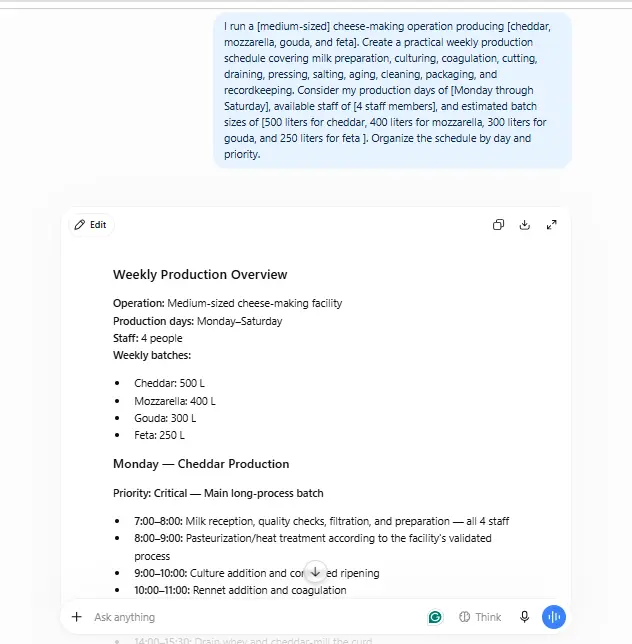
Prompt 1: Build a Weekly Cheese Production Plan
Prompt:
I run a [small/medium/large] cheese-making operation producing [list cheeses]. Create a practical weekly production schedule covering milk preparation, culturing, coagulation, cutting, draining, pressing, salting, aging, cleaning, packaging, and recordkeeping. Consider my production days of [days], available staff of [number], and estimated batch sizes of [sizes]. Organize the schedule by day and priority.
Prompt 2: Create a Batch Preparation Checklist
Prompt:
Create a detailed pre-production checklist for making [cheese type]. Include ingredient checks, equipment preparation, sanitation tasks, culture and rennet preparation, temperature checks, documentation, and anything that should be confirmed before production begins. Format it as a simple checklist that my team can use before each batch.
Prompt 3: Plan Production Around Multiple Cheese Types
Prompt:
I produce [cheese 1], [cheese 2], and [cheese 3]. Help me design an efficient production workflow that reduces unnecessary equipment changes, cleaning delays, ingredient waste, and scheduling conflicts. Assume I have [equipment/resources] and [number] production days per week. Present the recommended sequence and explain the reasoning briefly.
Prompt 4: Estimate Ingredient Requirements
Prompt:
Help me organize ingredient requirements for producing [quantity] of [cheese type]. My planned batch size is [batch size] and my available milk quantity is [quantity]. Create a production worksheet showing the ingredients I need, quantities to confirm, equipment required, and preparation tasks. Clearly label any figures that must be adjusted according to my actual cheesemaking formula.
Prompt 5: Create a Production Record Template
Prompt:
Design a simple production record template for my [cheese type]. Include fields for batch number, production date, milk information, cultures, additives, temperatures, timing, observations, salting, pressing, aging conditions, packaging date, and final notes. Keep it practical enough for repeated use by a small cheese-making team.
If your cheese business is becoming more complex, AI can also help organize purchasing, inventory, suppliers, and other operational workflows. Our ChatGPT prompts for supply chain managers provide additional ideas that can be adapted to food production.
Prompts for Recipe and Process Documentation
Cheese makers often need clear documentation for repeatability. ChatGPT can help turn your existing process into organized notes without pretending to replace your tested formula.
Prompt 6: Turn My Cheesemaking Notes into an SOP
Prompt:
Convert the following cheesemaking notes into a clear standard operating procedure for [cheese type]. Preserve my original process and technical details. Organize the SOP into preparation, ingredients, equipment, step-by-step production, observations, finishing, aging, cleaning, and recordkeeping. Do not invent missing measurements or steps. Ask me to verify any unclear information by marking it as [VERIFY].
Prompt 7: Simplify a Technical Cheesemaking Procedure
Prompt:
Rewrite this cheesemaking procedure so that a trained team member can follow it easily without changing the intended process. Improve organization, wording, and sequencing while preserving all measurements, temperatures, timings, and technical details exactly as provided.
Prompt 8: Create a Batch Comparison Sheet
Prompt:
I want to compare several batches of [cheese type]. Create a table that allows me to record and compare batch size, milk source, cultures, temperatures, make time, salting method, aging conditions, yield, texture observations, aroma, flavor, rind development, defects, and final customer feedback.
Prompts for Troubleshooting and Observation
When a batch does not behave as expected, organized observations are more useful than random guesses. ChatGPT can help you structure possible questions and comparisons, but production decisions should remain grounded in your established cheesemaking process and appropriate food-safety practices.
Prompt 9: Organize Possible Causes of a Batch Problem
Prompt:
I am making [cheese type] and observed the following issue: [describe the issue]. My process included [brief process details]. Help me organize the possible contributing factors into categories such as milk, cultures, temperature, timing, coagulation, cutting, draining, salting, pressing, aging, handling, and storage. For each category, give me questions I should investigate rather than assuming a cause.
Prompt 10: Compare a Good Batch with a Problem Batch
Prompt:
Help me compare these two batches of [cheese type].
Successful batch: [details]
Problem batch: [details]
Identify meaningful differences in the process records, conditions, timing, handling, and observations. Separate documented differences from possible hypotheses and do not claim a cause unless the available information supports it.
Prompt 11: Build a Troubleshooting Log
Prompt:
Create a troubleshooting log for my cheese production operation. Include fields for batch number, product, date, observed issue, when the issue appeared, process conditions, relevant measurements, what changed from the previous batch, immediate actions taken, later observations, and final assessment. Make it easy to use consistently over time.
Prompt 12: Identify Missing Production Data
Prompt:
Review the following batch record for [cheese type]: [paste record]. Tell me which important pieces of information are missing that would make future batch comparison and troubleshooting easier. Group the missing information into process, ingredient, environmental, aging, and quality-record categories.
Prompts for Aging and Inventory Organization
Aging cheeses can create a moving inventory problem because production today may not become sellable inventory for weeks or months. A structured system can make that easier to manage.
For broader inventory and operational workflows, you can also explore our ChatGPT prompts for supply chain managers.
Prompt 13: Create an Aging Inventory Tracker
Prompt:
Design an aging inventory tracker for my cheese business. I produce [cheeses] with different aging periods. Include batch number, cheese type, make date, target aging window, current age, quantity, storage location, inspection dates, packaging status, expected release date, and notes. Format it so I can easily transfer it into a spreadsheet.
Prompt 14: Plan an Aging Room Inspection Schedule
Prompt:
Create a recurring inspection schedule for my aging cheeses based on the information I provide. Include batch identification, inspection frequency, observations to record, and follow-up fields. Do not invent food-safety requirements or regulatory standards; focus on creating an organizational framework that I can adapt to my established procedures.
Prompt 15: Organize Upcoming Cheese Releases
Prompt:
Here is my current aging inventory: [paste inventory]. Organize it into an upcoming release calendar based on the target dates and aging windows I provide. Highlight cheeses that require packaging, labeling, photography, customer notification, or sales planning before release.
Prompts for Cheese Quality Notes
Describing cheese consistently helps with internal records, product pages, tasting events, and customer communication.
Prompt 16: Create a Professional Cheese Tasting Note
Prompt:
Turn my tasting observations into a clear professional tasting note for [cheese name]. My notes are: [paste notes]. Organize the description around appearance, aroma, texture, flavor, finish, and overall character. Do not invent sensory details that are not present in my notes.
Prompt 17: Build a Sensory Evaluation Form
Prompt:
Create a sensory evaluation form for [cheese type] that my team can use consistently. Include appearance, aroma, texture, flavor, balance, finish, rind or surface observations where relevant, and overall assessment. Add a section for free-form notes and a simple scoring framework that can be customized to our internal standards.
Prompt 18: Turn Customer Feedback into Quality Themes
Prompt:
Analyze these customer comments about my cheese: [paste feedback]. Group the comments into recurring themes such as flavor, texture, packaging, portion size, price perception, freshness, presentation, and overall satisfaction. Separate positive patterns from improvement opportunities and quote no customer information beyond what I provide.
Prompt 19: Compare Two Cheese Profiles
Prompt:
Compare these two cheeses based only on the descriptions I provide.
Cheese A: [description]
Cheese B: [description]
Compare appearance, aroma, texture, flavor, intensity, likely food-pairing direction, and overall positioning. Make clear which points come directly from my descriptions and avoid inventing characteristics.
Prompt 20: Rewrite Technical Notes for Customers
Prompt:
Rewrite the following internal cheese notes into a customer-friendly product description for [cheese name]. Keep the factual details accurate, explain technical terms in simple language when needed, and emphasize the actual characteristics I provide. Do not exaggerate flavor, quality, origin, or production claims.
Using These Prompts More Effectively
One of the easiest ways to improve your results is to treat ChatGPT as a structured assistant rather than a source of unexplained answers.
Instead of asking it to make assumptions, provide the information you already know and tell it exactly what output you need.
A useful formula for many cheese-making tasks is:
Role + Cheese Context + Specific Task + Your Data + Constraints + Desired Format
For example:
“Act as a production planning assistant for a small artisan cheese business. I make [cheese types] in batches of [size] on [days]. Create a weekly production schedule that prioritizes efficient workflow and clear recordkeeping. Use a Monday-to-Saturday table and flag anything that requires me to insert my own process data.”
ChatGPT Prompts for Cheese Business Operations
Making cheese is only one part of running a cheese business. Orders need to be organized, inventory needs attention, customers need answers, and production decisions often have to line up with what the market actually wants.
ChatGPT can help turn scattered business information into clearer plans and working documents.
Prompt 21: Organize a Weekly Business Task List
Prompt:
I run a [small/medium] cheese-making business producing [cheese types]. Create a weekly business task list covering production planning, inventory, customer communication, packaging, purchasing, sales follow-up, bookkeeping preparation, marketing, and administrative work. Separate urgent tasks from recurring tasks and keep the plan realistic for a team of [number] people.
Prompt 22: Create a Daily Operations Checklist
Prompt:
Create a practical daily operations checklist for my cheese business. Include opening tasks, production-related checks, inventory review, order management, customer communication, packaging, cleaning documentation, end-of-day records, and follow-up tasks. Keep production-specific procedures based on my existing SOPs rather than inventing technical requirements.
Prompt 23: Organize Supplier Information
Prompt:
Turn the following supplier information into an organized supplier management sheet: [paste information]. Include supplier name, materials supplied, contact details, ordering frequency, lead time, pricing notes, minimum order requirements, backup supplier, and follow-up date. Flag missing information without making assumptions.
Prompt 24: Prepare a Purchasing Plan
Prompt:
Based on this production schedule and inventory information, create a purchasing plan for my cheese business: [paste data]. Group items into milk-related inputs, cultures and ingredients, packaging, cleaning supplies, labels, and general business materials. Separate items that need immediate attention from those that can be ordered later.
Prompt 25: Identify Business Bottlenecks
Prompt:
Analyze this description of my cheese-making operation: [describe workflow]. Identify potential operational bottlenecks involving production scheduling, equipment availability, packaging, inventory, staffing, order fulfillment, or communication. For each potential bottleneck, explain what information I should track to confirm whether it is actually causing a problem.
Prompts for Cheese Branding
A strong cheese brand needs more than a memorable name. Customers should be able to understand what makes the product distinctive and why it belongs in their shopping basket.
Prompt 26: Define a Cheese Brand Position
Prompt:
Help me define the brand positioning for my cheese business. We make [cheese types], use [production/origin details], and want to appeal to [target customers]. Based only on the information I provide, write a concise brand positioning statement, key differentiators, customer promise, and brand personality. Avoid generic marketing language.
Prompt 27: Develop a Cheese Brand Voice
Prompt:
Create a brand voice guide for my cheese company. Our brand is [describe personality], our customers are [audience], and our products are [description]. Define the preferred tone, vocabulary, sentence style, words to use, words to avoid, and how the brand should sound across website copy, product descriptions, emails, and social media.
Prompt 28: Generate Cheese Product Name Ideas
Prompt:
Generate 30 original name ideas for a [cheese type] made by a [type of cheese business]. The brand identity should feel [artisan/traditional/modern/rustic/premium/etc.]. Use themes related to [place, landscape, heritage, ingredients, production story]. Avoid names that sound generic or copied. Group the ideas by naming concept and explain the idea behind each name briefly.
Prompt 29: Create a Brand Story
Prompt:
Help me write a brand story for my cheese business using the following real information: [founding story, location, cheesemaking approach, inspiration, products]. Make it warm and authentic without inventing experiences, heritage, awards, family history, or claims that I have not provided.
Prompt 30: Create a Product Positioning Matrix
Prompt:
I sell these cheeses: [list]. Create a product positioning matrix comparing them by cheese style, texture, flavor profile, intended customer, suggested use, price positioning, and key differentiator. Use only information I provide and mark any field that requires additional input.
Prompts for Cheese Product Descriptions
Product descriptions should help customers understand what they are buying without turning every cheese into vague marketing copy.
Prompt 31: Write an E-Commerce Cheese Description
Prompt:
Write an e-commerce product description for [cheese name]. Use these factual details: [paste details]. Include a concise introduction, flavor and texture description, production details that are appropriate to share, serving ideas, and storage information if supplied. Keep the language specific and avoid unsupported claims.
Prompt 32: Create Short and Long Product Descriptions
Prompt:
Using the product information below, create three versions of a cheese description:
- A 40-word version for a product card
- A 100-word version for an online store
- A 180-word version for a detailed product page
Preserve the same factual information across all versions.
Prompt 33: Make a Technical Product Description Customer-Friendly
Prompt:
Rewrite this technical cheese description for everyday shoppers: [paste text]. Keep all factual information accurate but replace unnecessary jargon with clear language. Explain specialized terms only when they help customers understand the cheese.
Prompt 34: Write a Cheese Market Stall Description
Prompt:
Create a short spoken product description for my market stall team to use when introducing [cheese name] to customers. The description should be conversational, easy to remember, and based only on these product details: [paste details].
Prompt 35: Create Product Highlights
Prompt:
Turn the following product information into five concise product highlights for [cheese name]. Focus on distinctive characteristics, texture, flavor, production details, and practical uses where supported by the information provided. Avoid exaggerated adjectives and unsupported claims.
Prompts for Cheese Pairing and Serving Content
Pairing content can help customers understand how to use a cheese, while also giving a business more ideas for educational marketing.
Prompt 36: Create Cheese Pairing Ideas
Prompt:
Based on this cheese description, create pairing ideas for [cheese name]: [paste description]. Organize suggestions into fruit, vegetables, bread or crackers, condiments, herbs or spices, and beverages. Clearly distinguish general pairing suggestions from any claims that would require specialist verification.
Prompt 37: Create a Cheese Board Concept
Prompt:
Design a cheese board featuring [cheese names]. Create a balanced combination of textures, flavors, colors, accompaniments, and serving portions. Explain the role each cheese plays on the board and suggest an order in which guests could taste them.
Prompt 38: Write Serving Suggestions
Prompt:
Create practical serving suggestions for [cheese name] based on these characteristics: [paste details]. Include ideas for breakfast, lunch, dinner, snacks, appetizers, and cheese boards. Keep suggestions realistic for home cooks.
Prompt 39: Build a Cheese Tasting Flight
Prompt:
I have these cheeses: [list]. Create a tasting flight that moves from milder to stronger or more intense profiles based on the information I provide. For each cheese, give a short introduction, what tasters should notice, and a simple transition to the next cheese.
Prompt 40: Create a Cheese Pairing Guide
Prompt:
Build a customer-friendly pairing guide for my cheese range: [list cheeses and descriptions]. Organize the guide by cheese and include suggested foods, serving occasions, and simple serving ideas. Avoid presenting uncertain pairings as scientific or universally established facts.
Prompts for Pricing and Product Analysis
Pricing decisions involve costs, positioning, demand, packaging, production realities, and sales channels. ChatGPT can help organize the inputs, but it should not invent costs or tell you that one price is objectively correct without sufficient data.
Prompt 41: Build a Cheese Costing Worksheet
Prompt:
Create a costing worksheet for my [cheese type]. My known costs are: [ingredients], [packaging], [labor], [utilities], [aging/storage], [transport], and [other costs]. Organize the worksheet so I can calculate cost per batch, cost per unit, overhead allocation, gross margin, and target selling price. Leave unknown values blank instead of estimating them.
Prompt 42: Analyze Product Pricing Inputs
Prompt:
Review these pricing inputs for my cheese product: [paste data]. Organize the information into direct costs, indirect costs, sales-channel costs, packaging costs, and other relevant categories. Identify which additional figures I need before making a pricing decision.
Prompt 43: Compare Retail and Wholesale Pricing
Prompt:
Help me build a pricing comparison for my cheese sold through [farmers’ markets, retail stores, restaurants, online sales, etc.]. Use my actual cost and pricing information below: [paste data]. Create a table showing revenue, direct costs, estimated gross margin, packaging or channel costs, and key assumptions for each channel.
Prompt 44: Identify High-Value Cheese Products
Prompt:
Analyze my current cheese range using the following information: [products, prices, costs, sales volume, customer feedback]. Identify products that appear strongest in sales, margin, repeat interest, or strategic value. Do not make conclusions from missing data; clearly separate facts from areas that need further analysis.
Prompt 45: Create a Product Review Framework
Prompt:
Build a monthly review framework for my cheese products using sales volume, revenue, margin, customer feedback, production complexity, aging time, waste, and repeat purchases. Create a scoring or review system that I can customize to my business.
Prompts for Marketing Content
Cheese makers often have plenty of stories and useful knowledge but not enough time to turn that material into regular content.
Prompt 46: Create a Monthly Cheese Content Calendar
Prompt:
Create a 30-day content calendar for my cheese business. My products are [list], target audience is [audience], and primary goals are [brand awareness/sales/education/community growth]. Include a balanced mix of product education, behind-the-scenes content, recipes, pairing ideas, customer questions, production stories, seasonal topics, and promotional posts. Avoid repeating the same idea.
Prompt 47: Generate Educational Cheese Topics
Prompt:
Generate 25 educational content ideas for customers who want to learn more about cheese. Focus on topics that relate naturally to the cheeses I produce: [list]. Prioritize useful questions beginners actually have and organize the ideas into beginner, intermediate, and product-specific topics.
Prompt 48: Turn a Production Day into Content
Prompt:
Here are the real details from today’s cheese production: [paste notes]. Turn them into five content ideas for social media, including one behind-the-scenes post, one educational post, one short-form video idea, one customer-focused post, and one story-style post. Do not add production details that I did not provide.
Prompt 49: Create a Cheese-Making Story Post
Prompt:
Write a social media post based on this real production story: [paste story]. Make it informative and engaging while keeping the tone appropriate for an artisan cheese business. Do not exaggerate the story or invent details.
You can also find related AI workflows for food-focused writing and observation in our ChatGPT prompts for food critics guide.
Prompt 50: Repurpose One Cheese Topic Across Platforms
Prompt:
Take this cheese-related topic: [topic]. Create platform-specific content for Instagram, Facebook, Pinterest, LinkedIn, Threads, TikTok, and YouTube. Adapt the format, tone, length, and hook to each platform instead of copying the same post everywhere.
Prompts for Email and Customer Communication
Clear communication can make a small cheese business feel organized and trustworthy.
Prompt 51: Write a New Product Announcement
Prompt:
Write an email announcing the release of [cheese name]. Use only these details: [product information, availability, price, ordering information]. Keep the message concise, warm, and customer-focused. Include a clear call to action without sounding overly promotional.
Prompt 52: Write an Out-of-Stock Message
Prompt:
Write a customer-friendly message explaining that [cheese name] is temporarily unavailable. Include the expected availability date if provided, suggest an alternative product if I supply one, and encourage customers to check back without making promises beyond the information I give you.
Prompt 53: Respond to a Customer Product Question
Prompt:
Draft a helpful response to this customer question: [paste question]. Here are the confirmed facts I can provide: [facts]. Answer clearly, do not guess missing information, and identify anything I should verify before replying.
Prompt 54: Request Customer Feedback
Prompt:
Write a short message asking customers for feedback on [cheese/product]. Make it easy to answer and ask about flavor, texture, packaging, serving experience, and overall satisfaction. Keep the tone friendly and avoid making the request feel intrusive.
Prompt 55: Create a Wholesale Introduction Email
Prompt:
Write a concise introductory email to a potential wholesale buyer such as a specialty food store, restaurant, or cheese shop. Our business is [description], our products are [list], and our relevant sales information is [details]. Focus on why the products may fit their customers without making unsupported claims.
Making Business Prompts More Useful
Business prompts become much stronger when they include actual operating information.
For example, replace:
“Help me create a pricing strategy.”
with:
“I produce 400 units of [cheese] per month. My current direct cost per unit is [amount], packaging is [amount], average wholesale price is [amount], and retail price is [amount]. I sell through [channels]. Help me organize these figures and identify which additional costs I need to account for before reviewing my pricing.”
The difference is important: ChatGPT can reason about your inputs, but it cannot accurately calculate unknown business realities that you never provide.
This same principle applies to marketing. A prompt containing your real product details, customer profile, location, brand voice, and sales goal will usually produce much more useful content than a broad request with no context.
ChatGPT Prompts for Cheese Makers
Social Media Prompts for Cheese Makers
Social media gives cheese makers a way to show the work behind the product, educate customers, highlight new releases, and create a stronger connection with their audience.
The strongest content usually comes from real material you already have: production days, new batches, tasting notes, customer questions, seasonal products, market events, and the story behind a particular cheese.
For additional food-focused content ideas, you can also explore our ChatGPT prompts for food bloggers.
Prompt 56: Create a Week of Social Media Posts
Prompt:
Create a 7-day social media content plan for my cheese business. My products are [list], target audience is [audience], and my main goal is [goal]. Use a mix of educational, behind-the-scenes, product-focused, engagement, customer-focused, and promotional content. Give each post a topic, hook, short caption idea, visual direction, and CTA. Avoid repeating the same content angle.
Prompt 57: Write an Instagram Caption for a Cheese
Prompt:
Write an Instagram caption for [cheese name] using these real details: [paste details]. Highlight its actual characteristics, serving ideas, and what makes it distinctive. Start with a natural hook, keep the tone [brand tone], and end with a simple question that encourages genuine conversation.
Prompt 58: Create a Short-Form Video Script
Prompt:
Create a 30–45 second short-form video script about [topic/cheese]. Use this information: [paste information]. Structure it with an opening hook, 3–4 useful points, suggested visual shots, and a simple ending CTA. Make the script conversational and easy to film in a real cheese-making environment.
Prompt 59: Generate Cheese Content Hooks
Prompt:
Generate 30 social media hooks for my cheese business. Focus on curiosity, education, sensory experiences, common customer questions, behind-the-scenes moments, and surprising but accurate details. Base the hooks on these products and topics: [list]. Avoid clickbait and unsupported claims.
Prompt 60: Create a Carousel Post
Prompt:
Create an educational carousel about [cheese topic]. Give me a slide-by-slide structure for 7–9 slides. Each slide should contain a short headline and concise copy. Keep the information practical for [beginner consumers/food enthusiasts/home cooks/etc.] and end with a useful takeaway or CTA.
Prompt 61: Create Pinterest Content
Prompt:
Create an SEO-friendly Pinterest pin for [cheese/product/topic]. Provide a concise pin title, description, relevant keywords, suggested text for the image, and a short CTA. Keep the copy natural and based on the factual information I provide.
Prompt 62: Write a YouTube Video Description
Prompt:
Write a YouTube description for a video about [topic]. The video covers [summary]. Include a clear opening description, useful related keywords, a concise explanation of what viewers will learn, and a natural CTA. Do not stuff keywords or add claims that are not supported by the video information.
Prompt 63: Turn Customer Questions into Content
Prompt:
Here are common questions customers ask about my cheese: [paste questions]. Turn them into 15 social media content ideas. For each one, give me the question, a useful answer angle, recommended format, and a short hook. Prioritize questions that are genuinely useful to customers.
Prompt 64: Create a Behind-the-Scenes Series
Prompt:
Design a 10-post behind-the-scenes content series for my cheese business using these real activities: [list activities]. Each post should show a different part of the business, such as preparation, production, aging, packaging, quality checks, or market preparation. Give each post a unique angle and avoid revealing information I have not supplied.
Prompt 65: Turn a New Cheese Launch into a Campaign
Prompt:
Create a 7-day launch campaign for my new cheese, [name]. The confirmed details are [product details], target customers are [audience], and launch date is [date]. Include content for awareness, education, product introduction, serving ideas, social proof if I provide it, launch-day messaging, and follow-up. Do not fabricate reviews or customer reactions.
Prompts for Recipe Development
Cheese makers can also use ChatGPT to turn their products into meal ideas that help customers see practical ways to use them.
The key is to provide the cheese’s actual characteristics and any dietary, ingredient, or equipment limitations.
Prompt 66: Create Recipes Using My Cheese
Prompt:
Create 10 practical recipes using [cheese name]. Based on this cheese description: [paste description]. Each recipe should have a clear purpose, realistic ingredients, concise preparation steps, estimated serving size, and a brief explanation of how the cheese contributes to the dish. Do not make unsupported nutrition or food-safety claims.
Prompt 67: Develop a Signature Recipe
Prompt:
Help me develop a signature recipe featuring [cheese name] as the main ingredient. My target customer is [audience], and I want the recipe to feel [rustic/modern/family-friendly/premium/etc.]. Suggest the dish concept, ingredients, preparation method, plating idea, and a short story or serving note that could accompany it.
Prompt 68: Create Seasonal Cheese Recipes
Prompt:
Generate seasonal recipe ideas using [cheese name] for [season]. Prioritize ingredients commonly associated with the season and practical preparation methods. Group the ideas into breakfast, lunch, dinner, appetizers, and desserts where suitable. Avoid forcing the cheese into recipes where it would not naturally fit.
Prompt 69: Adapt a Recipe for a Different Cheese
Prompt:
Adapt the following recipe so that [my cheese] replaces [original cheese]: [paste recipe]. Explain what may change in flavor, texture, melting behavior, or seasoning based on the characteristics I provide. Clearly identify any parts of the recipe that I should test rather than assuming the substitution will work identically.
Prompt 70: Create Recipe Content for Customers
Prompt:
Turn this recipe featuring my cheese into customer-facing content: [paste recipe]. Create a recipe title, short introduction, ingredients section, step-by-step directions, serving suggestion, storage note if provided, and a brief social media caption. Preserve all factual recipe details I supply.
Prompts for Customer Research
Understanding customers can help cheese makers decide what to promote, what information to explain, and which products deserve more attention.
Prompt 71: Build a Customer Persona
Prompt:
Create a customer persona for my cheese business using these known details: [customer information]. Include likely needs, purchasing motivations, common objections, preferred content topics, product interests, and buying considerations. Clearly label assumptions so they are not confused with confirmed customer research.
Prompt 72: Analyze Customer Feedback
Prompt:
Analyze the following customer feedback about my cheese business: [paste feedback]. Identify recurring themes, frequently mentioned products, positive experiences, complaints, questions, and possible areas for improvement. Separate patterns supported by multiple comments from isolated comments.
Prompt 73: Generate Customer Survey Questions
Prompt:
Create a short customer survey for my cheese business. I want to learn about product preferences, purchasing frequency, price perception, preferred buying channels, favorite cheeses, serving habits, and unmet needs. Keep the questions clear and avoid leading respondents toward a particular answer.
Prompt 74: Identify Customer Objections
Prompt:
Based on these products, prices, and customer comments, identify potential buying objections: [paste information]. Group them into price, product understanding, availability, convenience, flavor, packaging, and trust-related concerns. Then suggest useful information I could provide to address each concern without using aggressive sales language.
Prompt 75: Find Content Gaps from Customer Questions
Prompt:
Review these customer questions and comments: [paste data]. Identify topics that my website, product pages, FAQ section, or social media content should explain better. Prioritize the opportunities according to usefulness to customers rather than search volume alone.
Prompts for Wholesale and Restaurant Sales
Cheese makers selling to restaurants, specialty stores, delis, or other businesses need communication that is clear and relevant to professional buyers.
Prompt 76: Create a Wholesale Product Sheet
Prompt:
Create a professional one-page wholesale product sheet for my cheese range using these confirmed details: [paste details]. Include cheese name, style, size, packaging, case information, availability, storage information where provided, pricing fields, and concise product descriptions. Leave unknown information blank instead of guessing.
Prompt 77: Write a Restaurant Outreach Email
Prompt:
Write a concise outreach email to a restaurant that may be interested in [cheese/products]. The restaurant is [type/style], and my confirmed business details are [information]. Explain why the product may fit their menu without assuming what the chef or restaurant currently wants. End with a low-pressure next step.
Prompt 78: Prepare for a Wholesale Buyer Meeting
Prompt:
Help me prepare for a meeting with a wholesale buyer for my cheese business. My products are [list], the buyer is [business type], and my known commercial information is [details]. Create a preparation checklist, key questions to ask, information to bring, and topics I should be ready to discuss.
Prompt 79: Create Wholesale Follow-Up Messages
Prompt:
Write three short follow-up messages for a potential wholesale buyer after an initial conversation about my cheese products. Create versions for: 1. a buyer who showed interest, 2. a buyer who has not replied, and 3. a buyer who asked for additional product information. Use only the business details I provide.
Prompt 80: Build a Wholesale FAQ
Prompt:
Create a wholesale FAQ for my cheese business based on these confirmed details: [paste information]. Cover ordering, minimum quantities, availability, lead times, packaging, storage, delivery or pickup, payment terms, and product information where applicable. Mark unanswered questions so I can supply the correct information.
Prompts for Sales and Customer Conversion
Good sales content should make it easier for customers to understand the product and make an informed decision.
Prompt 81: Create a Product Comparison Guide
Prompt:
Compare these cheeses from my range: [list]. Organize the information by texture, flavor intensity, serving style, ideal use, and customer profile based only on the descriptions I provide. Create a simple guide that helps customers choose the cheese most suitable for their preferences.
Prompt 82: Build a Cheese Gift Guide
Prompt:
Create a customer-friendly gift guide using my cheese products: [list]. Organize products by recipient or occasion such as host gifts, holidays, food lovers, dinner parties, or beginner cheese enthusiasts. Use only confirmed product characteristics and available packaging information.
For more AI-assisted ways to organize and respond to customer opinions, see our ChatGPT prompts for customer feedback.
Prompt 83: Create a Cross-Sell Strategy
Prompt:
Analyze my product range: [list]. Suggest logical cross-selling opportunities such as cheese combinations, tasting sets, serving accessories, or recipe bundles. Explain why each combination makes sense from the customer’s perspective without inventing demand data.
Prompt 84: Create a Cheese Sampler Concept
Prompt:
Design three sampler concepts using these cheeses: [list]. Create a budget option, a balanced option, and a premium option. For each sampler, include the cheeses, intended customer, serving concept, product story, and a suggested presentation approach.
Prompt 85: Write a Limited-Release Announcement
Prompt:
Write a product announcement for a limited release of [cheese name]. Confirmed information: [details]. Make the message informative and appealing without creating false scarcity, inventing demand, or using exaggerated claims. Include a clear ordering or availability CTA.
Prompts for Business Growth Planning
Growth does not always mean producing more cheese. A useful growth plan should consider production capacity, customer demand, cash flow, staffing, distribution, and operational constraints.
Prompt 86: Create a 90-Day Growth Plan
Prompt:
Create a practical 90-day growth plan for my cheese business. My current products are [list], current sales channels are [channels], team size is [number], production capacity is [capacity], and my primary growth goal is [goal]. Divide the plan into monthly priorities, weekly actions, measurable indicators, and dependencies. Do not invent financial targets or market data.
Prompt 87: Identify Growth Opportunities
Prompt:
Analyze the following information about my cheese business: [paste business information]. Identify potential growth opportunities across products, customers, sales channels, partnerships, content, and operations. Rank the opportunities by likely effort, required resources, and strategic fit based on the information provided.
Prompt 88: Evaluate a New Sales Channel
Prompt:
I am considering selling my cheese through [new channel]. Here is my current business information: [paste data]. Help me evaluate the opportunity by organizing potential benefits, costs, operational changes, customer considerations, risks, and questions I should answer before deciding. Do not assume the channel will be profitable.
Prompt 89: Plan a Seasonal Sales Push
Prompt:
Create a seasonal sales plan for my cheese business around [holiday/season/event]. My products are [list], target customers are [audience], and sales channels are [channels]. Include product bundles, content ideas, promotions, email themes, merchandising ideas, and operational preparation. Keep all recommendations realistic for my available resources.
Prompt 90: Create a Business Review Dashboard
Prompt:
Design a simple monthly dashboard for my cheese business. Include revenue, units sold, product performance, gross margin, repeat customers, average order value, inventory, production output, waste, wholesale accounts, online performance, and customer feedback where applicable. For each metric, explain what decision it could help me make.
Turning ChatGPT into a Practical Cheese Business Assistant
The most useful way to work with these prompts is to build a small library of reusable prompts around the tasks you perform repeatedly.
For example, you might keep separate versions for:
Production: planning, batch records, troubleshooting, aging inventory.
Products: tasting notes, descriptions, pairing guides, recipes.
Customers: FAQs, feedback analysis, surveys, support responses.
Marketing: captions, videos, educational posts, product launches.
Business: costing, wholesale outreach, channel analysis, growth planning.
When you reuse a prompt, do not simply copy it unchanged. Add the information that makes the task specific to your operation.
A useful input structure is:
What I make → Who I serve → What I know → What I need → What constraints apply → What format I want
For example:
“I make small-batch aged cheddar for local specialty food customers. I sell at farmers’ markets and through three retail partners. I have six weeks of customer comments and sales records. Analyze the information to identify which product characteristics customers mention most often and turn the findings into five content themes.”
That gives ChatGPT enough context to work with your actual business rather than generating generic cheese-business advice.
ChatGPT Prompts for Cheese Makers
Financial Organization Prompts for Cheese Makers
A cheese business can become difficult to manage when production records, expenses, sales, and inventory are stored in different places. ChatGPT can help organize the information you already have into clearer financial planning tools.
It should be used to structure and analyze your figures, not to invent missing costs or replace professional accounting advice.
Prompt 91: Organize Monthly Business Expenses
Prompt:
Organize these monthly expenses for my cheese business: [paste expenses]. Group them into production costs, packaging, labor, utilities, transportation, marketing, equipment, administration, and other relevant categories. Create a summary showing the total for each category and identify expenses that need clarification or further classification.
Prompt 92: Create a Simple Cash Flow Planner
Prompt:
Create a monthly cash flow planning template for my cheese business using these known figures: [paste income and expenses]. Include expected sales income, production expenses, packaging, wages, supplier payments, rent or utilities, marketing, equipment costs, taxes or professional fees where applicable, and ending cash position. Leave unknown figures blank instead of estimating them.
Prompt 93: Review Product-Level Costs
Prompt:
I produce these cheeses: [list]. Here are my known costs for each product: [paste data]. Organize the information into a product-level cost comparison. Show direct costs, packaging costs, labor inputs, aging or storage considerations, estimated cost per unit based only on supplied figures, and missing data that could affect the calculation.
Prompt 94: Calculate Break-Even Inputs
Prompt:
Help me organize a break-even analysis for my cheese business. My fixed costs are [amount/details], variable cost per unit is [amount], and selling price is [amount]. Show the formula and calculations clearly. If any required information is missing, identify it instead of making assumptions.
Prompt 95: Prepare Questions for an Accountant
Prompt:
Create a list of practical questions I should ask my accountant about running a cheese-making business. Cover bookkeeping, inventory, production costs, equipment purchases, taxes, wholesale sales, retail sales, and recordkeeping. Keep the questions general and do not assume which accounting or tax rules apply to my location.
Inventory and Supply Management Prompts
Inventory problems can affect both production efficiency and cash flow. A structured inventory system can make it easier to see what is available, what is being used quickly, and what needs attention.
Prompt 96: Create an Ingredient Inventory Tracker
Prompt:
Create an inventory tracker for the ingredients and production supplies used in my cheese business. Include item name, category, supplier, quantity on hand, unit, reorder point, usual order quantity, storage location, last order date, and notes. Organize the template so it can be copied into a spreadsheet.
Prompt 97: Create a Packaging Inventory Tracker
Prompt:
Build a packaging inventory tracker for my cheese business covering labels, boxes, wraps, containers, seals, bags, cartons, and other packaging materials I use. Include current stock, minimum stock level, supplier, lead time, intended product, and reorder status.
Prompt 98: Identify Inventory Risks
Prompt:
Review this inventory list: [paste inventory]. Identify potential issues such as low stock, excessive quantities, items used across multiple products, supplier dependency, or missing reorder information. Distinguish between confirmed issues and items that need more information.
Prompt 99: Create a Reordering Framework
Prompt:
Help me create a simple reorder framework for my cheese business. I regularly purchase [list items], and my typical usage is [usage information]. Create reorder fields for average usage, current stock, supplier lead time, minimum stock, reorder quantity, and next review date. Do not invent thresholds where I have not provided enough data.
Cheese makers who work closely with agricultural suppliers may also find useful ideas in our guide to ChatGPT prompts for farmers.
Prompt 100: Organize Supplier Alternatives
Prompt:
Create a supplier contingency worksheet for my cheese business. For each important ingredient, packaging material, or supply, include primary supplier, backup supplier, lead time, price information, ordering requirements, contact details, and notes. Highlight categories where I currently have no backup source.
Team Training and Documentation Prompts
As a cheese business grows, important knowledge should not remain only in one person’s head. Clear documentation can help team members understand recurring tasks and reduce unnecessary confusion.
Prompt 101: Create a Team Training Checklist
Prompt:
Create a training checklist for a new employee joining my cheese-making business. Cover workplace orientation, equipment familiarization, sanitation procedures, production documentation, packaging, labeling, inventory handling, customer service, and emergency or escalation procedures. Do not invent technical or regulatory procedures; leave areas that require my established SOPs clearly marked.
Prompt 102: Turn an SOP into Training Material
Prompt:
Convert this existing SOP into a training document for a new team member: [paste SOP]. Use simple language, step-by-step instructions, key points to remember, common errors to avoid, and a short knowledge-check section. Do not alter technical requirements or invent missing steps.
Prompt 103: Create a Staff Handover Document
Prompt:
Create a staff handover template for my cheese business. Include unfinished production tasks, batches requiring follow-up, inventory issues, customer orders, supplier matters, packaging tasks, upcoming deadlines, and important notes. Make it easy for one employee to hand responsibilities to another.
Prompt 104: Create a Process Knowledge Base
Prompt:
Help me organize my cheese business knowledge into a searchable internal knowledge base. Based on these procedures and documents: [paste information], group the material into production, equipment, cleaning, packaging, inventory, customer service, sales, administration, and troubleshooting. Identify duplicate information and missing documentation.
Prompt 105: Create a Training Quiz
Prompt:
Create a short training quiz based only on this internal procedure: [paste SOP]. Include multiple-choice, true-or-false, and scenario questions. Make the questions test understanding rather than memorization, and provide an answer key based strictly on the supplied procedure.
Website Content Prompts
Your website should make it easy for visitors to understand what you make, why it is different, how to buy it, and how to use it.
For more help creating effective business pages, explore our ChatGPT prompts for landing pages.
Prompt 106: Plan a Cheese Business Website
Prompt:
Create a practical website structure for my cheese business. We sell [products], serve [audience], and use these sales channels: [channels]. Suggest the most useful pages, navigation structure, calls to action, product information sections, FAQ topics, and customer education content. Prioritize usability over adding unnecessary pages.
Prompt 107: Write an About Page
Prompt:
Write an About page for my cheese business using only these real details: [paste details]. Explain what we make, where we operate, why the business exists, and what customers can expect. Keep the tone [brand tone], and do not invent heritage, awards, family history, values, or production claims.
Prompt 108: Create a Cheese FAQ Page
Prompt:
Create an FAQ page for my cheese business using these products and customer questions: [paste information]. Group the questions into product information, ordering, storage, serving, availability, shipping or pickup, and general business questions where relevant. Clearly identify questions that require information from me.
Prompt 109: Improve a Product Page
Prompt:
Review this existing product page copy for [cheese name]: [paste copy]. Identify unclear sections, missing useful information, repetitive wording, unsupported claims, and opportunities to make the page easier for customers to understand. Then provide a revised version using only verified information from the source text.
Prompt 110: Create a Cheese Buying Guide
Prompt:
Create a beginner-friendly cheese buying guide for visitors to my website. Explain how to choose among my products based on texture, flavor intensity, serving occasion, and intended use. Use these confirmed product descriptions: [paste descriptions]. Do not make claims that are not supported by the product information.
SEO and Content Planning Prompts
Search-focused content can help potential customers discover your cheese business, but useful information should remain the priority.
Prompt 111: Create a Cheese Content Topic Cluster
Prompt:
Create a topical content plan for my cheese business around [main topic]. My products are [list] and my target audience is [audience]. Organize useful article ideas into product education, buying questions, serving and recipes, cheesemaking education, storage, pairing, and business-specific topics where appropriate. Focus on genuine customer questions rather than keyword stuffing.
Prompt 112: Find Questions Customers Might Search
Prompt:
Generate 40 realistic questions that someone interested in [cheese/topic] might search online. Group them by beginner questions, product selection, serving, storage, recipes, purchasing, and deeper educational topics. Prioritize questions that a cheese business could answer helpfully from its own knowledge and verified information.
Prompt 113: Create an SEO-Friendly Article Brief
Prompt:
Create an article brief for the topic “[topic].” Define the likely search intent, target reader, primary question, useful supporting questions, recommended structure, important entities and terminology, and practical information the article should contain. Do not recommend keyword repetition or artificial keyword density.
Prompt 114: Improve Existing Cheese Content
Prompt:
Review this article about [topic]: [paste article]. Identify areas where the content could become more useful, specific, accurate, easier to scan, or better aligned with the reader’s likely intent. Then suggest improvements without adding unsupported claims or unnecessary sections.
Prompt 115: Create Internal Linking Ideas
Prompt:
Here are the existing articles and pages on my cheese website: [paste list]. Based on their topics, identify natural internal-link opportunities between them. For each opportunity, suggest the source page, destination page, and a descriptive anchor-text idea. Do not invent pages or URLs that I have not provided.
Customer Education Prompts
Education can turn a product page or social post into something customers actually learn from. It can also reduce repeated questions by explaining unfamiliar cheese concepts in accessible language.
Prompt 116: Explain a Cheese-Making Concept Simply
Prompt:
Explain [cheesemaking concept] to a general consumer who has no technical background. Use a simple analogy or example where useful, but do not oversimplify to the point of becoming inaccurate. Keep the explanation focused on what the customer needs to understand.
Prompt 117: Create a Cheese Storage Guide
Prompt:
Create a customer-facing storage guide for my cheeses using the storage information I provide: [paste information]. Explain packaging, storage conditions, handling, serving preparation, and general quality considerations without inventing food-safety requirements that I have not supplied or verified.
Prompt 118: Explain Different Cheese Types
Prompt:
Create a beginner-friendly guide explaining these cheese styles: [list]. For each one, describe its general characteristics, texture, flavor direction, and typical ways consumers might encounter or serve it. Distinguish general educational information from details specific to my own products.
Prompt 119: Create a Cheese Tasting Guide for Customers
Prompt:
Create a simple tasting guide for customers trying my cheese. Include preparation, appearance, aroma, texture, flavor, finish, and note-taking. Make the guide approachable for beginners and use the actual product information I provide where relevant.
Prompt 120: Create Educational Answers to Common Myths
Prompt:
Here are common statements customers make about cheese: [paste statements]. Review each one and classify it as accurate, oversimplified, context-dependent, or requiring verification. Then provide a clear customer-friendly explanation. Do not present uncertain claims as facts.
Event and Market Prompts
Farmers’ markets, tasting events, food festivals, and local gatherings can create opportunities for direct customer interaction.
Prompt 121: Plan a Farmers’ Market Setup
Prompt:
Create a practical preparation checklist for a farmers’ market where I will sell [products]. Include product preparation, packaging, labels, inventory, pricing displays, signage, payment setup, customer education materials, sampling supplies where applicable, transportation, and end-of-day tasks. Keep the checklist adaptable to my established procedures and local requirements.
Prompt 122: Create a Cheese Tasting Event Plan
Prompt:
Plan a cheese tasting event featuring [cheeses]. Create a simple event flow including welcome, tasting order, descriptions, pairing suggestions based on the information provided, audience interaction, questions, and closing. Keep the event length to [duration] and audience size to approximately [number].
Prompt 123: Write a Cheese Tasting Host Script
Prompt:
Write a host script for a tasting of these cheeses: [list]. For each cheese, include a short introduction based on its confirmed characteristics, a tasting observation prompt, and a transition to the next cheese. Keep the language natural and conversational.
Prompt 124: Create Market Customer Conversation Starters
Prompt:
Generate 20 natural conversation starters for customers visiting my cheese stall. Focus on helping them choose a cheese, understand flavor or texture, discover serving ideas, and learn about unfamiliar products. Avoid pushy sales language.
Prompt 125: Review an Event Afterwards
Prompt:
Analyze these notes from a cheese market or tasting event: [paste notes]. Summarize sales observations, popular products, customer questions, operational issues, successful activities, and improvements for the next event. Separate observations from assumptions.
Strategic Decision-Making Prompts
Some of the most useful applications of ChatGPT involve organizing a complicated decision before you make it.
Prompt 126: Compare Two Business Options
Prompt:
Help me compare these two options for my cheese business:
Option A: [details]
Option B: [details]
Compare them across investment, production complexity, staffing, customer fit, operational requirements, revenue potential, risks, and reversibility. Use only the information I provide and clearly identify unknowns.
Prompt 127: Build a Decision Matrix
Prompt:
Create a customizable decision matrix for choosing between [options]. Relevant criteria include [criteria]. Show the criteria, weighting fields, scoring method, total score, and notes. Explain how I can adjust the weights to reflect my business priorities.
Prompt 128: Evaluate a New Product Idea
Prompt:
Evaluate this potential new cheese product: [concept]. My current products, resources, production capacity, customers, and sales channels are [information]. Identify potential advantages, operational questions, customer-fit questions, testing requirements, and risks. Do not assume market demand without evidence.
Prompt 129: Conduct a Pre-Launch Review
Prompt:
Create a pre-launch review checklist for a new cheese product. Include product documentation, costing, packaging, labeling, photography, website copy, inventory, customer education, sales channels, staff preparation, and marketing materials. Clearly separate items that depend on my own procedures or local requirements.
Prompt 130: Create an Annual Business Review
Prompt:
Create an annual review framework for my cheese business. Use these available records: [sales, products, costs, customer feedback, production data, marketing data]. Organize the review into financial performance, product performance, operations, customers, sales channels, marketing, inventory, team, and next-year priorities. Include questions that help turn the review into practical decisions.
A Practical Way to Use These Prompts
A large prompt library becomes much more useful when you treat it as a working system rather than a collection of one-time questions.
For recurring tasks, save your best prompts and create versions that already contain your basic business context. You can then update only the information that changes.
For example, your reusable product-analysis prompt might begin with:
“I run a small artisan cheese business. My current products are [list]. Our target customers are [audience]. We sell through [channels]. Our brand voice is [description].”
Then add the task:
“Analyze this month’s customer feedback and identify the three product characteristics customers mention most often.”
This saves you from repeatedly explaining the same background information.
It is also useful to ask ChatGPT to distinguish between known information, assumptions, and missing information. That simple instruction can make business planning more reliable and reduce the risk of treating an AI-generated assumption as a confirmed fact.
ChatGPT Prompts for Cheese Makers
Advanced Marketing Prompts for Cheese Makers
Once your basic marketing is organized, ChatGPT can help you connect individual pieces of content into campaigns, customer journeys, and repeatable marketing workflows.
The key is to provide real product information, actual customer insights, and clear business goals rather than asking for generic promotional copy.
For broader marketing workflows that can be adapted to a cheese business, see our ChatGPT prompts for marketing managers.
Prompt 131: Build a Complete Cheese Marketing Campaign
Prompt:
Create a marketing campaign for [cheese/product]. My target audience is [audience], campaign goal is [goal], sales channels are [channels], campaign period is [dates], and confirmed product information is [details]. Build the campaign around awareness, education, consideration, purchase, and follow-up. Include content ideas, email themes, social posts, website updates, promotional concepts, and measurable indicators. Do not invent customer data or product claims.
Prompt 132: Create a Customer Journey for a Cheese Product
Prompt:
Map a simple customer journey for someone discovering, considering, purchasing, and becoming a repeat customer of my [cheese/product]. Use these known details: [business/product information]. For each stage, identify the customer’s likely question, useful content, possible friction point, and action I can take to improve the experience.
Prompt 133: Create a Product Launch Content Funnel
Prompt:
Build a content funnel for launching [cheese/product]. Create content for awareness, education, product discovery, purchase consideration, launch day, and post-purchase engagement. Use these real details: [paste information]. Give each stage a specific content objective and format.
Prompt 134: Write a Seasonal Email Series
Prompt:
Create a 5-email seasonal campaign for my cheese business around [season/holiday/event]. My products are [list], target audience is [audience], and confirmed offers or availability are [details]. Give each email a subject line, purpose, opening, main message, and CTA. Keep the sequence varied and avoid repeating the same sales message.
Prompt 135: Create a Re-Engagement Campaign
Prompt:
Create a customer re-engagement campaign for people who purchased from my cheese business in the past but have not ordered recently. Use these customer and product details: [information]. Create a sequence that provides useful reasons to return, such as new products, seasonal releases, serving ideas, educational content, or relevant updates. Avoid guilt-based or overly aggressive messaging.
Customer Retention Prompts
Acquiring a customer is only part of the relationship. Returning customers can provide useful feedback, recurring sales, and a stronger connection to the brand.
For sales-focused AI workflows that can complement customer retention, explore our ChatGPT prompts for sales managers.
Prompt 136: Create a Customer Retention Plan
Prompt:
Create a practical customer retention plan for my cheese business. My products are [list], customers typically buy through [channels], and my current follow-up methods are [details]. Suggest useful retention activities such as post-purchase education, seasonal communication, new-product announcements, loyalty ideas, feedback requests, and personalized recommendations.
Prompt 137: Create a Post-Purchase Email
Prompt:
Write a short post-purchase email for customers who bought [cheese/product]. Include a thank-you, helpful serving or storage information based only on what I provide, a suggestion for getting the most from the product, and an invitation to share feedback. Keep it friendly and informative rather than promotional.
Prompt 138: Create a Customer Loyalty Concept
Prompt:
Develop three customer loyalty concepts for my cheese business. My average customer purchases [information], products are [list], and sales channels are [channels]. For each concept, explain how it would work, customer benefit, operational requirements, potential drawbacks, and what I would need to measure before deciding whether to implement it.
Prompt 139: Segment My Customer Base
Prompt:
Help me organize my customers into useful segments using this information: [customer data]. Consider purchase frequency, favorite products, order value, buying channel, product preferences, and engagement where available. Create practical segments that could support more relevant communication without making assumptions unsupported by the data.
Prompt 140: Create Personalized Product Recommendations
Prompt:
Build a simple product recommendation framework for my cheese range. Here are my products and their characteristics: [list]. Create recommendation paths based on customer preferences such as mild vs. intense flavor, soft vs. firm texture, cooking vs. snacking, and beginner vs. experienced cheese buyer. Keep recommendations tied to the characteristics I provide.
Partnership Prompts
Partnerships can connect cheese makers with restaurants, specialty stores, chefs, food creators, local producers, event organizers, and other complementary businesses.
Prompt 141: Find Partnership Ideas
Prompt:
Generate 20 partnership concepts for my cheese business based on these products, audience, location, and sales channels: [information]. Consider restaurants, specialty food retailers, bakeries, farms, wineries or beverage businesses where appropriate, chefs, event organizers, culinary educators, and local creators. For each idea, explain the mutual value and first step without assuming the partner will be interested.
Prompt 142: Write a Partnership Proposal
Prompt:
Write a concise partnership proposal for [business/partner type]. My cheese business offers [products], and the potential partnership would involve [concept]. Use only the information I provide. Explain the potential mutual benefit, proposed collaboration, practical requirements, and a simple next step.
Prompt 143: Create a Chef Collaboration Concept
Prompt:
Develop three collaboration ideas between my cheese business and a chef or restaurant. My cheeses are [list], the restaurant is [description], and the collaboration goal is [goal]. Include the concept, customer experience, promotional opportunities, operational considerations, and questions that need to be resolved.
Prompt 144: Build a Local Business Collaboration Plan
Prompt:
Create a collaboration plan involving my cheese business and complementary local businesses such as [types]. Suggest joint events, product bundles, educational content, tasting experiences, or cross-promotion ideas. Keep the concepts realistic for a small business and explain what each participant would contribute.
Prompt 145: Prepare for a Partnership Meeting
Prompt:
Prepare me for a partnership meeting with [business/partner type]. Based on these details: [information], create a meeting agenda, questions I should ask, information I should bring, collaboration ideas to discuss, possible concerns, and follow-up actions.
Content Repurposing Prompts
One detailed piece of content can often become many smaller assets without simply copying and pasting the same text everywhere.
Prompt 146: Repurpose a Cheese Article
Prompt:
Turn this article into a content package for my cheese business: [paste article]. Create a short newsletter section, Instagram caption, Facebook post, LinkedIn post, Pinterest description, Threads post, short-form video script, and five story ideas. Keep each format native to its platform while preserving the original factual information.
Prompt 147: Turn a Tasting Note into Multiple Assets
Prompt:
Repurpose this tasting note for [cheese]: [paste tasting note]. Create a product-page paragraph, short social caption, educational carousel outline, 30-second video script, email snippet, and market-stall talking point. Keep the wording varied while preserving the same facts.
Prompt 148: Convert Customer Feedback into Content
Prompt:
Analyze these customer comments: [paste comments]. Identify recurring themes and turn the strongest legitimate insights into content ideas. Create three educational topics, three social posts, two FAQ entries, and one email topic. Do not exaggerate the feedback or represent isolated comments as universal customer opinion.
Prompt 149: Create a Content Repurposing Workflow
Prompt:
Design a weekly content repurposing workflow for my cheese business. I can produce [number] original pieces of content per week. My primary platforms are [platforms]. Show how one original topic can become multiple useful pieces of content while avoiding duplicate messaging and excessive workload.
Prompt 150: Build a Cheese Content Library
Prompt:
Create a content-library structure for my cheese business. Organize reusable material into product information, tasting notes, production stories, recipes, FAQs, customer questions, testimonials or reviews I provide, photography ideas, videos, seasonal content, and educational topics. Include fields for source, date, product, platform, status, and reuse opportunities.
Productivity Prompts for Cheese Makers
Small businesses often lose time by repeatedly doing the same administrative tasks. ChatGPT can help turn notes into organized action lists and simplify routine planning.
Prompt 151: Plan My Workday
Prompt:
Here are today’s tasks for my cheese business: [paste tasks]. Organize them by urgency, dependency, estimated effort, and importance. Create a realistic daily schedule that considers production-critical tasks first and leaves reasonable time for interruptions.
Prompt 152: Turn Notes into Action Items
Prompt:
Convert these business notes into a clear action list: [paste notes]. For each item, identify the task, owner, priority, deadline if stated, dependency, and next action. Do not invent deadlines or assign owners unless I provide them.
Prompt 153: Create a Weekly Team Meeting Agenda
Prompt:
Create a 30-minute weekly team meeting agenda for my cheese business. Cover production, inventory, product quality observations, customer orders, sales, upcoming events, marketing, problems requiring decisions, and action items. Keep the meeting focused and practical.
Prompt 154: Organize a Busy Production Week
Prompt:
Here is everything scheduled for my cheese business this week: [paste tasks, orders, production dates, events]. Organize the workload by urgency and dependency. Identify possible conflicts, overloaded days, and tasks that need to be completed earlier.
Prompt 155: Create a Recurring Task System
Prompt:
Create a recurring task system for my cheese business based on these routine activities: [list]. Group them into daily, weekly, monthly, quarterly, and seasonal tasks. Include an owner field, completion status, and notes section.
Business Analysis Prompts
Once you have accumulated sales, product, production, and customer data, ChatGPT can help organize that information into a more useful review.
For a broader collection of AI workflows for analyzing business information, see our ChatGPT prompts for business analysis.
Prompt 156: Analyze Sales by Product
Prompt:
Analyze this sales data for my cheese products: [paste data]. Summarize revenue, units sold, average selling price, product share, and changes over time where the data supports them. Identify notable patterns and clearly distinguish observations from possible explanations.
Prompt 157: Analyze Sales by Channel
Prompt:
Compare my sales channels using this data: [paste data]. Analyze revenue, units, average order value, product mix, costs provided, customer behavior, and operational workload. Show which channels appear strongest according to the available data and identify what additional information would improve the comparison.
Prompt 158: Review Underperforming Products
Prompt:
Review these product records: [paste sales, pricing, cost, and customer feedback]. Identify products that appear to be underperforming and organize possible reasons into pricing, positioning, customer awareness, availability, product characteristics, production complexity, or sales-channel issues. Do not claim a cause without supporting evidence.
Prompt 159: Analyze Customer Purchase Patterns
Prompt:
Analyze this customer purchase data: [paste data]. Look for patterns in purchase frequency, product combinations, order size, buying channel, seasonality, and repeat purchases. Clearly state which patterns are supported by the data and which would require more information.
Prompt 160: Build a Monthly Management Review
Prompt:
Create a monthly management review using these business records: [paste information]. Summarize sales, products, customers, operations, inventory, production, marketing, and financial indicators where available. End with a short list of decisions that need attention next month.
Advanced Workflow Prompts
These prompts combine several tasks into a single workflow and can be especially useful once you have established records and repeatable processes.
Prompt 161: Create an End-to-End Product Workflow
Prompt:
Map the complete workflow for launching a new cheese product, from initial concept through production planning, costing, testing, packaging, labeling, photography, website publication, marketing, launch, customer feedback, and post-launch review. Identify dependencies and clearly mark steps that require information or approval from me.
Prompt 162: Create a Monthly Cheese Business Strategy Session
Prompt:
Act as a business planning assistant for my cheese company. Using the information below, help me conduct a monthly strategy review: [paste data]. Cover product performance, customer feedback, sales channels, production capacity, inventory, marketing performance, partnerships, operational problems, and upcoming opportunities. Separate facts, assumptions, and decisions.
Prompt 163: Build a New Product Testing Plan
Prompt:
Create a structured testing plan for a potential [cheese/product]. My concept is [description], target customer is [audience], and available resources are [details]. Include objectives, variables to document, customer feedback questions, production observations, decision criteria, and a post-test review. Do not create technical production requirements that are not supplied.
Prompt 164: Create a Business Scenario Analysis
Prompt:
Help me compare these business scenarios for my cheese company:
Scenario A: [details]
Scenario B: [details]
Scenario C: [details]
Compare expected workload, resources, operational complexity, customer impact, financial inputs, risks, and flexibility. Clearly identify assumptions and missing information.
Prompt 165: Build a Cheese Business Improvement Roadmap
Prompt:
Review all of this information about my cheese business: [paste information]. Identify the most important improvement opportunities across production, inventory, product quality, customer experience, marketing, sales, administration, and profitability. Rank them by priority, effort, dependency, and potential business impact. Avoid vague recommendations and focus on actions I can realistically evaluate.
How to Get More Useful Results from Any Cheese-Making Prompt
The prompts in this guide become much more useful when you treat them as starting frameworks rather than magic commands.
A good prompt usually gives ChatGPT five things:
Context: What kind of cheese business are you running?
Input: What information do you already have?
Task: What do you want the AI to do with it?
Constraints: What should it avoid changing, assuming, or inventing?
Output: How should the result be organized?
For example:
“I run a small artisan cheese business selling three cheeses through farmers’ markets and local retailers. Analyze the customer comments below and identify the most frequently mentioned product characteristics. Separate recurring observations from individual comments, then turn the findings into five marketing topics and three product-page improvements. Use only the information provided.”
That is considerably more useful than simply asking:
“Analyze my customer feedback.”
Keep Important Information in the Prompt
For recurring work, create a standard context section that you can reuse.
It might contain:
- Your cheese range
- Product descriptions
- Target customers
- Sales channels
- Brand voice
- Production capacity
- Packaging formats
- Common customer questions
- Business goals
- Relevant operating constraints
Then add the individual task underneath it.
This can reduce repetitive setup and make your results more consistent.
Ask ChatGPT to Separate Facts from Assumptions
This is particularly useful for business planning.
A simple instruction such as:
“Separate confirmed information, reasonable assumptions, and missing information.”
can prevent an AI-generated suggestion from being mistaken for a fact about your business.
That matters when working with pricing, customer behavior, product performance, production issues, or strategic decisions.
Use Human Judgment for Important Decisions
ChatGPT can organize information, generate ideas, draft documents, compare options, and help you think through a problem.
It should not be treated as a replacement for your professional judgment, established cheesemaking procedures, appropriate food-safety practices, qualified financial or legal advice, or requirements that apply to your location.
For technical or safety-sensitive questions, provide authoritative information you already rely on and ask ChatGPT to help explain, organize, or apply it rather than asking it to invent a procedure.
FREE AI TOOLS
Visit Our Free AI tools
Prompts AI Hub Team Has Tailored Their AI Knowledge and Created Tools for You Free of Cost, Enjoy
Frequently Asked Questions
Can ChatGPT help cheese makers with production planning?
Yes. It can organize production schedules, batch records, preparation checklists, inventory planning, documentation, and troubleshooting questions. The usefulness of the result depends on the accuracy and completeness of the information you provide.
Can ChatGPT create recipes using my cheese?
Yes. You can provide the cheese’s characteristics and ask for recipes suited to different meals, seasons, audiences, or cooking styles. For technical cooking or food-safety questions, verify important details independently.
Can ChatGPT write product descriptions for artisan cheese?
Yes. Give it the actual cheese characteristics, origin information you are comfortable publishing, packaging details, serving suggestions, and other verified facts. It can then turn those details into customer-friendly product copy.
Can cheese makers use ChatGPT for marketing?
Absolutely. It can help create content calendars, captions, video scripts, product launches, emails, educational posts, customer FAQs, and campaign ideas. Your real product information and customer insights will make those outputs much more relevant.
Can ChatGPT help with cheese pricing?
It can organize your costs and help build costing worksheets, break-even models, pricing comparisons, and financial questions to investigate. It should not invent missing costs or be treated as a substitute for professional accounting or tax advice.
Can ChatGPT troubleshoot cheese-making problems?
It can help organize observations, compare a successful batch with a problem batch, identify questions worth investigating, and structure troubleshooting records. It should not be treated as the sole authority for diagnosing technical production or food-safety problems.
What information should I give ChatGPT about my cheese business?
Useful context can include your cheese types, production scale, target customers, sales channels, product characteristics, business goals, available resources, brand voice, and the specific task you need help with.
How can I make ChatGPT’s answers less generic?
Add specific context and constraints. Explain what you make, who you serve, what information you already have, what the AI should accomplish, what it must not assume, and how you want the final output formatted.
Can I reuse these prompts for other AI tools?
Yes. Most of these prompts can be adapted for other conversational AI systems. You may need to adjust the wording depending on the tool’s capabilities and preferred input format.
Should I use every prompt in this guide?
No. Choose the prompts that match your actual workflow. A small collection of well-customized prompts you use regularly is more valuable than a large library you never adapt.
Download All Prompts
To Download 50K Plus Prompts Click Below and Get Them In One Click.
Final Thoughts
Cheese makers already have specialized knowledge that AI cannot replace: understanding their products, observing changes, working with ingredients and equipment, listening to customers, and making decisions based on real-world experience.
The more useful role for ChatGPT is as a support layer around that expertise.
It can help turn production notes into organized documents, customer feedback into themes, product information into clearer copy, business data into useful comparisons, and ideas into practical plans.
The strongest results usually come from a simple approach: give ChatGPT real context, define the task clearly, set sensible constraints, and review the result with your own expertise.
That makes the prompts in this guide useful not just as isolated commands, but as building blocks for a repeatable AI-assisted workflow for a cheese-making business.
At Prompts AI Hub, the goal is to make that process easier with practical prompts that can be adapted to real-world tasks rather than generic one-line commands.

For More Information, About Author Visit Our Team